Competences:
Interior Design, Concept development, Lighting, Building preservation
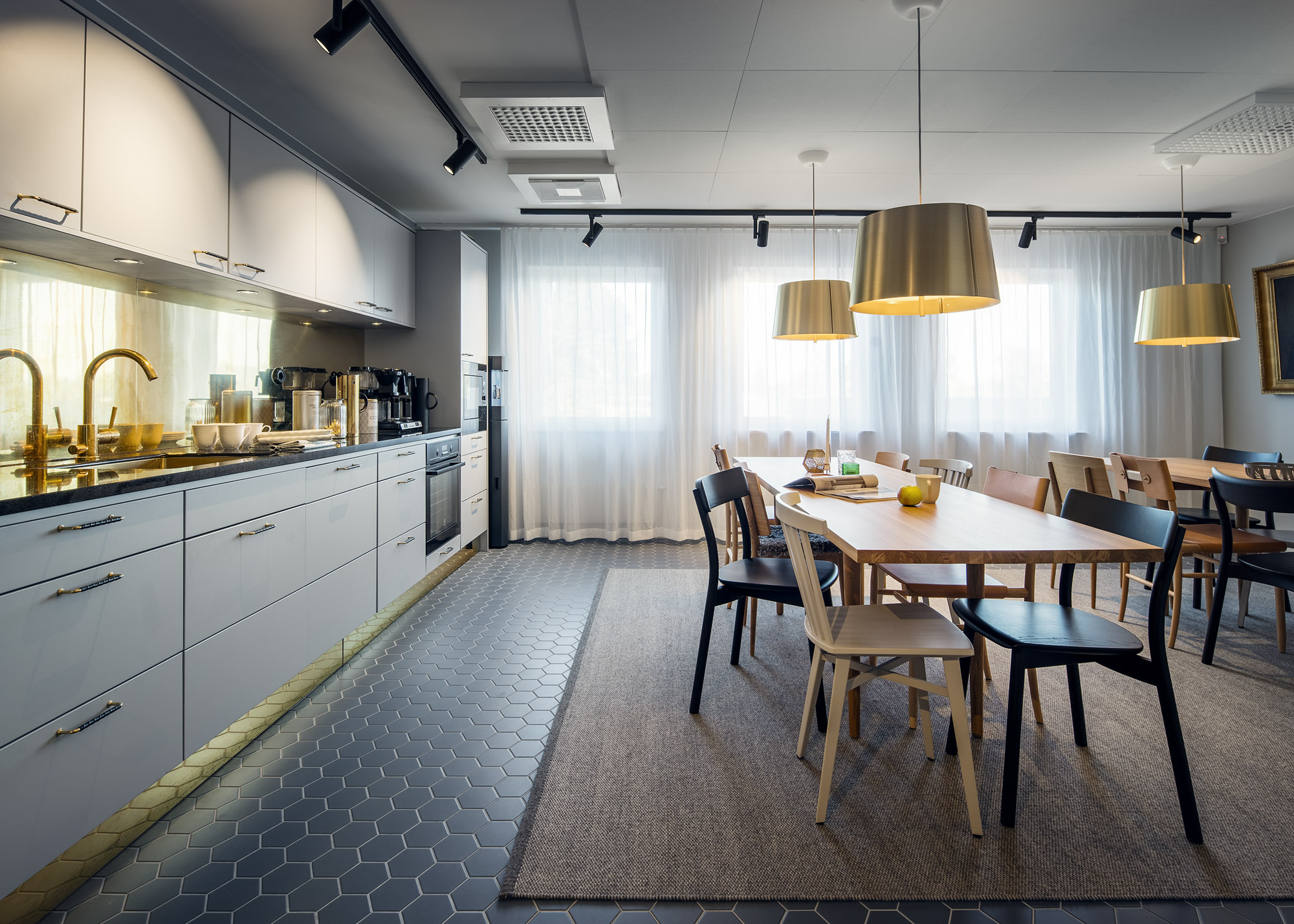
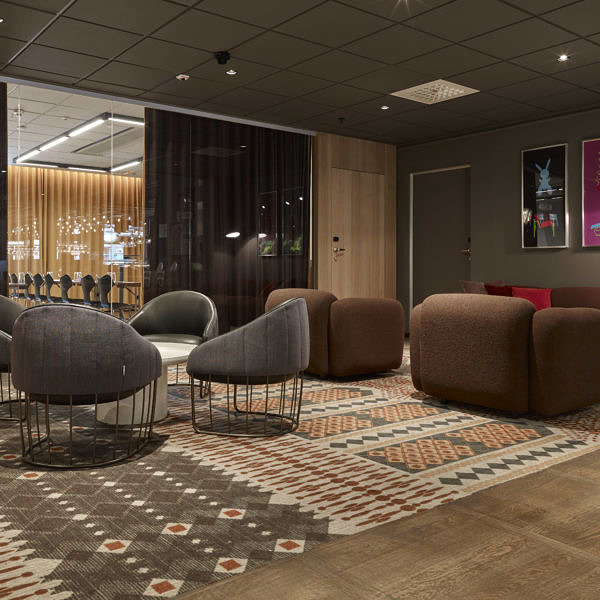
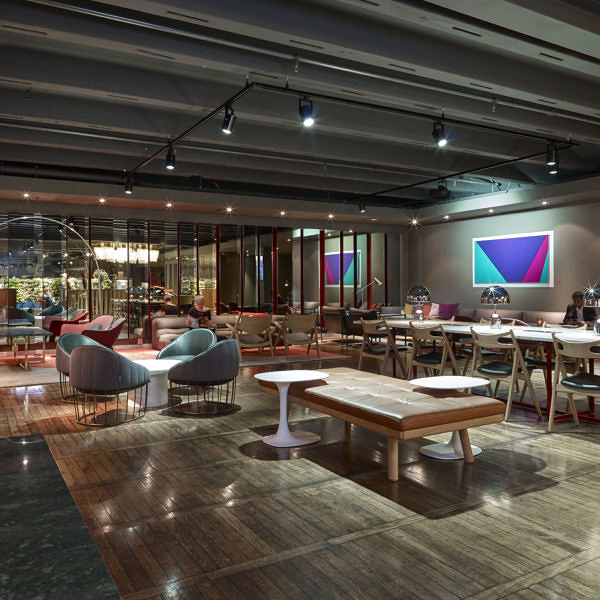
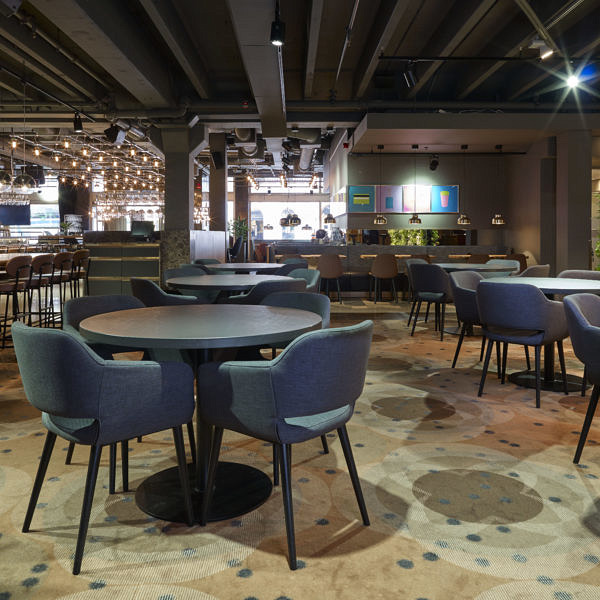
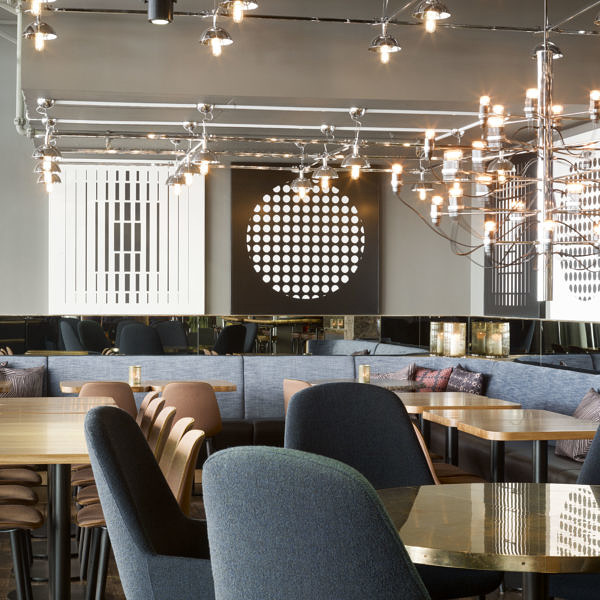
When the Banking foundation Färs & Frosta in Sjöbo were about to move into new premises with dark wood and brown carpets from the 1970s, there was an urgent need for a new start. Our interior designers created a modern interpretation of the foundation’s venerable activity in a palace environment.
The Sparbank foundation is faithful to the Sjöbo area and supports youth activities, sports and culture in the area. The foundation has its roots in the two Scania regions Färs and Frosta, with a direct connection to the castles Övedskloster in Sjöbo and Fulltofta in Hörby. A rich and varied history that has inspired our interior architects in their work on the premises of the Sparbank foundation.
Inspired by the salon of the castle
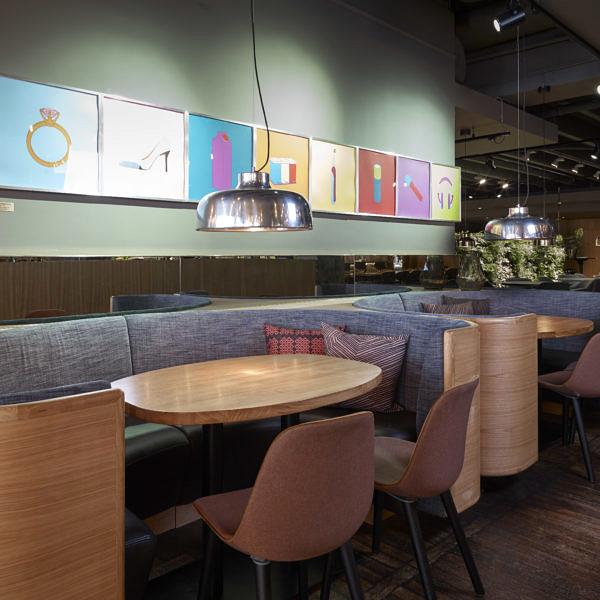
The offices have room for four employees and a board of 16 people. There is an office, a boardroom, a kitchenette and a lounge. Out went the brown fitted carpets, the dark-stained wood materials and plastic mats. Instead, we made a colour scheme of blue and grey, inspired by the Blue salon at the castle at Övedskloster, and tried and tested materials such as un-tanned leather – a nod to the rustic leather covers and horse husbandry of the old castle environment. Brass and copper details bring warmth and contrast to the rooms.
Photographer: Felix Gerlach
Photographer: Felix Gerlach
Photographer: Felix Gerlach
“We wanted to create a familiar, intimate feeling in the new space and highlight the exciting history of the foundations without turning toffice into a museum”.
Patrik Haglund, architect and former studio manager at Tengbom in Malmö
The project
Patrik has a personal connection to the area. He knows the castles and farms that shape the foundation’s history.
“We have received great trust from the Sparbank Foundation Färs & Frosta,” he says. “Our task is to preserve something historic while making it modern, representative, and functional. I am very proud of the results.”
Client:
The Swedish National Courts Administration
Type of project:
Office, Public Authority
Competences:
Interior Design, Building preservation, Product Design, 3D-illustration
Different tasks require different approaches – that much is self-evident. In a court, perpetrators and victims meet in a vulnerable situation. Thus the need of architects who know how to create functional environments with a touch of warmth.
Some buildings are particularly important for society and require a lot of us, both as citizens and as architects. The court is one such example. Here you have an interplay between a number of elements, both on a practical and a symbolic level. Hässleholm District Court is housed in a red brick building from the 1800s. The task was to transform it into a modern workplace with all that entails, with regard to technical advances and new laws and regulations.
“The big challenge was to make a high-security design with high technical functionality that still feels human and familiar without losing its seriousness. We wanted to convey a serious and caring atmosphere in a setting that is also functional,” says Patrik Haglund, project architect responsible for the interior.
From the 1800s to today
Tengbom came in early in the project and had great opportunities to build strong relationships with both the client and the house architect for the Courts Administration. A thorough renovation and expansion was on the docket, with both the public areas, offices and mediation rooms needing to be revised to fit into the 2010s. The basic task was to separate the public from those whose work for the court, something that was not as important previously as it is now. The mission has always been to create a peaceful and harmonious atmosphere, where the internal environment interacts with the overall character of the building and contributes to a pleasant experience for both visitors and employees.
“I’m always coming back to this idea of humanity. This is a technically challenging environment with microphones and monitors everywhere, but it shouldn’t feel like entering into a technological vortex – there should be some dignity in the space. In Sweden, you are innocent until you are convicted, and the building must reflect these fundamental rights,” says Patrik Haglund.
Gravity and function in Hässleholm District Court
There is the one, very public side of the court, with arbitration and judgements. But it was also important for the team to talk to those who work there and understand what their professional roles look like. Not all their time is spent in the courtroom. Much of their work consists of processing large amounts of text, video and film material for evidence. Therefore, it is of course equally important that the building function as a workplace. The work environment and office space stood very much in focus. In order to enjoy your job and perform at your best, it is important to feel that you are able to relax in daily life.
The two central roles of the building are to be functional, and to serve as a symbol. But Patrik Haglund also emphasises comfort as a third. A holistic approach in terms of colours and materials is fundamental. The team chose to work with large textile pieces. Such as drapes and curtains, as a stylistic tie-in with the old building. A very large part of the interior in the public area is custom designed to the smallest detail.
“The most successful part, I think, was the arbitration rooms. Here, we stuck with a muted, cohesive palette, we were incredibly careful with the technical solutions. We created beautiful, delicate spaces that also function in the context of modern society,” he concludes.
How do you design and communicate the soul and identity of a company –particularly when it’s a name as well known as Telia Company? With curiosity, energy, and courage – and of course, a big dose of architecture.
Photographer: Per Ranung
When the move to a new building on top of the Mall of Scandinavia in Solna was planned in 2014, Telia took the opportunity to not only acquire new facilities, but also to use the project as part of the plan to become a “new generation Telco”.
“The highest level executives were there listening and engaging. Telia was an enthusiastic client who constantly pushed us to be better. ‘We don’t want what we already know you can do. We want you to find new solutions,’ they said,” according to project architect Torbjörn Höeg.
“This is a new office for a new Telia. The main function is to be a place of cooperation and a place of inspiration and energy. Where they sit together, see each other, and are seen. They did a lot of work with branding at the same time as we worked on the interior design, and our efforts dovetailed. They tell the same story but with different “dialects”,” he continues.
Photographer: Per Ranung
Photographer: Per Ranung
Photographer: Per Ranung
Photographer: Per Ranung
Photographer: Per Ranung
Photographer: Per Ranung
A dizzying undertaking
Telia has 3,800 employees and its headquarters measure in at 47,000 square metres. What’s more, they needed to begin with the move as soon as possible. After winning the competition, the challenge began for our interior architects.
“During the first six weeks after the holidays in 2014, we did program work and planned solutions for the main part of the buildings. There were only four of us architects. That wasn’t supposed to work, but it did,” said Torbjörn Höeg.
“We had just finished working on Swedbank’s new headquarters, which was on the same scale, and we had taken away a lot of lessons from that experience. Along with the courage to dare,” says Linn Sylvan.
New office – new opportunities
The office consists of five buildings, four of which are clustered around three large atriums. The assignment was to create a well-functioning, activity-based office for a modern media company. The challenges were many. The enormous scale, of course, was one, but also the variations that were needed. Certain departments required special technical solutions while others, such as customer service, had quite different needs.
The atriums help the employees see each other and be seen in a completely different way than in the closed corridors. This building is a place for meeting and communication.
“Early on, we found a basic structure that worked. We wanted to give Telia a sense of speed, agility and energy. It was important to instil this active feeling, while making sure the office functions as a whole. Now when we pop in for a visit, we see that people have made those different spaces their own,” says Linn Sylvan.
“The atriums help the employees see each other and be seen in a completely different way than in the closed corridors. This building is a place for meeting and communication. There is conversation everywhere,” concludes Torbjörn Höeg.
The interior concept
For the interior design, we developed a concept called Spectrum/Speed of Light, which reflects the brand and the company’s digital operations. The interior breathes with a sense of speed and action, inviting activity and movement, as well as providing energy through a wide spectrum of colours with strong accents. The concept, along with Telia’s core values Dare, Care and Simplify – and a major focus on sustainability – were the leitmotifs of this project.
Tengbom by Slussen became the creative home for our Stockholm office when we moved into a newly designed space on Katarinavägen in spring 2016. Geographically, it was just a few floors up in the same building. Mentally, it sparked the beginning of a transformative journey that continues today. We remained at this address until March 2023, when we relocated to Hagastaden.
We say (perhaps a little dramatically) that the Tengbom HQ office is never going to be finished. That doesn’t mean that pipes are dangerously dangling from the ceiling and that every other corner is stacked with unpacked boxes. Rather, it’s an attitude that our offices should never look stagnant; they should be cutting-edge and evolving.
“In this project, we got to try on the role of the client, which is perhaps the hardest thing to do as an architect. But it has been a very educational process. We’ve learned a lot of lessons that will hopefully make us better architects and partners,” says Johanna Munck af Rosenschöld, previous Practice Director in Stockholm.
Many felt that it was a disaster waiting to happen.
A journey of change at Tengbom
Tengbom is expanding and developing its services at a rapid clip. This made it very clear to us one day that we had outgrown our premises and had many new needs to be addressed. This was the start of a journey of change we all were to embark on: a process of a clear direction but less-clear goals, led by change leader and Tengbom architect Torbjorn Höeg.
“Many felt that it was a disaster waiting to happen, but I never saw it that way. Rather, I see my role as being the one who helps ask the questions, rather than providing the answers,” he says.
The whole office was involved in workshops to find and identify our needs and new ways of working. A number of complex studies, including area and efficiency studies, allowed us to free up space for meetings and creativity by doing away with loads of storage.
A workshop
Regardless of our address, we see the office as a workshop—a creative hub for our core business. It’s a melting pot where ideas are born, and spontaneous encounters spark innovation.
“The goal has been a creative workshop where nothing is stopping us from working, getting materials out and making a mess. We want our colleagues to display the projects they are working on, to debate and learn from each other. We have focused a lot on making the interior facilitate this. Therefor we have had to let go of the guide rails and look at reality,” says Mark Humphreys, Practice Director.
“We don’t want it to be finished! We don’t call it activity based, but ‘innovation based’. That’s the next step,“ says Johanna Munck af Rosenschöld.
One important space for this kind of meetings and workshops is the area in the heart of the office. We call it the Arena. Here, we created a place that is equally well suited for lots of small, spontaneous meetings and large lectures and exhibitions. A place for knowledge sharing, basically.
Tengbom by Slussen – a hub for collaboration and co-creation
One of the major goals of the office is that it should promote and support collaboration across competence boundaries. Therefor we have plenty of open space and fewer dedicated areas. We think that seeing what someone is doing is a stepping-stone toward contact and engagement. We also have rooms with specific functions to facilitate co-creation with our clients and partners. And there are rooms that are especially suited for idea generation, video conferencing, and quiet, focused work.
What you see is what you get within Tengbom by Slussen
We take a transparent approach to our Tengbom HQ office. We don’t decorate or pose things just for the sake of it. And we aren’t trying to be something we are not. Our employees stand for creativity here. That’s why we like to say that the office should be like a blank canvas. It’s up to each and every one of us to fill it.
Satisfied, but never finished
Shortly after moving in to our new offices, we found that the trip went surprisingly well. The the change that followed has had positive effects. For example, we have been able to do away with even more storage to free up the teams’ energy. Having said that, we are not finished or complacent. We continue to push the boundaries of what an office can be, with ourselves in the centre as test subjects in a living lab.
“It takes courage to have fewer desks than employees, like we do. Especially in a time when the office is growing fast. All the decisions we made are backed up by the surveys we did on internal needs. And we now have a number of alternative workplaces instead. We feel confident in our decisions at the same time, as we are not afraid of new solutions or changes in the future. The most important thing is a vibrant and enthusiastic work place,” states Johanna Munck af Rosenschöld.
At the end om March 2023, we set off for new adventures as we packed up Tengbom by Slussen and moved to Hälsingegatan 49 in Hagastaden.
Partners:
Forsen Projektledning, Bengt Bodin Bygg and Pronova inredning
A sober, elegant atmosphere that invokes Madison Avenue in the ‘60s, but with a modern outlook and with a touch of both Jackie Kennedy and Mick Jagger. This is what went on in the minds of our interior designers when they created the new concept for Clarion Hotel Amaranten on Kungsholmen in Stockholm.
Maybe it was the older generation that felt most at home when the doors opened again to Clarion Hotel Amaranten in May 2016. The hotel has been given an eagerly awaited new suit, which despite its modern take embodies the same type of elegance and materiality as when it first opened in 1969 – from the ground level and all the way up to the 461 rooms on the floors above.
“One of the first things we found when we started doing research for this project was a fantastic drawing of the original lobby. Obviously, we were over the moon when we found out that the enormous crystal chandelier in the picture was still around, locked away in a storage area for many, many years”, says Josef Zetterman, the interior designer in charge of the project.
Photo: Per Ranung
Old qualities, new details
The team found and restored the chandelier, which spans approximately three meters in diameter. It has now become one of the lobby’s wow-factors. Below the chandelier, a striking reception desk in brass and oak mirrors its shape and size. Around it, a large and inviting social space unfolds. Extra attention has been given to the flow, ensuring seamless transitions between the hotel’s various activities. We have kept many of the existing qualities of the entrance floor and improved them with new solutions. The concrete roof has been uncovered and painted in a darker shade of the sober grey that we selected for the walls.
Elements of light reflecting bronze, chrome and brass contrast with the warm, dark shades of both fixed and mobile fittings. The original floors of wood and limestone contrast with a new carpet that we designed specifically for the project.
“Our colleague, Sandra Wall, is very good at creating patterns. She developed the design of the carpet inspired by a dress from Yves Saint Laurent from the same era.”
Linda Wedebrunn, Interior Designer
‘60s rock inspired the hotel rooms
Photo: Per Ranung
All of the nearly five hundred rooms at Clarion Hotel Amaranten now have a new, customized look. Inspired by icons like Mick Jagger in Performance, we have created an exclusive atmosphere with a touch of rock ’n’ roll. Every piece of furniture is specially designed. Sofas feature wooden frames with integrated desks, and wardrobes have built-in lighting in the clothes rails. The overall concept draws heavily from the materials, textures, and colors of the ’60s, but with a modern twist. Details set the tone. Every element, from furniture to lighting design, has been carefully considered to create the warm, exclusive feeling that defines the rooms.
Continental hotel bar and restaurant – with cocktails on tap
Next to the lobby is the new bar, the Tap Room, an extension of the restaurant Kitchen & Table right next door (our first project at Amaranten – and a concept that we have developed further at Clarion Hotel Malmö Live). In the Tap Room, the focus is on innovative service, clean taste experiences and the combination of food and drink. The new bar is one of the focus points of the hotel, with a lot of capacity and flexibility during the day and three full service bar stations. It is open to the public as well as the hotel guests. This is intended to be a destination for food, drinks and atmosphere.
Photo: Per Ranung
“The details have been super important both for Clarion and for us in the entire project. The common vision for the decoration in the Tap Room has been very specific which is why we have designed all the furnishings ourselves. Our product designers have for example designed a cool bar stool in consultation with Pronova Interiör which comes in two models,” says Linda Wedebrunn, interior designer at Tengbom.
We have also been able to design something that we probably would never have imagined in our wildest dreams: a cocktail tap. This is because in the Tap Room you can order Sweden’s first – and so far the only – draft Manhattan.
“Actually, the only thing that is left is the building and the facade of the hotel, which means that we have made an incredible journey to the goal of raising the hotel to a brand new level. The new bar which is unique in Sweden is the finishing touch.”
Erica Lund, hotel director at Clarion Hotel Amaranten
Conference rooms in old bank vaults
Adjacent to the lobby, the new conference facility takes shape through a close collaboration with Clarion. Together, we have created unique rooms based on the design concept. Several of the rooms face the street, offering passers-by an exciting glimpse of the new environment. Working with older buildings and drawings always brings challenges. Unexpected surprises emerge, but they also create new opportunities. The team preserves solid materials and unique details. At the same time, they introduce new elements that add fresh character. Some of the conference spaces once belonged to a bank. A large vault from that era still stands. It has now been transformed into the meeting room The Situation Room. It may not suit those who dislike enclosed spaces, but for everyone else, it offers an exciting and unique setting.
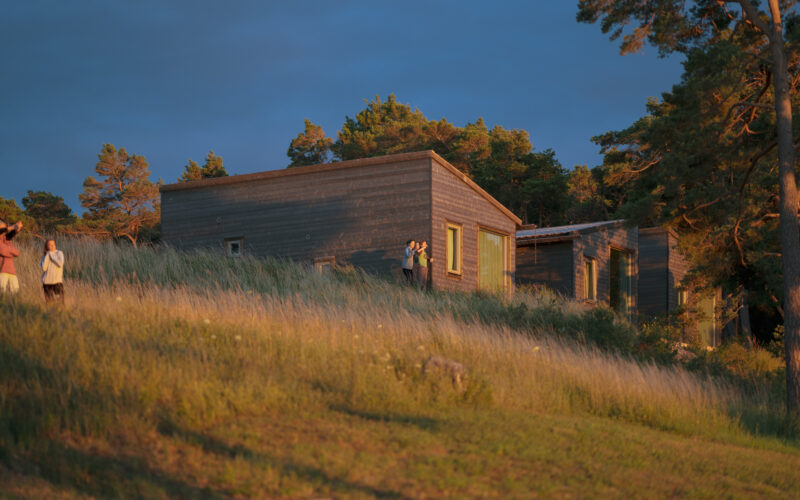
At the foot of Skuleberget’s steep cliff sides of almost three hundred meters, to the west of the Ångerman river, is Kramfors. In this town, we designed Skarpåkersskolan – a school, inspired by the dramatic landscape of the region. The local enthusiasm for the new school has turned it into a central meeting place for the area.
Forestry and modern architecture in the shadows of Skuleberget
Kramfors breathes the dramatic presence of Skuleberget. Its striking silhouette, the rich colours of the landscape, the surrounding pine forests, and the mysterious caves have inspired myths and stories for centuries. The town carries a deep connection to the sawmill industry. It takes its name from Christopher Kramm, who founded the area’s first sawmill in the 1700s. Wood craftsmanship remains a source of pride for Kramfors’ 6,000 residents. Since 2007, the town has entered a new era of construction, its first major development since the mid-20th century. Today, modern architecture stands side by side with its industrial heritage, shaping a new chapter in Kramfors’ story.
Photo: Torbjörn Bergkvist
Creative collaboration with enthusiastic Krambo
In 2011, the municipal housing company Krambo Bostads AB gave us the task of designing a new school for years K-3 in the area of Skarpåkern, with twice the capacity of the outdated primary school from 1972. The local council wanted to create an attractive school and were inspired by our vision of flexibility and design inspired by the dramatic forest all around. In September 2014, Skarpåkersskolan was completed. The school stretches over 3,240 sqm, has room for 240 students and is one of the largest construction projects in Kramfors in modern times. The most important success factor was Krambo’s enthusiasm for the architectonic vision. We have loved the creative partnership, and been impressed by their courage, desire and responsiveness.
Foto: Torbjörn Bergkvist
Skarpåker’s school – forest, mountain and magic
We chose a wooden façade for Skarpåker’s school, using local wood that reflects the changing colours of the mountain. A broken roofline creates movement in the building’s silhouette, mirroring the ups and downs of Ådalen’s mountain landscape.
The entrances take inspiration from the caves in Skuleberget. Inside, wood from Kramfors was used for both the construction and surface layers. The layout of the interior spaces follows a natural flow. Ceiling light in the heart of the school—the square—mimics the way sunlight filters through the tree canopies in the surrounding forest.
We also wanted to capture the magic of the mountain. Colours, materials, and patterns reflect this idea, especially in details such as the glass sections.
We chose to cover Skarpåker’s school in a wooden façade from local wood, with the changing colours of the mountain.
Architecture against bullying in tomorrow’s learning environments
Local builders and craftsmen stayed highly engaged throughout the project. As a result, their dedication played a key role in achieving a high-quality result. Consequently, Skarpåkersskolan has become a central meeting place and a great source of pride in the area. In addition, the rooms provide flexible solutions tailored to the needs of future learning environments. They not only support various activities for students but also serve other purposes outside school hours. This ensures that the space remains active and valuable to the community at all times.
The architecture reflects openness, playfulness, and transparency. It encourages collaboration while reducing vulnerability and bullying among students.
Welcome to one of the world’s most sustainable university hospitals and number seven in the ranking of the world’s best hospitals. Perhaps Sweden’s most extensive project of its kind, New Karolinska Solna is also a major driving force in the development of Hagastaden, a new urban district and Scandinavian centre for Life Science.
Photo: Felix GerlachPhoto: Felix Gerlach
A great investment to meet the care challenges of the future
Stockholm County is growing rapidly. Between 2010 and 2020, the population is expected to increase by 350,000 people. At the same time, the number of children and older adults is rising faster than other age groups, and our lifespan will continue to grow.
Most of today’s hospitals were planned in the 1960s and 70s. They are not designed for today’s or tomorrow’s rapid developments in, for example, medical technology, pharmaceuticals, new treatment methods, or working practices. Neither do they meet the expectations of the modern patient. As in many other sectors, healthcare increasingly depends on interdisciplinary environments, not least to enable knowledge exchange between medicine, research, and education—so-called Life Science operations.
To meet future healthcare needs, the Stockholm County Council is making one of its largest investments ever. The NKS project is a central component of this initiative. The hospital welcomed its first patients in 2016 and is now fully operational.
Photo: Fredrik Sweger
Collaboration in the White Tengbom Team
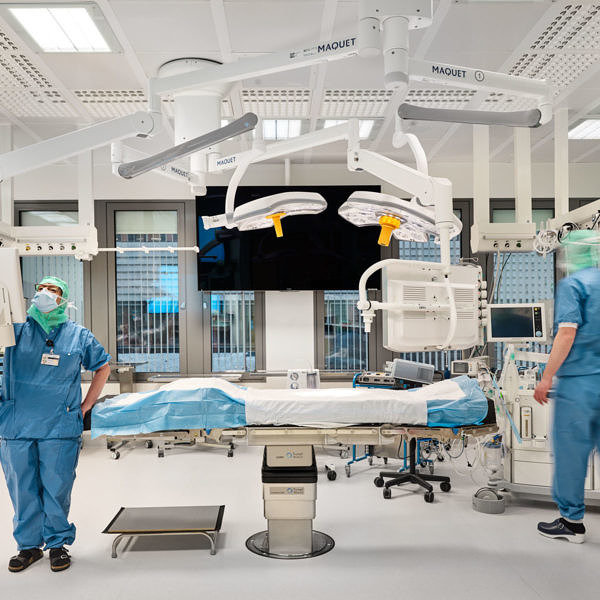
With a total area of around 330,000 m², including 630 patient rooms, 35 operating theatres, advanced technology for highly specialised care, and stringent environmental requirements, the NKS project presents immense challenges for all parties involved. It is Sweden’s largest project carried out as a Public–Private Partnership (PPP) and the country’s most advanced BIM project. The hospital is also the first to be environmentally certified according to both Swedish and international standards.
To address the architectural complexity, we formed White Tengbom Team in 2010—a project-specific company through which we collaborated with architecture firm White to jointly design the hospital. Around sixty of our architects, engineers, and project managers have worked on the assignment over the eight years the project has been ongoing. Follow-up work continues until the final phase is handed over in 2018.
Flexible environments for sustainable development
The hospital is designed to function for up to one hundred years—even though we cannot predict what healthcare will look like then. We anticipate rapid medical progress and exciting technological advances. The facility is planned with a high degree of generality and flexibility. The building can be adapted over time as research, treatment methods, working processes, or technology evolve and demand new solutions.
Generous floor-to-floor heights, robust floor structures, and substantial capacity in infrastructure and technical systems are examples of important investments. These enable the hospital operations to develop sustainably over time.
The patient in focus
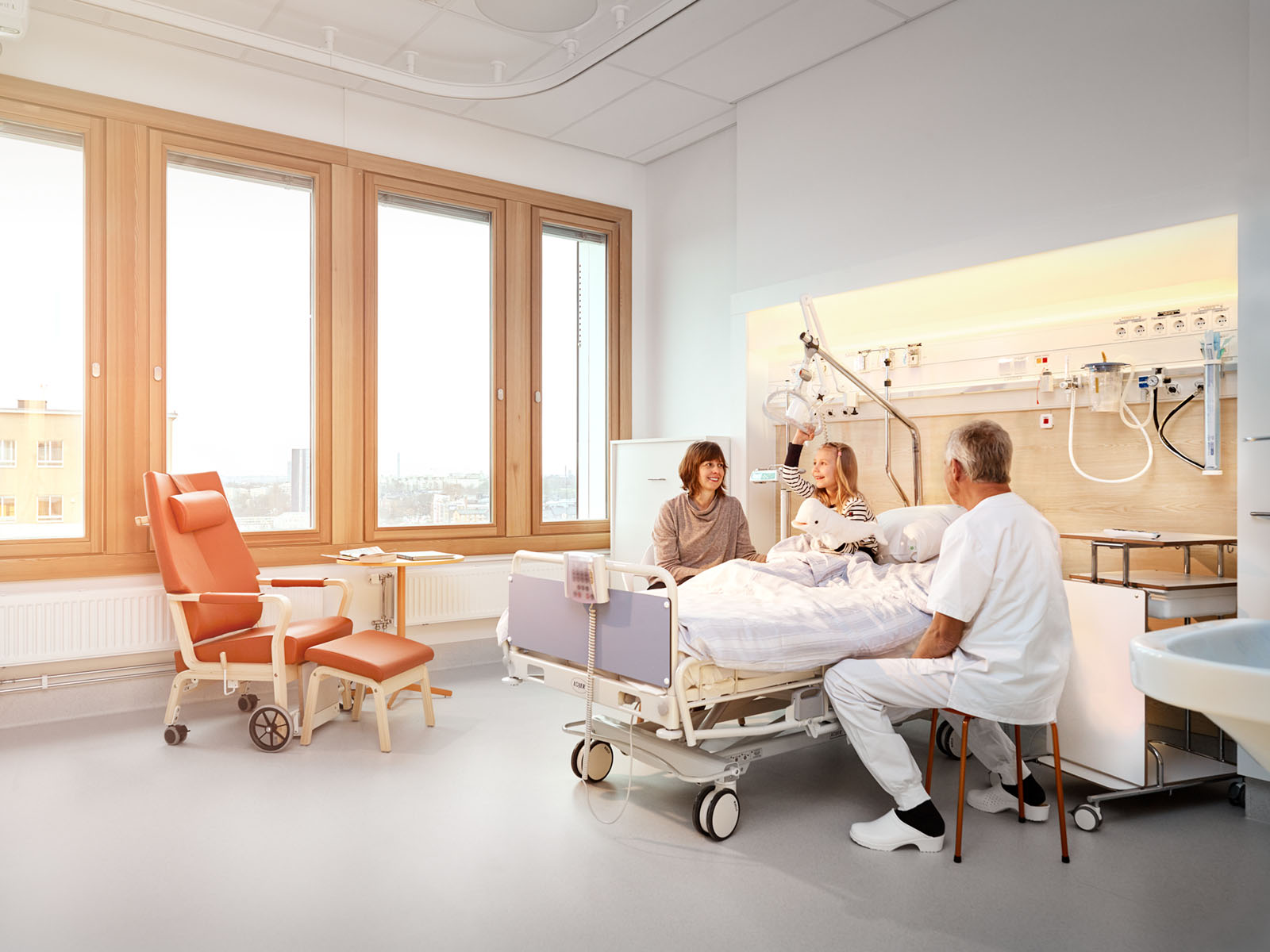
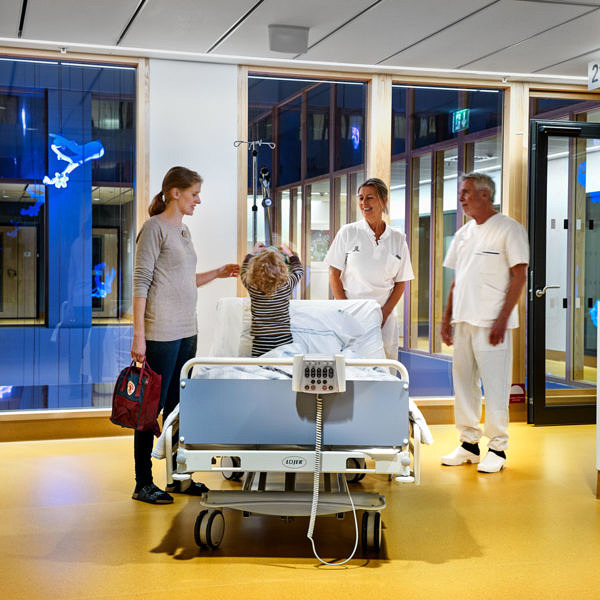
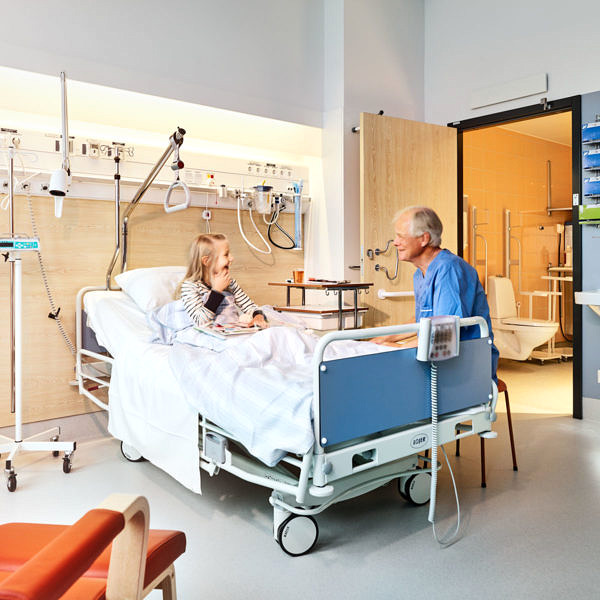
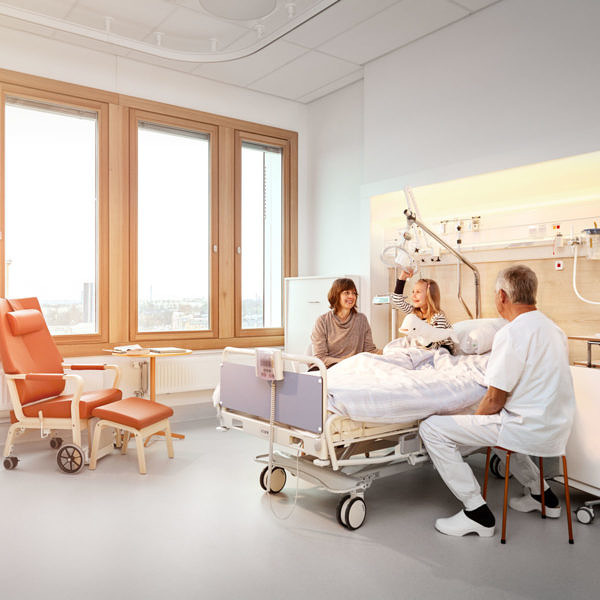
The guiding principle for the entire NKS project is “the patient always first.” All planning and design have been based on the patient’s safety, privacy, and comfort. Each patient is cared for in a private room with an associated hygiene room. Single rooms provide greater privacy and security and reduce the risk of infection and medication errors. Their design also enables care teams to work together at the patient’s bedside and facilitates close collaboration with researchers and students, who can visit in new ways. In this way, care moves closer to the patient.
A healing atmosphere within Nya Karolinska Solna
Photo: Felix Gerlach
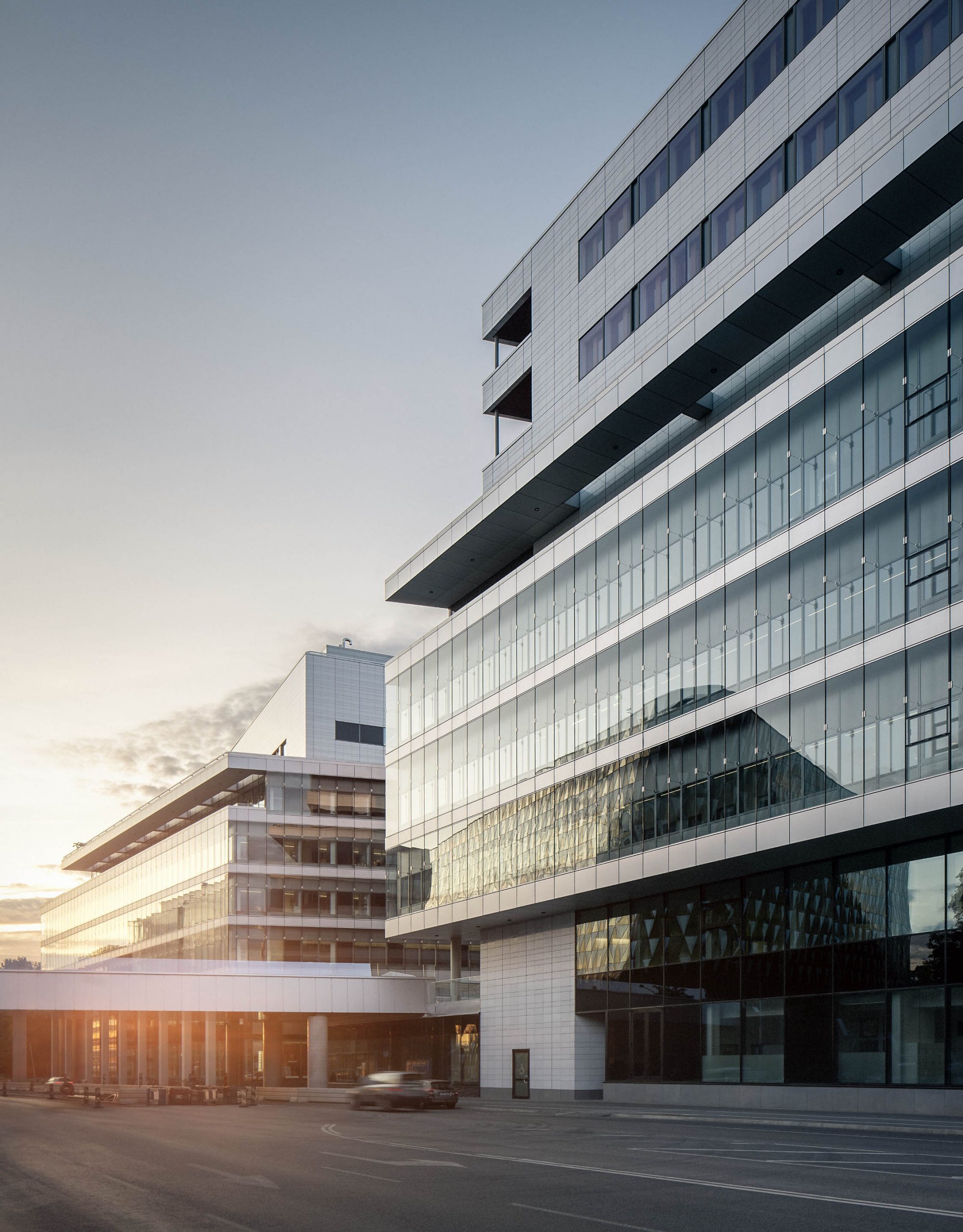
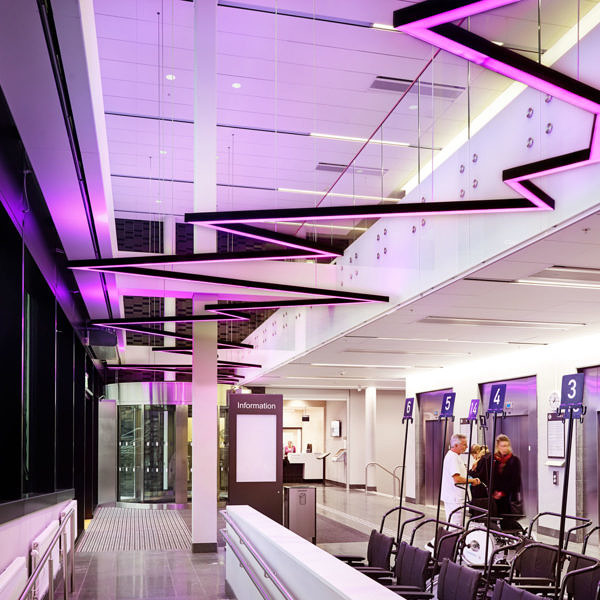
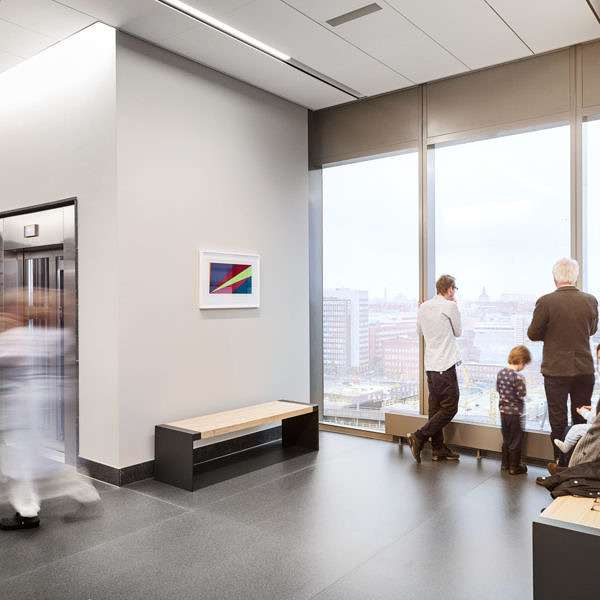
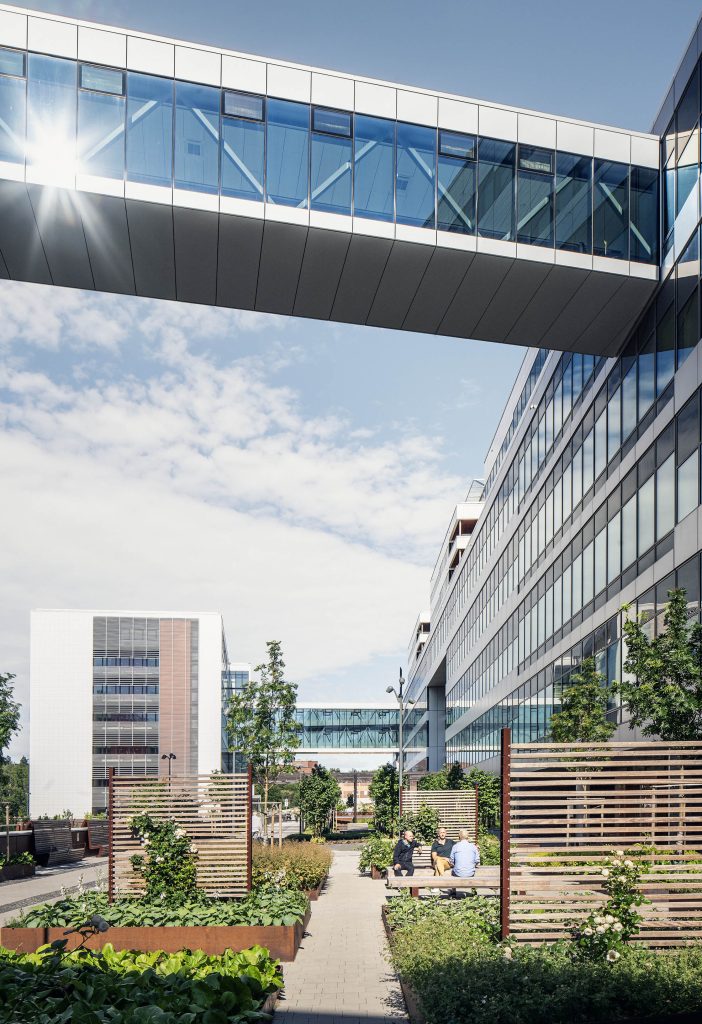
We have carefully shaped care environments that have a positive impact on patients. The interior atmosphere is characterised by generous public spaces and numerous meeting places where people can gather. Externally, New Karolinska Solna features a façade of glass, steel, and white tiles. The building follows a rectilinear block structure that continues the pattern of the traditional stone city. Five building volumes are tied together by a glass-clad mantle structure. Entrances and functions maintain the most open relationship possible to surrounding streets and squares.
The care quarters connect to the research buildings to the north and to Karolinska Institutet’s new laboratory to the west. Between the care and research functions runs the Academic Promenade, which links the hospital with Karolinska Institutet and bridges Solnavägen via a new pedestrian and cycle bridge.
World leading Life Science cluster in Hagastaden
Stockholm aims to be a Scandinavian centre and catalyst within Life Science—a place where industry, academia, and clinical care and research meet and collaborate. This is the vision expressed by Karolinska Institutet, KTH, Stockholm University, the City of Stockholm, the City of Solna, and the Stockholm County Council in the joint “Vision 2025 – Science City.” Consequently, collaboration between healthcare, research, and education has been a fundamental architectural premise in the NKS project.
The New Karolinska Solna project will ultimately be a key driver in the development of Hagastaden, where the cities of Solna and Stockholm meet. Once fully developed, the area will offer around 6,000 new homes and 50,000 workplaces. A science district for world-leading education and research is being created here under the collective name Stockholm Life. The hospital’s main building will form the backdrop at Hagaplan, the district’s new urban square.
Photo: Felix GerlachPhoto: Felix Gerlach
Nya Karolinska Solna will also be the single most important motor behind the development of Hagastaden – the new district where Solna and Stockholm meet, and which when completed will offer approximately 5,000 new homes and 50,000 jobs of which just over 6 000 at NKS. We are creating a science city for cutting edge education and research under the common name Stockholm Life. The main building of the hospital will form the focal point of Hagaplan, the new town square.
Illustration: Tengbom
Awards and Recognitions
The World Architecture Festival nominated NKS in 2019 in the Completed Buildings: Health category. In 2025, Newsweek ranked it fifth globally.
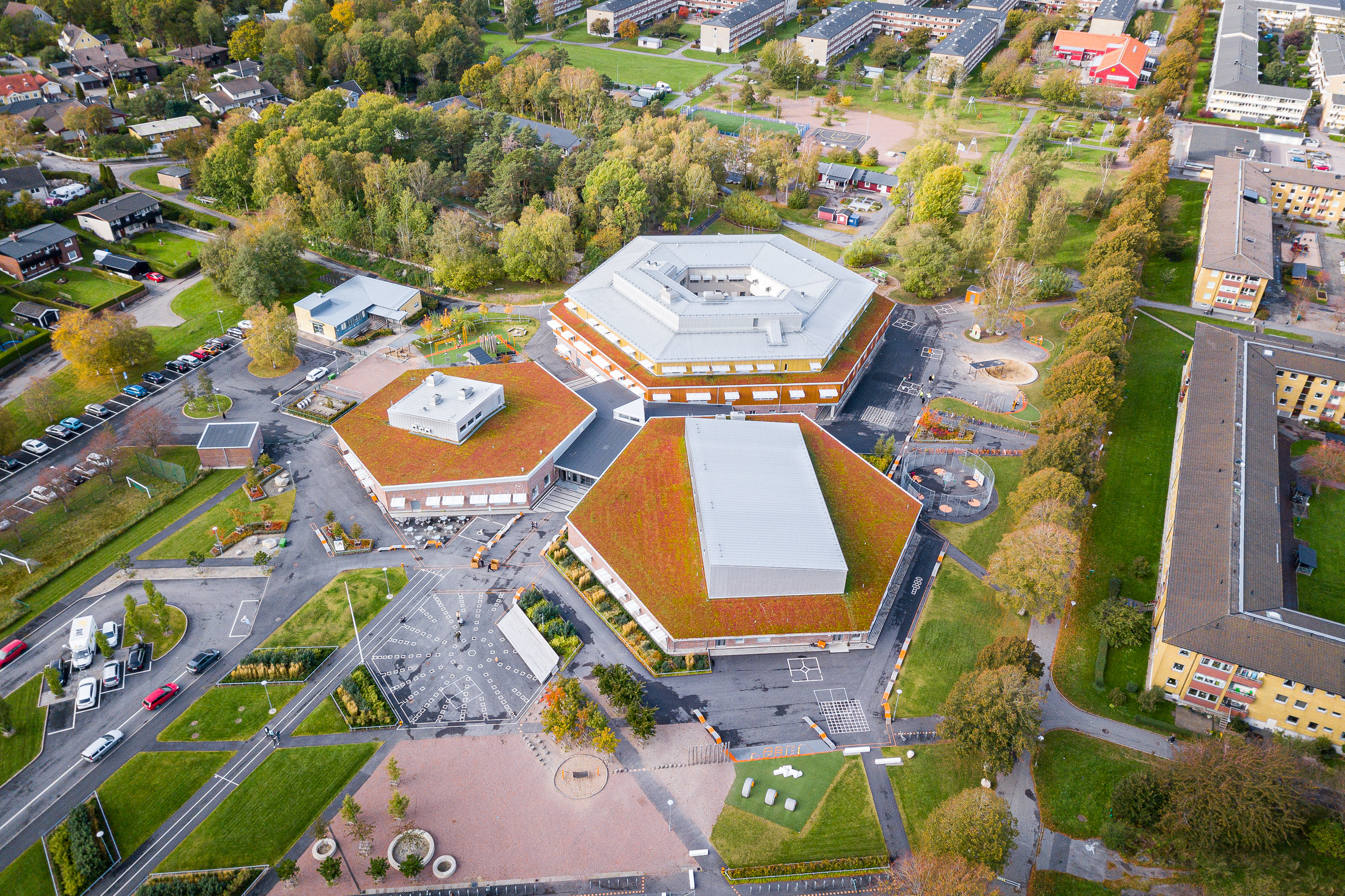
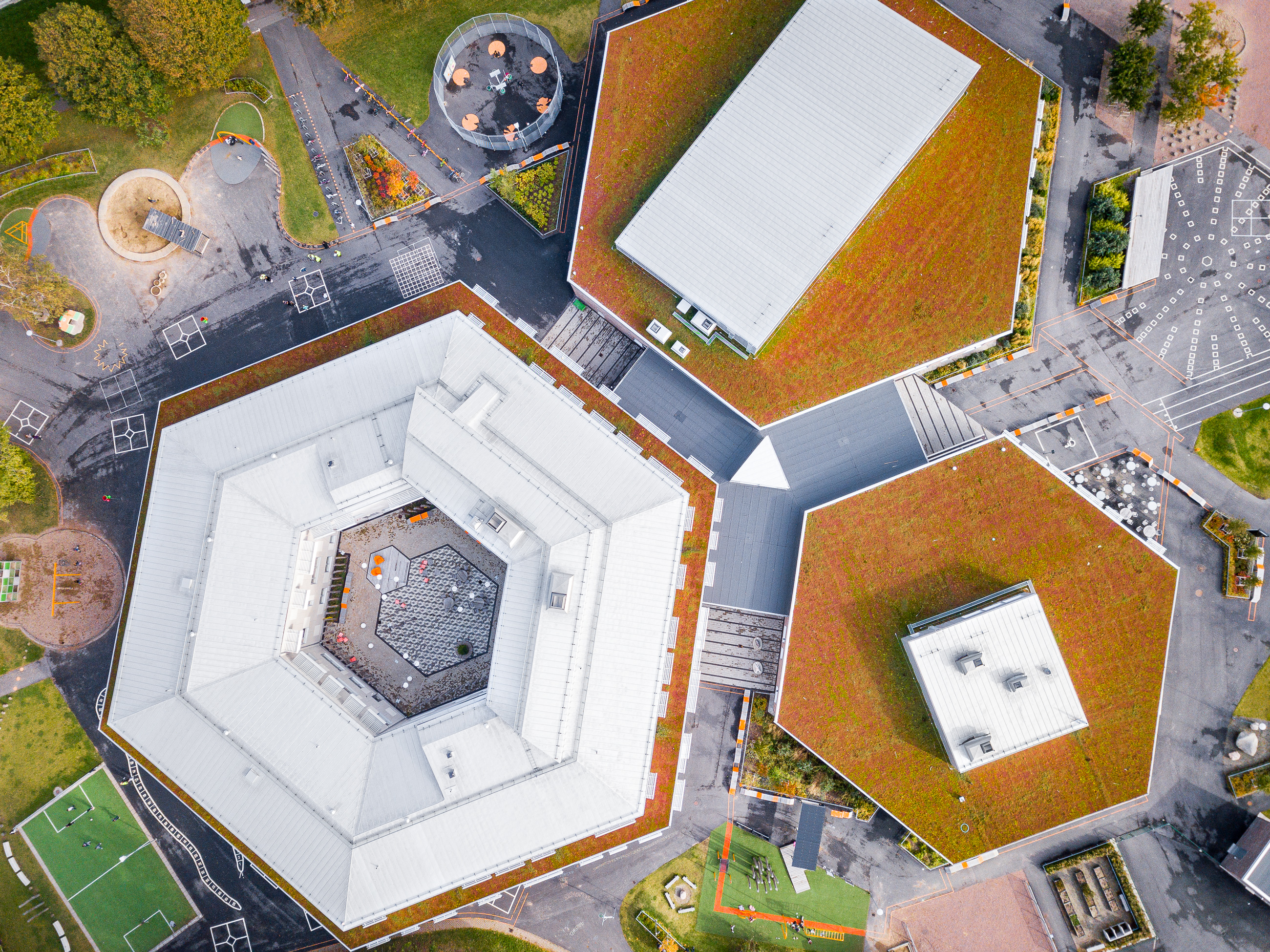
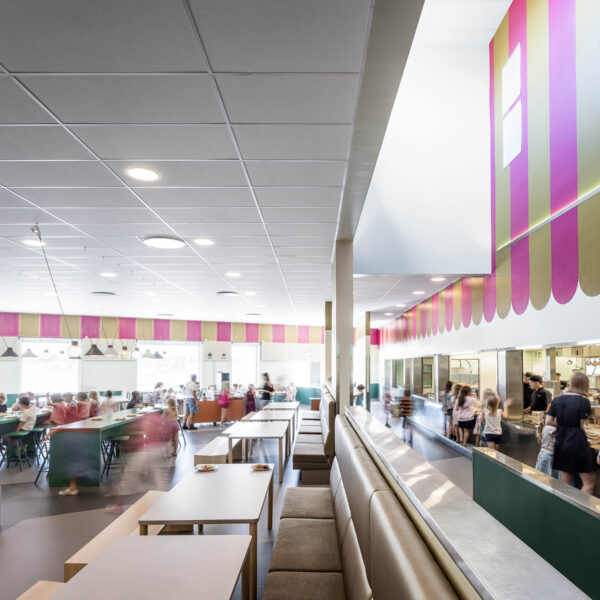
Freja school is unique in both form and function. Three hexagon-shaped buildings create a diverse outdoor environment while enriching the urban space. The school building is oriented to face all directions on the large site.
Frejaskolan – a competition win
In 2014, Tengbom won the commission to design the new Grevegårdsskolan, now called Frejaskolan, through a competition organized by Lokalförvaltningen in Gothenburg. Over two years, we worked closely with the school staff and client to create a new school for approximately 650 students and 100 educators. Freja school (Frejaskolan) is one of the largest new construction projects for our client and a long-awaited upgrade for the educators and students who had eagerly anticipated their new school.
“A strong, well-executed concept. Mångsida features a clear structure with beautiful outdoor spaces and excellent connections between indoor and outdoor environments. With its welcoming entrance, it invites the neighborhood’s residents both during and after school hours.”
— Jury statement
A school without a backside
The competition proposal, named Mångsida, addressed everything from traffic solutions and outdoor environments to logistics, phased construction, and contributing to playfulness in the surrounding urban area. The concept of three hexagon-shaped buildings connected by an entrance hub is designed to create diverse outdoor spaces for children. But as well enrich the existing urban fabric, and face all directions on the large site. Together, the buildings form a school without a backside.
We wanted to create something both enduring and adaptable, designed to withstand use
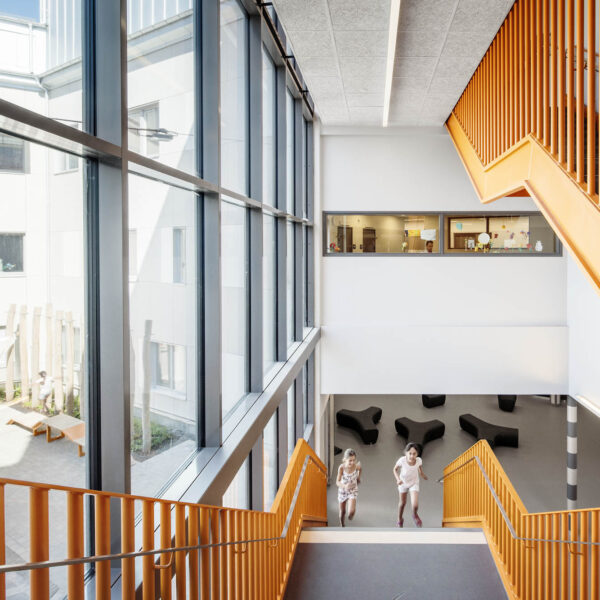
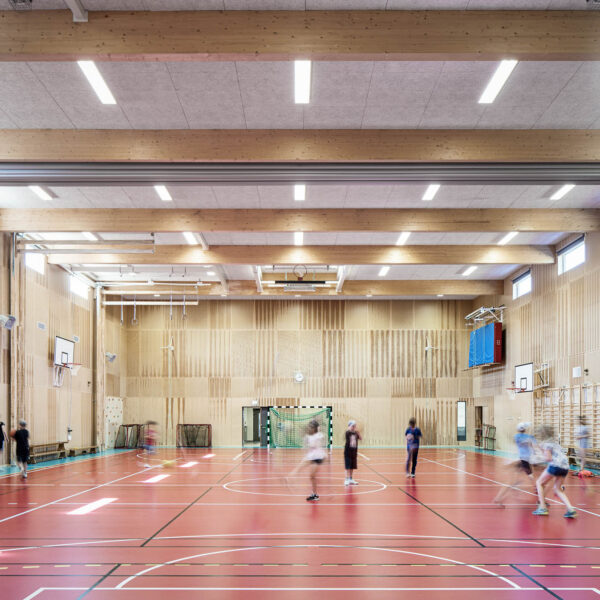
Externally, the school is both strict and playful, a design approach that also defines the interior concept. Just as the school appears different from various distances, the interior scale also shifts. A variety of room shapes create spaces that foster safety, community, playfulness, and inspiration. We carefully chose the materials, both inside and out, to ensure they endure and improve over time.
The school stands at the center of the district, serving as a hub for the area. It provides new meeting places for diverse activities and creates arenas for interaction.
The lighting series Miso was born when our interior designers developed the interior concept for Nova in Örebro. The building houses Örebro Business School, a place intended to inspire entrepreneurship and innovation. The shape of the Miso range – a distillate of a mushroom – became a metaphor for all the ideas that will emerge in the university environment.
Blond produced Miso, a series of light fixtures inspired by our designs for Örebro Business School. We aimed to merge the hard and soft elements of the environment. To achieve this, we let the form transition from square to organic. The base features molded aluminum, while the shades use pressure-lathed metal.
The aluminium provides a visual weight that fits well in the raw architecture, while the lathed shades harmonize with the decoration.
”We were already at an early stage of the project inspired by all the activities that were going to be housed in the new building, from the Business School to Drivhuset and the Entrepreneur forum. Innovative ideas will emerge throughout the building – a bit like mushrooms in a fertile environment. From here, we developed a distilled shape which we named Miso”, says Mathieu Gustafsson, product designer.
Innovative ideas will emerge throughout the building – a bit like mushrooms in a fertile environment
Photo: Barabild
Integrated technique
Blond offers an extended selection of Miso fixtures as products today. The series includes suspended, floor, and table lamps, all of which can be supplemented with electricity, network, and USB contacts. Additionally, customers can order the series through Blond , with more products planned for the future.
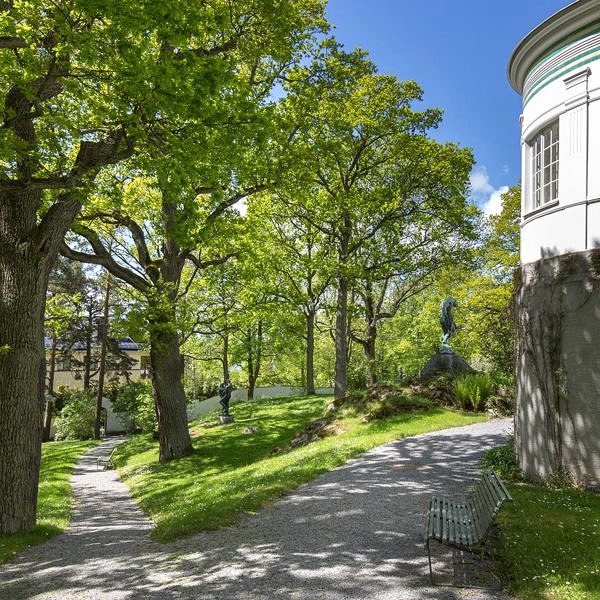
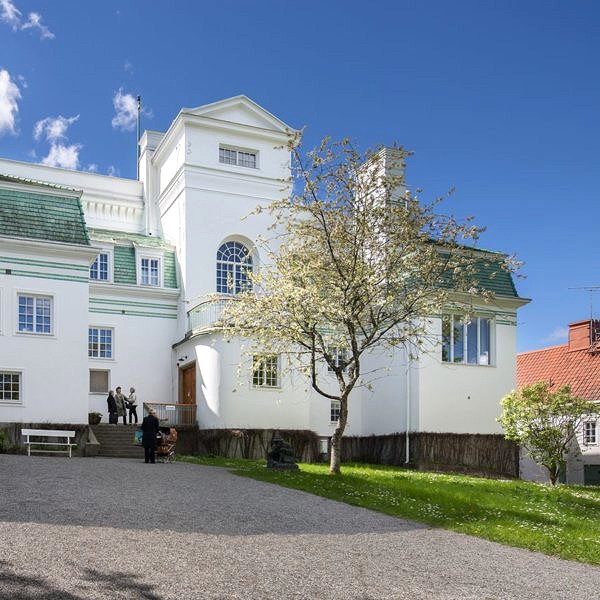
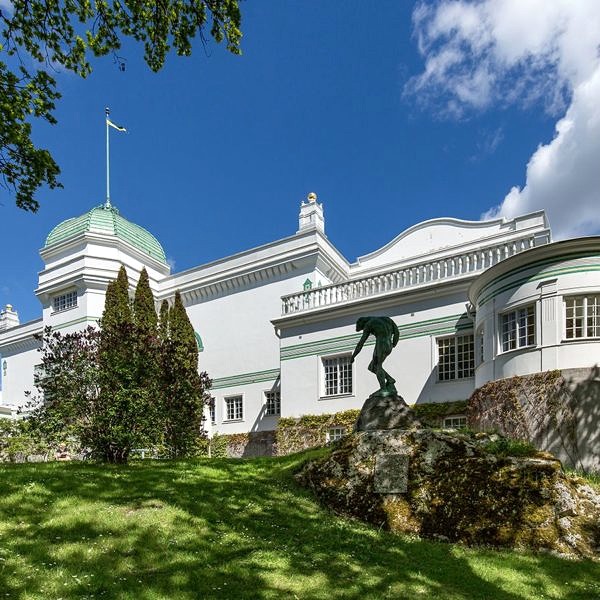
Founded in 1907 and situated in a walled park far out on Djurgården’s Blockhusudden, the Thiel Gallery is one of Sweden’s most beautiful museums. We served as building architect and general consultant for the gallery from 2013 to 2019, providing administrative support and taking responsibility for the listed building’s maintenance and development on an ongoing basis.
The architect Ferdinand Boberg designed the Thiel Gallery. He drew inspiration for the unusual building from the Orient, southern Europe and the late Art Nouveau era. Work on the venue was completed in 1907, realising the dream of financier and patron of the arts Ernest Thiel to create a home and art gallery. After being acquired by the state in 1924, Thiel was converted into a museum, before being conferred national listed building status in 1958. Our work on the museum took place in close collaboration with the National Property Board of Sweden. As well as the venue’s tenants.
Complex projects requiring a highly sensitive approach
Our projects at the Thiel Gallery were often of a complex nature, requiring knowledge and understanding of a range of factors related to climate, technology, logistics and programming within the scope of an art museum. With considerable respect for the cultural-historical values of this listed building, we carried out adjustments and highly skilled design work on a small and large scale. We also handled permit issues, long-term plans for maintenance and restoration as well as acting in an advisory capacity. Among other things, the commission required advanced knowledge of installation techniques both new and old.
Our role in the project is fundamentally underpinned by a holistic approach, awareness and flexibility.
Effective collaboration and close contact
We worked on a range of projects at the Thiel Gallery. We renovated the café kitchen and cafeteria and installed new lighting in the exhibition halls. We also prepared the Annex for the museum’s offices and conferences. To improve accessibility, we conducted a comprehensive survey of the entire venue. This led to the installation of a new lift and the creation of new public areas, including a shop, cloakrooms, and toilets.
Photo: Sten Jansin
Photo: Sten Jansin
Photo: Sten Jansin
Effective and clearly defined partnerships are fundamental to every project. To ensure this, we involve technical consultants and other specialists at an early stage. Close contact and long-term collaboration with administrators, tenants, and authorities remain essential. We also work closely with specialists, craftsmen, and contractors throughout the process. Our role in each project is built on a holistic approach, strong awareness, and flexibility.