Archives

High6

High, sustainable and innovative living
Architecture
Residential
Client: Obos Sverige AB
Location: Kalmar
Years of commission: 2016-2019
Contractor: Obos/Myresjöhus
Partner: Smart Housing Småland

High6 is the name of both the research project aimed at finding an efficient way to construct quality prefabricated apartment buildings and the actual result: a pleasant, human-scaled high-rise built in a factory. The six-story building is set to be completed in 2020.

You can summarise the research project High6 which Tengbom is a part of as a new way of building multi-family houses, High6. Modular buildings are not a novelty in of themselves, as villas have been manufactured in the factory and sold turnkey for a long time, but most higher buildings are designed and produced in other ways. Now this is changing. The project makes it both more sustainable and easier to plan housing construction.

The company Obos has been building homes since 1927, among other brands such as Myresjöhus and Smålandsvillan. But they were interested in developing their business, investing in a new market and exploring alternative ways of building, which is where the collaboration with Tengbom got its start. Next year, the six-storey building High6 will be erected in Kalmar.
“It is a positive development that architects have started to approach the industry, and vice versa. Everyone benefits from it. In the end, it gives a better result and better housing. This is an important trend and we are one of the architectural firms leading the way”, says architect Joao Pereira.

High6

The best of both worlds

The project required using Obos’ existing factory and working with module dimensions of 4 x 12 meters. This approach allows for efficient manufacturing and easy transportation of the apartments to their final location. The development includes 31 apartments, assembled from 64 units. Wood serves as the dominant material, creating a warm and inviting atmosphere. The team maximized available technology to enhance the manufacturing process. In addition to housing, the project features communal spaces, including a bicycle workshop, a greenhouse, and a shared roof terrace.

The factory as a lab

For architects, this is in part a new way of working. The modules are manufactured in their entirety in the factory, complete with a refrigerator, freezer, and a washing machine, and then driven just over 10 miles to the place where they are to be placed. To assemble the entire six-storey house then only takes one working week. The advantage of the close cooperation between the manufacturers and the architects is that the development work has been able to continue throughout the project period.
“The factory works in this case as a laboratory. Since the modules are completely built on the conveyor belt, you can enter the apartments before they are in place. We can see how things work before everything is finished and make improvements before the modules are assembled”, says Joao Pereira.

The vision was a final product of high quality, well-functioning construction, and respect for both the residents and the surrounding environment

High quality is the be-all and end-all

One challenge with the project has been to design a building that makes everyday life better for people while at the same time having to meet strictly given manufacturing templates. Design and function are the focus, rather than technical specifications. What do people want a home to offer? What is needed for a family? These needs have been analysed, and the responses and desires shown there have been adapted to the given frameworks.
“The vision was to deliver a high-quality, well-functioning building while respecting both residents and the surrounding area,” Joao Pereira said. “We have now reached that point.”

Contact person

Joao Pereira

Practice Director Kalmar and Linköping
+46 708 79 99 38

Kikås Upcycling galleria

Galleria Reuse and circular economy
Architecture
Retail
Client: City of Mölndal
Years of comission: 2017 -
Project type: recykling galleria
Location: Kikås recykling centre, City of Mölndal

Tengbom, in collaboration with the City of Mölndal, has developed a concept for a recycling gallery where circular economics is embedded in the entire operation. Here is Kikås Upcycling galleria.

The City of Mölndal aims to dramatically reduce waste in the municipality by 2022. As part of this effort, the Kikås Upcycling Galleria provides visitors with valuable insights into recycling and reusing. To support this goal, Tengbomdesigned the space to make the recycling process both visible and engaging. Through an interactive experience, visitors can better understand how their choices impact sustainability and, over time, influence purchasing behaviour . Additionally, they can see and touch raw materials as they are transformed into new products. Ultimately, this transparent presentation strengthens customers’ understanding of the entire journey from waste to new products and encourages more conscious purchasing behavior.

Kikås Upcycling
Illustration: Tengbom

We took a holistic approach to create an attractive location that challenges the perception of a recycling center. The building’s placement acts as a screen, shielding the recycling area while maintaining visibility. With its own entrance to the upcycling mall, the design optimizes conditions for attracting visitors. The building itself embodies reusability and durability, using as many recycled building materials as possible.

Kikås Upcycling
Illustration: Tengbom

The upcycling mall in Kikås stands out for its workshops, where entrepreneurs both produce and sell their products on site. The entire core of the business operates within a 75-meter radius. It hardly gets more circular than that.

Contact person

Kajsa Crona

Practice Director Gothenburg
+46 727 07 79 73

Bryggudden Residencials

Where history meets the present
Architecture, Landscape, Urban Development
Idea & Vision, Parks, Play & Public Spaces, Residential, Residential environments
Client: Löfbergs fastigheter, Prepart projektutveckling, Byggbolaget
Place: Karlstad
Years of commission: 2011 - ongoing
Awards and Recognitions: Winner of the Architecture Award, Karlstad Municipality 2017 & 2018
Contractor: Löfbergs fastigheter/SPG Bostad

Bryggudden, Karlstad’s newest district, sits right on the water, just a stone’s throw from the city center. The gentle sounds of boats in the Inner Harbour fill the air. The rich aroma of Löfberg’s Coffee Roasters drifts through the streets. Historic harbor warehouses stand beside modern housing, creating a vibrant and timeless waterfront atmosphere.

Bryggudden is growing! The number of homes is increasing at a steady pace and is filled with people who want to live here, where classic landmarks and old buildings meet new. Bryggudden is surrounded by water on two sides. All the apartments in the new buildings have balconies and if you look east, there is a view of Pråmkanalen. When Löfbergs moved their warehouse, the ambition of Löfberg Fastigheter AB was to fill the area with more apartments, a large food store, a preschool and a multi storey car park. Today, Bryggudden is an area full of life.

New residential area surrounded by water

On the south-west side of Bryggudden there is a quay area where you can walk along the jetties, cafes, and outdoor restaurants. If you turn east, there is a canal area where the sides of the buildings are facing the street. These two areas meet at the Redaretorget at the southernmost tip of the area. This is where the city’s newest landmark can be found, in the shape of Karlstad’s tallest building: a 20-storey high apartment complex housing 62 flats with a view of Karlstad and Vänern.

600 high quality homes

Tengbom  has been involved in Bryggudden since the project began. The team has developed seven phases. Four completed, two underway, and one still on the drawing board.

In recent years, several large construction projects have finished, with more on the way. These include both rental and privately owned apartments. So far, Tengbom has designed over 600 modern, high-quality homes in Bryggudden.

Our vision for Bryggudden has been to create exclusive residences inspired by the character of the old harbor warehouses in the area.

A touch of the old warehouse

The classic 1950s buildings with light brick across Pråmkanalen inspired the latest phases of Bryggudden. The upcoming phases maintain the same volume and scale but take on colors from surrounding buildings. Dark red brick and black detailing create a strong connection to the harbor warehouses.

“We use a lot of bricks and solid materials,” says Anki Haasma, architect and office manager. “The client, Löfberg Fastigheter, wants to preserve the marina feel.”

Well-known landmarks in Karlstad frame the new area, and many residents enjoy views of Karlstad’s water tower.

Contact person

Elin Larsson

Practice Director Karlstad
+46 702 75 67 66

NEO auditoriums

Butong meets parametric design

When Tengbom designed NEO and Technology and Health, they featured two spherical lecture halls, but there was no technical solution as to how the shape would actually be realised. By means of parametric design and the material Butong, a complex design proposal became a reality.

The requirement was to design an exterior that reflects the high-tech, digital “state of the art” interior. It also needed to have the ability to both reflect light and absorb sound. The result became the almost futuristic elements of the world-leading Life Science cluster at Karolinska in Huddinge.  

From charcoal sketch to complex formability

With the help of Computational Design, the vision for the auditoriums was realised. Through a close collaboration with Lars Höglund, founder of Butong, and our digital expert in ArchTech & Future, the complex shapes were developed based on a parametric model – with only a series of charcoal sketches as the foundation.

NEO
By working with 3D we could alter the shape how many times we wanted until the day of production.

The shape was created from a variety of mathematical parameters that can be rendered in 3D, which creates flexibility in the shape that continues until the final pressing of the production button. The finished solution required approximately 3,500 unique parts for the frame and mould, with minimal tolerance over the double curved surfaces of the mould.

When Butong met parametric design, the positive effects were numerous. In addition to being able to design complex environments, zero intermediates and minimal material consumption were required, which was good from both a sustainability and cost saving perspective.

“We adjusted every part of the casting together with the customer,” says Shahrokh Kamyab. “This made the project more time-efficient and allowed us to generate finished production files directly for manufacturing.”

“We regularly work with plant walls, especially green façades. But Tengbom took our material in a completely new direction,” says Lars Höglund, founder of Butong. “They focused on formability and the permeability of light and sound. This solution could only have been created through digital fabrication and parametric design.”

NEO
Photo: Felix Gerlach

Contact person

Mark Humphreys

Practice Director Stockholm
+46 8 412 53 43

SciLifeLab

An extented biomedical hub
Architecture
Health, Life Science
Client: Akademiska Hus
Completed: 2014
Structure: extension, reconstruction
BTA: 10.000 m2
Classification: Environmental Building Silver

The extension to BMC in Uppsala has become something of a local landmark. SciLifeLab has been given a lively green colour that daringly takes its place on campus, and contributes to a new feel.

SciLifeLab SciLifeLab

The Biomedical Centre (BMC) stands as a well-executed example of late functionalism. Its carefully planned system for lab spaces remains effective even today. When Tengbom took on the task of designing an extension, the goal was clear—to break the rigid structure and create a natural, inviting gathering place. The original building’s size and systematic repetition made navigation monotonous and difficult. Tengbom set out to change that.

SciLifeLab

The exterior was also intended to create a contrast with the existing building. The extension has its back firmly anchored to the original austere structure, while the new façade flows freely towards the courtyard. The façade’s shifting green steel grid contributes to a soft feel. Indoors, the environment offers fresh air, greenery, and views. The meeting square in The Hub serves a function that is otherwise missing from BMC. By connecting the floor plan as mezzanines, open or with glass, to the entrance hall, the whole extension has an airy and open feeling. The added part, The Hub, is classified as Environmental Building (miljöbyggnad in Swedish) Silver.

SciLifeLab on our Swedish website.

Photo: Tim Meier

Contact person

Mark Humphreys

Practice Director Stockholm
+46 8 412 53 43

Housing project for Ikano Bostad

The home that works for everyone
Architecture
Residential
Client: IKANO bostad
Photographer: Felix Gerlach

Flexible, urban, and sustainable accommodation for the modern family with small children? “No problem!”, we sunk our teeth into the problem right away. With Ikano Bostad we designed town houses in partnership, after winning a competition.

Ikano Bostad

The target audience is the modern family, which can take a number of different forms. Some parents live as couples, while others are single parents, have a baby on the way or look after their child every other week. This can obviously place high demands on the house. We think that it is important to focus on everyday needs, designing houses to suit people – not the other way round.

Our vision was to create smart, flexible, personal housing, and our aim was to make it adaptable, enabling smart choices, as well as sustainable. We feel we’ve succeeded.

Ears to the ground

So what do families demand nowadays? That is where we started. How do we make life easier for the people who live in the house, so that they have time left for things other than cleaning, doing the dishes, the washing, stressing – the big question, right?

Of course, the home should be cosy and inviting. That’s why we used high-quality materials, both inside and outside, offer a pleasant fireplace, the opportunity to include a greenhouse, and have designed a well-thought-out floor plan where the lower floor is more open and social, while the upper floors give the feeling of separation.

Another more basic, but well-functioning, solution to at least some of these problems lay in storage. A tidy everyday life requires proper wardrobes, this much is clear. We therefore designed extra opportunities for tucking things away. And as the cherry on the cake, we have customised them to Ikea’s popular wardrobe series.

Flexibility a matter of honour

This type of reality anchoring and flexibility has been a golden thread throughout the project, both from us and Ikano Bostad.

These are combined to create different types of houses, providing a system that can be altered and developed over time for different locations. Urban characteristics such as varying heights, displacements, open ground floors, private upper floors and renewable materials create a diverse environment, reinforcing the city feel.


A better world for everyone with Ikano Bostad

But if you want to make the world better, you have to think even bigger — and that’s exactly what we did. It’s not just families’ everyday lives that should be versatile and sustainable, but the entire neighbourhood. By building small, flexible houses, we can use sites that are otherwise hard to develop. At the same time, we unlock attractive locations near the city that have long stood unused.

Creating housing that works on several levels is essential.

Many young families want to live climate-smart but are unwilling to compromise on the emotions and aesthetics tied to their home. We have listened to these needs. Homeowners can customize many aspects of their house while the buildings maintain a shared design language. This balance creates a strong visual relationship and a popular urban look. Smart solutions also make sustainable living easier. Zero-maintenance façades, solar panels, garbage sorting, and car pools help parents meet their environmental ambitions with less effort.

First to be completed are the town houses in Vikhem in Staffanstorp and Elinegård in Malmö. But the point is that the houses can be adapted to numerous locations. For example, Ikano Bostad has now bought land in Nacka to build 100 homes.

Contact person

Mark Humphreys

Practice Director Stockholm
+46 8 412 53 43

Gasometer

Industrial heritage repurposed for the arts
Architecture, Cultural Heritage
Accessibility, Building Preservation & Restoration, Culture, Heritage Expertise, Renovation & Transformation
Client: Stockholms Stad
Assignment year: 2017-
Where: Hjorthagen, Norra Djurgårdstaden
Project type: For musicals, concerts, events, conferences, televised galas, and more
Awards and recognitions: Nominated for the World in Property Award 2024

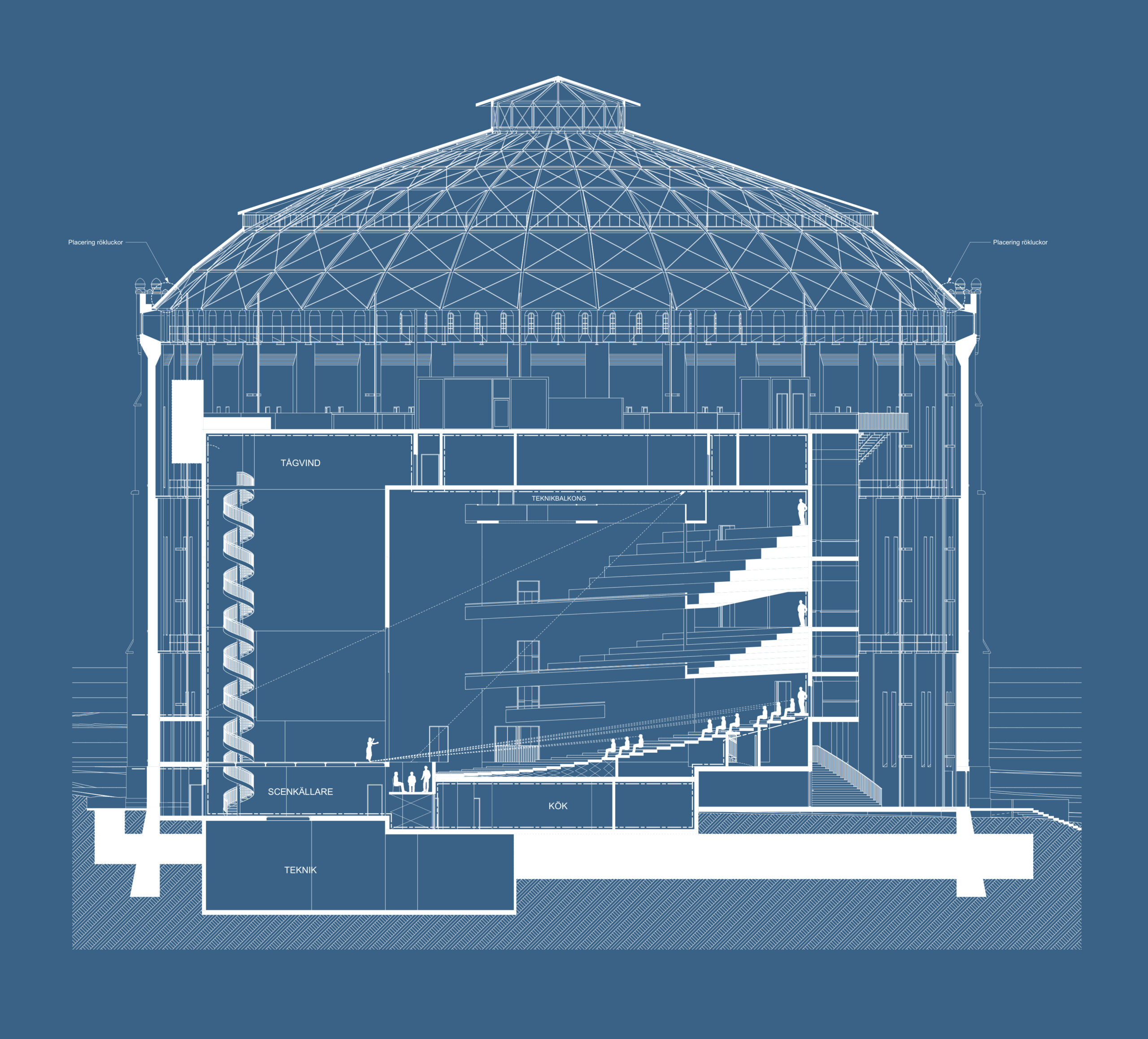
Commissioned by the City of Stockholm’s Development Office, Tengbom has proposed transforming Gas Holder 2 in Hjorthagen into a state-of-the-art cultural venue with a banquet hall. The concept for the Gasometer – a “box within a box” – offers future visitors a spatial experience like no other.

Hjorthagen undergoing major development

Located just outside Stockholm, Hjorthagen is an area undergoing large-scale transformation. Once an inaccessible industrial zone, it will soon become home to around 15,000 new residents. The broader development includes approximately 6,000 apartments and 100,000 square meters of commercial space.

From gas holder to Gasometer

Gas holder no. 2

In 2017, Tengbom won a tender and we were entrusted with designing an international performance venue within Gas Holder 2. Now known as the Gasometer, the venue will host up to 2,300 guests, offering world-class concerts, musicals, and theater productions. At the top of the inner “box,” there will also be a banquet hall accommodating 1,000 seated guests.

Ferdinand Boberg designed the unique and historically listed gas holder in 1899. The exterior will remain in its original state, while the interior will transform into a space with spectacular spatial experiences. The performance hall will float within the larger structure, encapsulated by an outer shell.

Gas holder no. 2

Optimized for audience and acoustics

By stacking the audience over three levels, the design maximizes capacity while ensuring the best possible acoustics. Visitors will undoubtedly experience something extraordinary. The project is led by Tengbom architect Jan Izikowitz, whose previous work includes the Gothenburg Opera House.

Gasometer in the larger context of Gasverket Västra

Gas Holder 2 is part of the Gasverket Västra development plan, which also includes a museum, school, preschool, sports hall, and office spaces.

Royal Swedish Opera moves in

In October 2024, it was announced that the Royal Swedish Opera would temporarily relocate to the Gasometer while the Opera House undergoes renovation.

Contact person

Elin Larsson

Project Lead
+46 702 75 67 66

Malmö Service Building

Seamless logistics at a high level
Architecture, Landscape
Health, Life Science, Parks, Play & Public Spaces
Client: Region Skåne
Location: Malmö Hospital Area
Years of commission: 2016-2021
Contractor: Regionfastigheter
Project type: Service building
Awards and Recognitions: Nominated for Steel Building Prize

The new service building at Malmö Hospital Campus blends efficiency with architectural integrity and aesthetic clarity. A pivotal facility for both patients and staff—framed by generous green spaces.

Photo: Mads Frederik

A logistical powerhouse behind the scenes

At a modern hospital, operations must run smoothly—if not seamlessly. An efficient service infrastructure is essential. Inside the new service building in Malmö, four hundred staff members ensure that goods and services reach every corner of the hospital. According to lead architect Magnus Nilsson, it’s something of a “logistical marvel”, supplying hospital departments with everything from medications and lab results to freshly prepared meals. The building also manages laundry, waste, and returns, all flowing through an extended underground culvert system.

“This building is here to support healthcare,” explains Helena Beckman, healthcare specialist at Tengbom. “It’s designed to make staff’s work easier—so they can focus on delivering safer, more efficient and more sustainable care. Our hope is that this building contributes to better care for patients and that staff feel proud of their working environment.”

Deliveries are handled by compact autonomous robots pulling single trolleys or even small trains to and from the hospital units.

Photo: Mads Frederik

A glass house powered by robots

Dark corridors and hidden back-of-house zones? Not here. Deliveries are instead transported via small robots that travel by lift directly to the wards.

“The region’s ambition is clear,” says Helena. “Doctors and nurses should be able to devote as much time as possible to their patients.”

Photo: Mads Frederik

Here, the service process doesn’t hide behind closed doors. Quite the opposite. Instead, through stacked glass volumes, the building proudly allows a degree of visibility into its inner workings. According to architect Patrik Ekenhill, that might come as a surprise.

“When you hear the term ‘service building’, glass isn’t the first thing that comes to mind. But we see it as a sustainable material—and one that lets us put the operations on display.”

Photo: Mads Frederik

“You’ll see the trolleys gliding to and from the culvert system,” adds Magnus. “Even the art installations reinforce the experience from the outside.”

A great deal of work has gone into making the building and its surroundings inviting—not only for staff and patients but also for the public.

A new civic landmark

One of the project’s key challenges was integrating the service building with the city. Located at the edge of the hospital campus, the site faces residential buildings just across the street. Socially, it’s vital that the hospital feels open and accessible to the public. Together with an older building and the new mortuary, a public square has been created in front of the building.

“I can picture it becoming a kind of attraction—where people pause to watch the little robots on the move,” says Helena.

Paths from the surrounding city lead towards the square and further into the hospital campus. This area has been designed as a calm, semi-wild environment, where visitors walk on boardwalk-style paths between rain gardens and planted zones. The square forms part of a wider area once home to the early 20th-century epidemic hospital. Here, old and new architecture come together. The existing parkland is interwoven with newly designed outdoor spaces, which offer hospital staff moments of rest and relaxation.

A complete approach to a complex system

Designing outdoor environments in a hospital context is no small feat. The site is governed by a detailed programme and a network of systems, logistics and technologies. As landscape architects, our task was to make the whole system work. At the same time, we needed to ensure that the space remains welcoming and safe for visitors and passers-by.

The service building itself is a large and complex undertaking—one that demanded close collaboration between architects from multiple disciplines: building, landscape, interior and urban planning. Both Magnus and Helena agree: this kind of teamwork just feels right.

Photo: Mads Frederik

Awards and recognition

In 2023, the Malmö Hospital Service Building was nominated for the Swedish Steel Construction Prize (Stålbyggnadspriset).

Contact person

Josefin Klein

Practice Director Skåne
+46 40 641 31 18

Buzzard Point

Scandinavian Way of Living
Architecture, Interior Design
Residential
Client: Akridge, Western Development, Orr Partners
Location: Washington DC
Type of project: Housing, Interior Design
Partners: Antunovich Associates, West 8, BCT Architects
Year of Commission: 2016-2020

500 apartments and amenity spaces were on the wish list when Tengbom was flown to Washington DC to create exclusive Scandi interiors that will attract design-savvy Americans to the new residential area on 1st Street at Buzzard Point.

– I love it!
– We love you!
– Bring forth the lobster!
– And the cappuccino!

That’s the sound of excitement when Scandinavian architecture makes an entrance in the United States. Tengbom has been commissioned to design 500 apartments with adjacent amenity spaces, which include a spa area, gym and a rooftop terrace with a pool in a property in the Buzzard Point area of Washington DC.

The project, which covers a total of 100,000 square meters, is scheduled to start in January 2018 and will be completed in 2020. There is a lot going on in the area – the entire district is being raised from the ground under the skilled eyes of renowned architect firms, including West 8 – whom we collaborate with in this project.

The whole story begins in Stockholm, where one of the American clients was staying briefly. One day, as he was walking in the city, he stumbled upon The Temporary Market Hall at Östermalmstorg, one of Tengbom’s most praised projects in recent years. It was love at first sight, and on the spot, he decided that he wanted to hire the company behind it for his new residential project at Buzzard Point.

Straight into the heart

The US Coast Guard previously occupied the building, but it will now transform into housing inspired by Nordic design. On-site in Washington, Johanna Munck of Rosenschöld and Stefan Rydin detailed their approach to the project. They presented the theoretical foundation and explained their material choices. The theme, The Scandinavian Way of Living, received standing ovations.

The love of light and nature

The idea is to create something completely new in Washington DC’s dense residential flora. Going the other direction than the trending “industrial chic”, we proposed light wood, natural materials such as leather, terrazzo and stone – all with great attention to high-quality material compositions. Top quality and meticulous finishes are be-all and end-all when it comes to environments based on clean lines.

“Industrial chic wasn’t even an option for us. Instead, we’ve tried to grasp the essence of Scandinavian design with its simplicity and clarity. In order to create an appealing and functional environment, the performance needs to be top-notch. We make very high demands on materials and the meeting points between them. The floor we choose is a wooden floor, but only the best quality will do, and this has been our approach to every detail, “says Stefan Rydin.

The new residential building’s design focuses on access to natural light and provides a lot of space for social gatherings.Buzzard PointWinning expertise

Our housing and interior architects won the commission in tough competition with three New York offices. For this project, Tengbom collaborates with local architects on-site, Antunovich Associates, but will have the main responsibility for the design. The team has already launched the project and expects to complete it in 2020.

Contact person

Mark Humphreys

Practice Director Stockholm
+46 8 412 53 43

The Solliden Stage

Modern expansion in historic environment
Architecture, Cultural Heritage
Accessibility, Building Preservation & Restoration, Culture, Heritage Expertise, Renovation & Transformation
Client: The Skansen Foundation
Location: Stockholm
Competences: Building preservation, Interior Design
Years of commission: 2002–

Our specialists in building preservation have assisted in the restoration and construction of the The Solliden Stage, on the basis of Skansen’s ambition to create Northern Europe’s most modern outdoor stage. The fairground was also improved through renovations and additions. We weighed various qualities in the project, such as the location’s view of the entrance to Stockholm and the historic building value of the original stage, against expectations of modern stagecraft and acoustics.

The Solliden Stage
The Solliden Stage. Photographer: Tove Falk Olsson
The Solliden Stage
Photographer: Tove Falk Olsson

Perhaps you yourself have sat at this classic location and gazed out over one of Stockholm’s most beautiful views. Or at least heard of the popular outdoor TV show Allsång på Skansen?

The Solliden stage (Sollidenscenen) was designed by Nils Einar Eriksson in 1938. It was at that time technically and acoustically of a very high quality. The audience sat facing the view and listened to acoustic music that was amplified through the spiral form of the stage.

But today’s concert situations and stagecraft, especially for TV broadcasts, place new demands on the stage environment. To meet these needs, we designed a completely new stage. We also developed related ancillary buildings in cooperation with the Stockholm Beauty Council and Skansen’s own curators.

Solliden stage side sketch_TengbomThe team carefully restored the original stage, Snäckan (“The Shell”), preserving its cultural value and keeping it at the centre. They designed the new stage around it, raising and deepening the stage floor while extending the roof to cover the entire stage. Built with thin ship-building plate on a steel structure, the roof enhances both function and form. The new annexes feature façades of untreated oak, which will naturally age over time to match the adjacent Öland Windmill.

New and better audience space

We redesigned the fairground to offer more and better space for the audience. Seats now stand centrally in front of the stage, framed by wooden benches made from Skansen’s own oaks. To improve accessibility, dedicated spaces for wheelchair users were added at an elevated spot near the mills. More spaces are also available beside selected rows at Sollidenplan. Removing the front row at the stage opened up the view towards Stockholm’s entrance, creating a more inviting experience.

The Solliden StageThe Solliden Stage and its new stage and fairground debuted in 2013 during Skansen’s National Day of Sweden celebration on June 6th. The following weekend, a dedication concert featured Radio Sweden’s Symphony Orchestra, Tommy Körberg, and Amanda Sedgwick.

The Solliden Stage
Photographer: Tove Falk Olsson

Several Skansen projects by Tengbom

  • Ironmonger’s building: The ironmonger’s building in the town quarter was completed in keeping with Skansen’s ambitions as a copy of an existing building from the 1880s in Hudiksvall.
  • The Skansen Shop: In 2010-2011, we renovated The Skansen Shop, previously the Alhambra restaurant, in order to create more appropriate premises for office, storage and accommodation rooms.
  • Lill-Skansen: We participated in a parallel engagement for a new Lill-Skansen children’s zoo.
  • New buildings for wild boar and European bison: We designed a new building in 2007 for two wild boar families and a building for European bison.
  • Dressing-room building: Design of a new dressing-room building at the Galejan dance pavilion is under way in 2016.
Contact person

Josefin Larsson

Business Developer
+46 72 183 02 34