Environmental certifications:
LEED Gold, Passivhus SE
Awards and Recognitions:
Winner of Meeting Place of the Year, Kalmar 2023
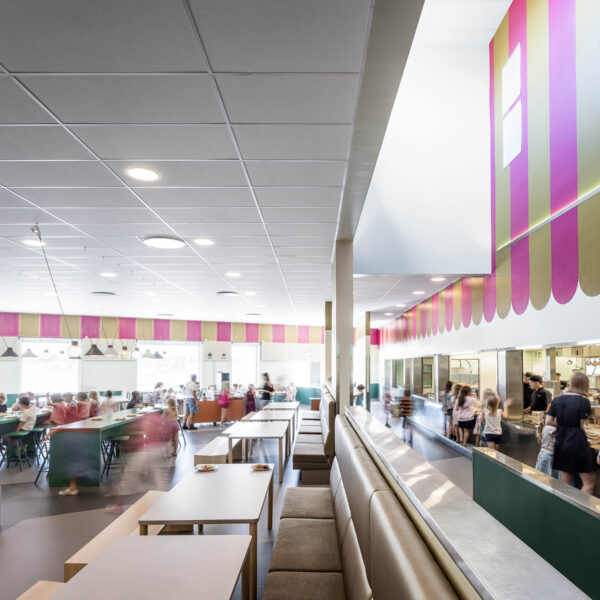
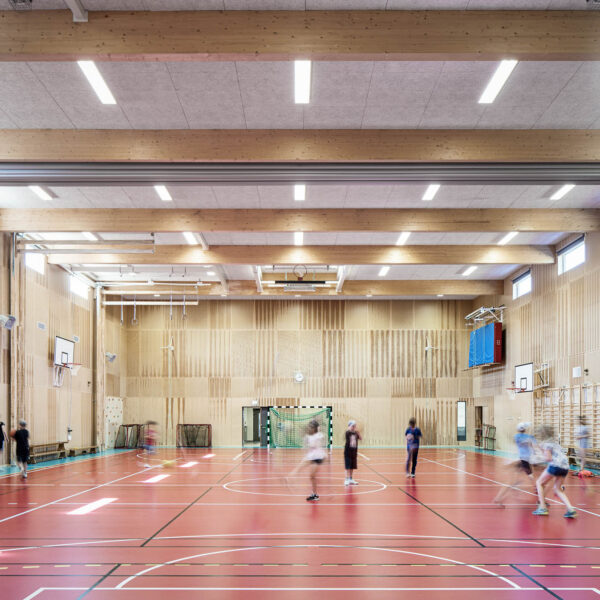
The Ölandsbron bridge has long defined Kalmar as a city, but now it has some competition. Linnaeus University is located proudly in the heart of the city as Kalmar’s most comprehensive construction. Encounters are the focus here – between the city, academia, students, teachers, the business community, and Kalmar’s residents and visitors. Boundaries between indoor and outdoor settings have been erased in an architectural style infused with daylight, spaciousness and sustainable materials.
Linnaeus University is located in the southern cities of Växjö and Kalmar. The university’s facilities in Kalmar were fragmented, spread throughout the town. However, with the unveiling of the new buildings, all the faculties have been gathered in one harmonized spot – Universitetskajen. Tengbom designed the eastern portion of the new university, which contains labs, classrooms, offices, a library, café, restaurant, student union premises and information desks. The western portion was designed by CCO Arkitekter.
The location in the heart of the city encourages interactions between the university and the city’s residents and businesses. Proximity to the marina keeps the area lively year-round, linked together by the new Universitetsplatsen. Photo: Felix Gerlach
A multi-functional meeting place
One of the university’s primary goals was to encourage spontaneous encounters among students, researchers, the city and the business community. The architecture meets this goal with a transparent, open environment that welcomes students and city residents alike. The indoor spaces are intentionally infused with an outdoor sensibility achieved with high ceilings, plenty of daylight through skylights, and airy entrances that erase the transition between indoors and out. Rustic and sustainable materials like wood, brick and concrete can be found both inside and on the exterior, and tie the settings together.
Linneaus university
“It’s a great honor for us to get to be part of building our future city.”
Linda Camara, Lead Architect
Openness and transparency encourage encounters and facilitate wayfinding. Photo: Felix Gerlach
Linnaeus University connects seamlessly with the city. People meet here—students and teachers, businesses and academia, residents and visitors. The welcoming entrances remove the boundary between outdoors and indoors. Wood, brick, and concrete shape both the interior and exterior. Photo: Felix Gerlach
Natural materials meet bold colours
The brick facades are treated, thus lending character to the block both indoors and out. On the courtyard side of the building, the stones, ribbon windows and brick pattern are all horizontal, while the pattern is vertical on the street side. The windows reinforce the height, while the window frames highlight the colours of the interior. The pairing of sturdy materials and bold colours is a consistent theme throughout. The shade of yellow, taken from Linnaeus University’s visual identity, is abundantly present both indoors and out.
The treated brick facades lend character to the block, both indoors and out. On the courtyard side, the stones, ribbon windows and brick pattern are all horizontal. The pattern is vertical on the street side, and the windows reinforce the height, while the window frames highlight the colours of the interior. Photo: Linnaeus University
Intuitive wayfinding
The large main staircase culminates in a magnificent roof light. The stairs and atrium facilitate communication and offer an overview of the entire floor. Photo: Felix Gerlach
The colours provide a beautiful contrast to the natural materials, while helping people orient themselves within the buildings. Simple wayfinding within the university is essential, and openness and transparency between the stories and the indoor and outdoor spaces are central contributing factors. The architectural structure incorporates interior avenues and atria, which create effective wayfinding and encourage encounters among people.
Sustainability is never sacrificed
The interior avenue features the courtyard building’s acoustic slats as an indoor wooden facade. Sheer balustrades, a false ceiling, rustic brick walls, and a shiny concrete floor enhance the space. These functional materials age beautifully and withstand the demands of a university setting. Photo: Felix Gerlach
Ambitious goals for sustainability and the promotion of biodiversity have characterized the project through everything from double environmental certifications to landscape planning. The university has many complex classroom and research settings. For one thing, marine biology is big in Kalmar. The university is home to everything from saltwater pools and greenhouses to algae collections.
A university that is part of the city
Linnaeus University stands out by integrating with the city, unlike many other higher education institutions built outside urban centers. In Kalmar, bringing the university and the community together is a priority. The waterside location fosters interaction with Kalmar’s residents and businesses. Its proximity to the marina keeps the area lively year-round, connected by the new Universitetsplatsen. The square serves multiple purposes, from start-of-term gatherings and thesis defenses to public events and celebrations.
Photo: Felix Gerlach
Catta Torhell, Head Librarian at Linnaeus University, says: “It’s been wonderful to help plan Universitetskajen. This university integrates with the city and serves as a meeting place for students and employees. At the same time, it welcomes residents and visitors. Here, we can showcase what’s happening at the university while actively participating in the city’s activities and cultural life. The students have already embraced the library building. We often hear spontaneous comments like, ‘What an awesome building – it’s grand and cozy all at once!’”
The main staircase is central within the library. Getting from one place to another, a place to meet and study – it all happens around the staircase! Photo: Felix Gerlach
Together with Ersta Diakoni, Tengbom is developing Ersta Hospital on Södermalm in central Stockholm. With an evidence-based approach and in close partnership with healthcare providers, the organization, patients and family members, we are creating an industry-leading healthcare environment where people will feel (almost) completely at home.
Ersta Hospital opened on the heights of Södermalm in 1864. In 1907, Axel Kumlien designed a new building for the hospital, which relocated nearby. Fifty years later, Tengbom designed major additions and extensions to the block. In 2014, an architectural design competition launched for Ersta Nya Sjukhus—the new Ersta hospital. The goal was to create a design that honored the historic identity of both the surroundings and the hospital’s key areas of expertise. Nyréns Arkitektkontorwon the competition and, together with RATIO, developed a concept that elegantly followed the topography and reflected the area’s scale and classical aesthetic. They led the project until the building permit application phase.
Winner of Best Healthcare category in Monocle Design Awards 2024
In 2017, Tengbom was tasked with managing and carrying out the project – and developing the function and design of the new hospital. Work was conducted in close partnership with the Ersta Diakoni Program Office, and in light of the modified and granted building permit, with the City of Stockholm and its architecture office.
Connection to the city
The new hospital rises some six stories up the hill from one of the island’s busiest streets, Folkungagatan. At eight stories, the building’s highest section runs from east to west along the crest of the hill, in harmony with the characteristic buildings nearby. Two projecting buildings – one facing south toward Folkungagatan and one facing the old hospital building to the north – form two lush courtyards.
Even inside the new hospital, the connection to the city is the primary theme. From the wards and rooms to the hallways and large rooftop terraces, the surrounding city and vegetation have a constant presence. The city landscape is part of the healing environment. The glassed-in hospital lobby is a large, bright and welcoming room rising up three stories, with views of the surroundings.
Architecture, exterior character and facades of the hospital
The interior and exterior of the new Ersta hospital create a sense of cohesion. Patients and visitors should feel welcome, safe and well cared for. In a classic interplay of large windows and horizontal and vertical features, the facades are made of metal and ocher brown anodized aluminum in a carefully chosen hue.
The materials change in character and reflect light, while the colours complement the yellow and brown plaster facades of the surroundings. Windows match the facade colour, creating a sturdy and uniform expression that enhances the urban quality. A grayish-red flamed granite foundation reinforces the building’s cohesive design.
Tengbom’s starting point is to create healthcare environments in which patients are the focus, and where the architecture supports medical development and new working methods.
Somewhere between a hospital and a home
If you imagine a scale ranging from the public, often impersonal spaces of large hospitals, to a private, home-like setting, the aim is for the new Ersta hospital to be a balance between both worlds. It should be infused with personality and a sense of care-giving, paired with professionalism and trust.
Interior
The new Ersta hospital is characterized by calm, quality, and genuine natural materials like wood and stone. The details are thoughtful and the colours are classic, light and earthy. The colour and material concept was developed with inspiration from Ersta’s visual legacy in an exciting collaboration with Emma Olbers Design.
The bright, glassed-in lobby runs through the building like an axis. A spacious open staircase defines the backdrop, creating a welcoming focal point with a sense of space and clarity. Patients, visitors, and staff share the hospital lobby and the adjacent elevator hall, reinforcing an open and inclusive atmosphere.
Outdoor environments
Designing the hospice ward required extra care. Patients and their families should feel at ease and spend quality time together. A private, green rooftop terrace offers a peaceful retreat. A swing by the elevators and a playroom for children add warmth and comfort to the environment.
In front of the main entrance at Folkungagatan, the courtyards and rooftop terraces are significant in terms of design. A fundamental part of our task is to make it possible to see nature from multiple stories in the building.
Unique operational development with long-term solutions
The new Ersta Hospital delivers resource efficiency, flexibility, a good working environment, and a strong focus on patient safety. The floorplan improves efficiency by using just one elevator hall with short corridors. Stacking hospital units keeps related functions close. The busiest departments, with the shortest visitation times, sit nearest to the entrance. In-ward recovery plays a central role in the hospital’s care concept. Patient rooms prioritise proximity to windows. The layout places the patient and family area by the window and the care provider area by the corridor. Staff conceal medical equipment and materials or integrate them into the surroundings. This creates a calmer and more patient-friendly atmosphere.
With Ersta Nya Sjukhus, the new Ersta hospital, the team at Tengbom aims to contribute to world-class medical care. The building extends the hospital’s long history and strengthens its presence in the city. It will play a key role in Stockholm’s continued growth.
Awards and nominations for Ersta Hospital
Stockholm Building of the Year 2024. Monocle Design Awards 2024, winner in the Best Healthcare category. Vårdbyggnadspriset 2025, awarded in the category “Spaces for Care”.
Kitchens, Offices, Parks, Play & Public Spaces, Residential environments
Client:Wihlborgs Fastigheter
Contractor:
Peab Sverige AB
Location:
Lund
Years of commission:
2011–2014 (detailed plan) 2014–2017 (projection) 2016–2018 (tenant adaptions)
BTA:
16 500 sqm
A rolling concrete façade nowadays cradles train travellers to Lund Central Station. Here Tengbom has created a sought-after office space which varies both in architectural expression and relation to the site. Meet Posthornet office building.
On behalf of Wihlborgs Properties, Tengbom has confronted the challenge of building on a narrow plot of land close to Lund’s central station. The result is modern office space, which is very sensitively coordinated with housing in the neighbourhood. The office building, called the Posthorn, is what you might call a dream project. Here Tengbom, along with the architect responsible, Charlotte von Brömssen, has been the driving force from detailed plan to tenant adaptation.
We have decided for ourselves in this project what is the possibility and breadth of the architect’s role.
“We have decided for ourselves in this project what is the possibility and breadth of the architect’s role. Through timing and pedagogy, we have paved the way for the quality of the built project in a variety of ways. Here, a clear design manual has been an important success factor to focus on,” says Charlotte.
In addition to architecture and strategic advice, Tengbom has provided services in landscape architecture, interior architecture, visualisation and catering.
Head entrance facing the square.
Character and materiality
The neighborhood is designed to interact with adjacent urban spaces. It rises and falls in dialogue with surrounding buildings. The main façade faces Lund’s town hall and rail bridge, gradually sloping down toward the main entrance on the southeast corner. Inside the block, a narrow and semi-public space features a rounded design where various practical functions come together.
To generate interest in the site, the design team crafted a story for the property owner. They chose the postal horn and stamp as symbols, inspiring the façade’s design language. Brass became a recurring material, while the yellow brick connects to the surrounding 1940s architectural style.
Well-arranged for tenants
The extent of Tengbom’s assignments has ranged from following up on the building on site to coordinating the work of tenants. We drafted contract and building documents for all tenants, and coordinated interior design projects. Tengbom also made the décor for three of the tenants: Folktandvården, Trivector and the law firm Trägårdh.
Awards and Recognitions:
Winner of the Architecture Award, Karlstad Municipality 2017 & 2018
Contractor:
Löfbergs fastigheter/SPG Bostad
Bryggudden, Karlstad’s newest district, sits right on the water, just a stone’s throw from the city center. The gentle sounds of boats in the Inner Harbour fill the air. The rich aroma of Löfberg’s Coffee Roasters drifts through the streets. Historic harbor warehouses stand beside modern housing, creating a vibrant and timeless waterfront atmosphere.
Bryggudden is growing! The number of homes is increasing at a steady pace and is filled with people who want to live here, where classic landmarks and old buildings meet new. Bryggudden is surrounded by water on two sides. All the apartments in the new buildings have balconies and if you look east, there is a view of Pråmkanalen. When Löfbergs moved their warehouse, the ambition of Löfberg Fastigheter AB was to fill the area with more apartments, a large food store, a preschool and a multi storey car park. Today, Bryggudden is an area full of life.
New residential area surrounded by water
On the south-west side of Bryggudden there is a quay area where you can walk along the jetties, cafes, and outdoor restaurants. If you turn east, there is a canal area where the sides of the buildings are facing the street. These two areas meet at the Redaretorget at the southernmost tip of the area. This is where the city’s newest landmark can be found, in the shape of Karlstad’s tallest building: a 20-storey high apartment complex housing 62 flats with a view of Karlstad and Vänern.
600 high quality homes
Tengbom has been involved in Bryggudden since the project began. The team has developed seven phases. Four completed, two underway, and one still on the drawing board.
In recent years, several large construction projects have finished, with more on the way. These include both rental and privately owned apartments. So far, Tengbom has designed over 600 modern, high-quality homes in Bryggudden.
Our vision for Bryggudden has been to create exclusive residences inspired by the character of the old harbor warehouses in the area.
A touch of the old warehouse
The classic 1950s buildings with light brick across Pråmkanalen inspired the latest phases of Bryggudden. The upcoming phases maintain the same volume and scale but take on colors from surrounding buildings. Dark red brick and black detailing create a strong connection to the harbor warehouses.
“We use a lot of bricks and solid materials,” says Anki Haasma, architect and office manager. “The client, Löfberg Fastigheter, wants to preserve the marina feel.”
Well-known landmarks in Karlstad frame the new area, and many residents enjoy views of Karlstad’s water tower.
Awards and Recognitions:
Nominated for Steel Building Prize
The new service building at Malmö Hospital Campus blends efficiency with architectural integrity and aesthetic clarity. A pivotal facility for both patients and staff—framed by generous green spaces.
Photo: Mads Frederik
A logistical powerhouse behind the scenes
At a modern hospital, operations must run smoothly—if not seamlessly. An efficient service infrastructure is essential. Inside the new service building in Malmö, four hundred staff members ensure that goods and services reach every corner of the hospital. According to lead architect Magnus Nilsson, it’s something of a “logistical marvel”, supplying hospital departments with everything from medications and lab results to freshly prepared meals. The building also manages laundry, waste, and returns, all flowing through an extended underground culvert system.
“This building is here to support healthcare,” explains Helena Beckman, healthcare specialist at Tengbom. “It’s designed to make staff’s work easier—so they can focus on delivering safer, more efficient and more sustainable care. Our hope is that this building contributes to better care for patients and that staff feel proud of their working environment.”
Deliveries are handled by compact autonomous robots pulling single trolleys or even small trains to and from the hospital units.
Photo: Mads Frederik
A glass house powered by robots
Dark corridors and hidden back-of-house zones? Not here. Deliveries are instead transported via small robots that travel by lift directly to the wards.
“The region’s ambition is clear,” says Helena. “Doctors and nurses should be able to devote as much time as possible to their patients.”
Photo: Mads FrederikPhoto: Mads Frederik
Here, the service process doesn’t hide behind closed doors. Quite the opposite. Instead, through stacked glass volumes, the building proudly allows a degree of visibility into its inner workings. According to architect Patrik Ekenhill, that might come as a surprise.
“When you hear the term ‘service building’, glass isn’t the first thing that comes to mind. But we see it as a sustainable material—and one that lets us put the operations on display.”
Photo: Mads Frederik
“You’ll see the trolleys gliding to and from the culvert system,” adds Magnus. “Even the art installations reinforce the experience from the outside.”
A great deal of work has gone into making the building and its surroundings inviting—not only for staff and patients but also for the public.
A new civic landmark
One of the project’s key challenges was integrating the service building with the city. Located at the edge of the hospital campus, the site faces residential buildings just across the street. Socially, it’s vital that the hospital feels open and accessible to the public. Together with an older building and the new mortuary, a public square has been created in front of the building.
“I can picture it becoming a kind of attraction—where people pause to watch the little robots on the move,” says Helena.
Paths from the surrounding city lead towards the square and further into the hospital campus. This area has been designed as a calm, semi-wild environment, where visitors walk on boardwalk-style paths between rain gardens and planted zones. The square forms part of a wider area once home to the early 20th-century epidemic hospital. Here, old and new architecture come together. The existing parkland is interwoven with newly designed outdoor spaces, which offer hospital staff moments of rest and relaxation.
A complete approach to a complex system
Designing outdoor environments in a hospital context is no small feat. The site is governed by a detailed programme and a network of systems, logistics and technologies. As landscape architects, our task was to make the whole system work. At the same time, we needed to ensure that the space remains welcoming and safe for visitors and passers-by.
The service building itself is a large and complex undertaking—one that demanded close collaboration between architects from multiple disciplines: building, landscape, interior and urban planning. Both Magnus and Helena agree: this kind of teamwork just feels right.
Photo: Mads Frederik
Awards and recognition
In 2023, the Malmö Hospital Service Building was nominated for the Swedish Steel Construction Prize (Stålbyggnadspriset).
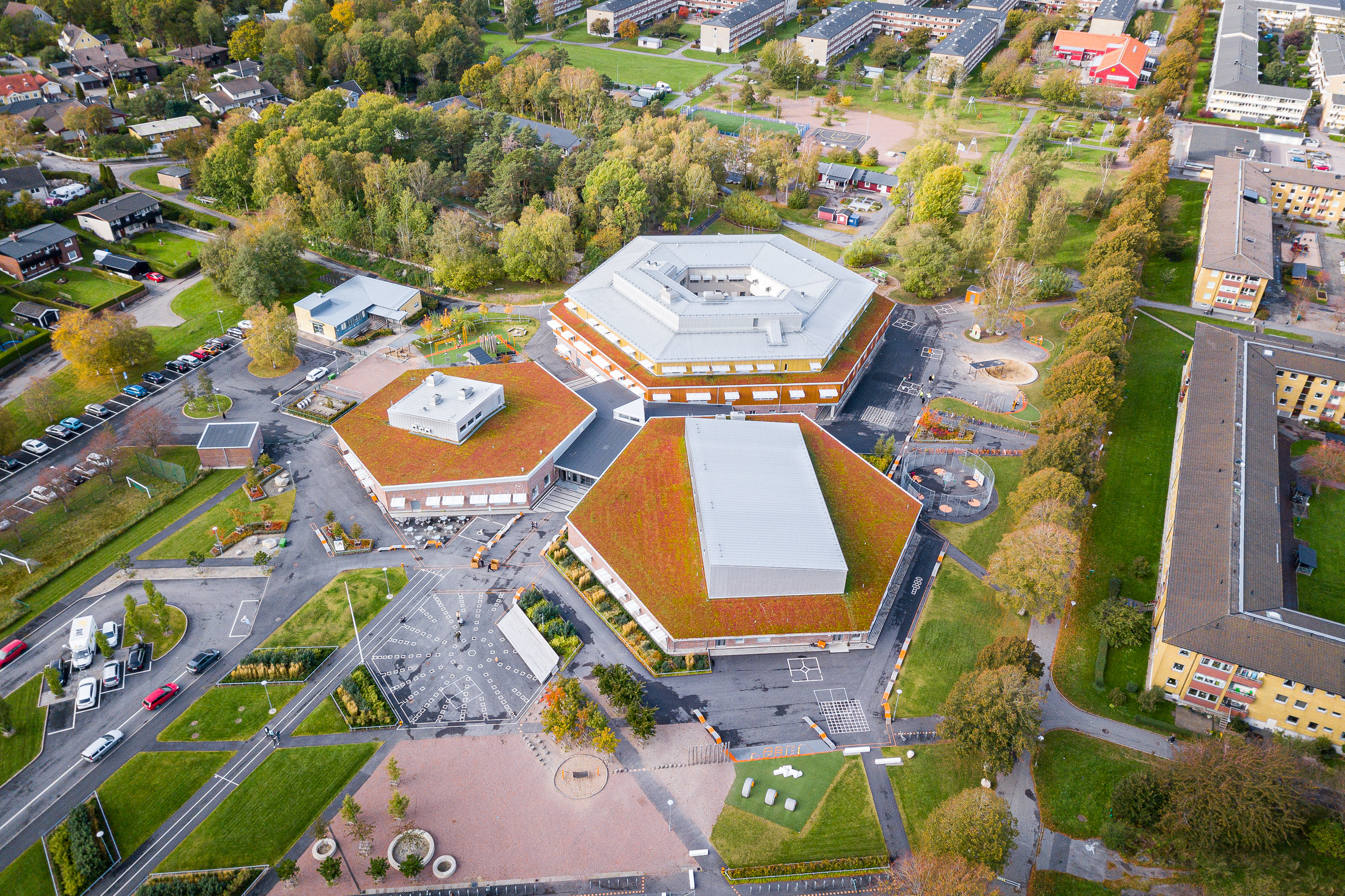
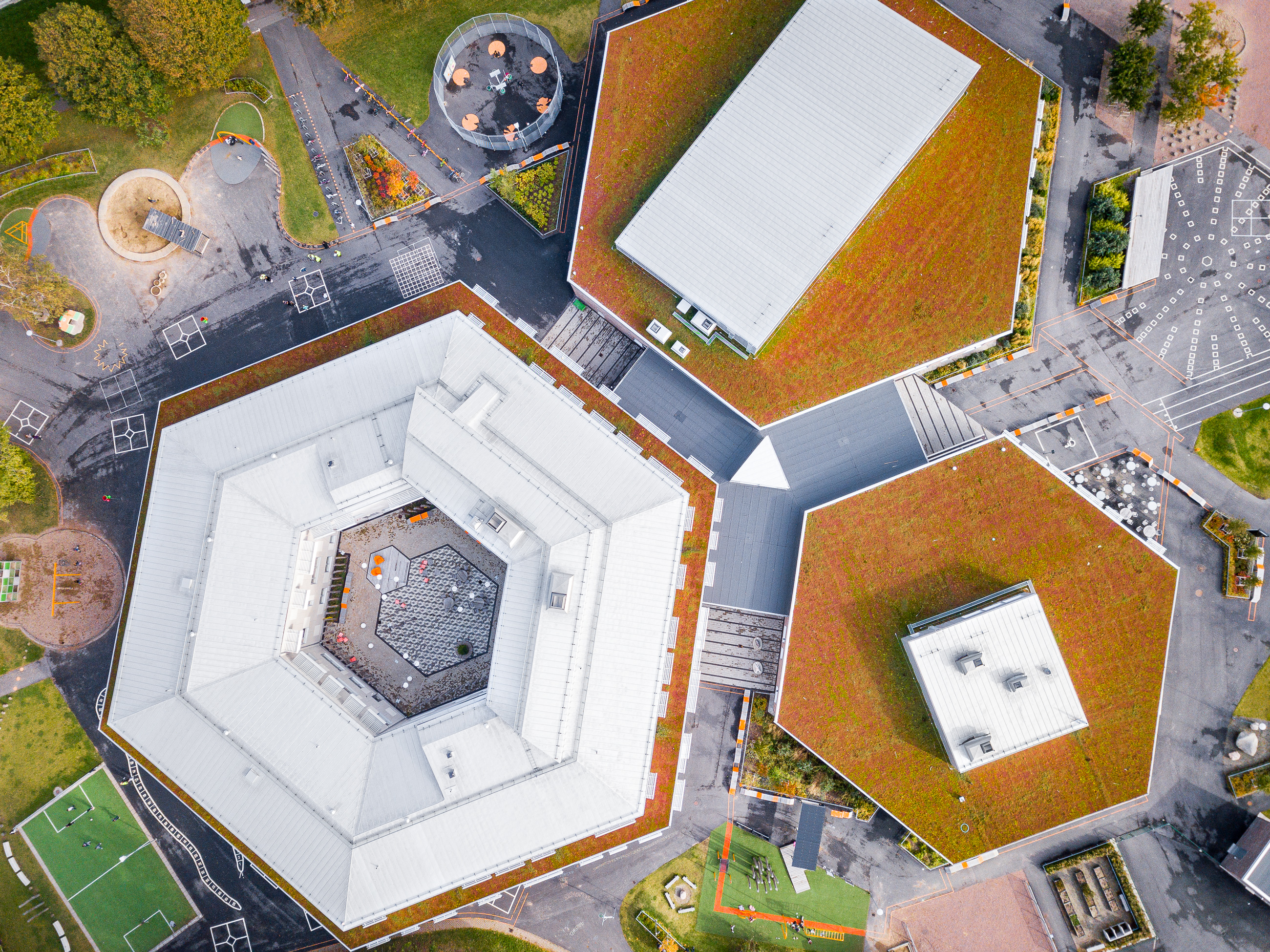
Freja school is unique in both form and function. Three hexagon-shaped buildings create a diverse outdoor environment while enriching the urban space. The school building is oriented to face all directions on the large site.
Frejaskolan – a competition win
In 2014, Tengbom won the commission to design the new Grevegårdsskolan, now called Frejaskolan, through a competition organized by Lokalförvaltningen in Gothenburg. Over two years, we worked closely with the school staff and client to create a new school for approximately 650 students and 100 educators. Freja school (Frejaskolan) is one of the largest new construction projects for our client and a long-awaited upgrade for the educators and students who had eagerly anticipated their new school.
“A strong, well-executed concept. Mångsida features a clear structure with beautiful outdoor spaces and excellent connections between indoor and outdoor environments. With its welcoming entrance, it invites the neighborhood’s residents both during and after school hours.”
— Jury statement
A school without a backside
The competition proposal, named Mångsida, addressed everything from traffic solutions and outdoor environments to logistics, phased construction, and contributing to playfulness in the surrounding urban area. The concept of three hexagon-shaped buildings connected by an entrance hub is designed to create diverse outdoor spaces for children. But as well enrich the existing urban fabric, and face all directions on the large site. Together, the buildings form a school without a backside.
We wanted to create something both enduring and adaptable, designed to withstand use
Externally, the school is both strict and playful, a design approach that also defines the interior concept. Just as the school appears different from various distances, the interior scale also shifts. A variety of room shapes create spaces that foster safety, community, playfulness, and inspiration. We carefully chose the materials, both inside and out, to ensure they endure and improve over time.
The school stands at the center of the district, serving as a hub for the area. It provides new meeting places for diverse activities and creates arenas for interaction.
As part of the contest for land allocation in a new district for housing and daily consumer goods, the aim was to create a future-orientated, urban, mixed-use district fully adapted to its surroundings in Brunnshög. The objective is to develop the Brunnshög district, based in Lund, into the world´s leading environment for innovation and research and a showcase for world-class urban development. By adopting a sensible, responsible approach to planning, we envisage a fantastic place in which to live, work and spend time. The vision is to make Brunnshög sufficiently appealing to attract visitors from all over the world. But how?
Situated in the north east of Lund, the new district of Brunnshög is emerging around the two research facilities of MAX IV and ESS. It is envisaged that the area will be home to around 40,000 residents and workers.
Illustration: Tengbom
Our vision of a sustainable community
As our society grows increasingly urbanised, we face the considerable challenges posed by climate change, more stringent demands on sustainability, constant time pressure and ill health. Although much of what makes us feel good costs nothing – chatting with our neighbours, daily exercise and a good night’s sleep – this is typically what many of us are lacking. Climate change is posing new, increasingly demanding challenges on the robustness of developments in relation to heat and water. Global warming is an issue many people find difficult to comprehend. What difference does it make if I take a holiday on the local hiking trail rather than travelling to Thailand?
Although much of what makes us feel good costs nothing – chatting with our neighbours, daily exercise and a good night’s sleep – this is typically what many of us are lacking.
Architecture which maximises sensory impression
When devising the concept for the district in proximity to the future square and tramway stop in Brunnshög, it was imperative that its functions and ambitions would meet the high standards encompassed by the Brunnshög vision. Our proposal involves creating a living environment for people and animals, which encourages taking the time to live and breathe, rather than consuming products. Minimising environmental impact by sharing, renting, borrowing or exchanging items. Maximising sensory impression through appealing architecture, which emphasises cultivation, food and dialogue.
Illustration: Tengbom
A district focused on the dining area
Our new district, the dining area of the future, focuses on the entire life cycle of food. It covers everything from cultivation to sales, preparation, and food waste management. The area is deeply connected to food and the dialogue around its role in the future of the city. A robust flexibility allows various participants to contribute and interpret food’s significance in different ways.
Our vision with the district is to create a diverse range of urban spaces of different sizes, functions and green structures. We want the buildings constructed here to stand for a hundred years. That is why we chose bricks for the façade, symbolising safety, warmth, identification, power and authority. Steel, wood and glass elements were also added as a clear compliment to the central brickwork. Over time, vines will grow over façades and balconies, becoming an integrated part of the design. The structures withstand use, reuse, and the test of time.
Nytorps Gärde is an important green meeting place for the Stockholm suburbs Hammarbyhöjden and Björkhagen. For our task here – to design a park proposal as part of the program for approximately 2 700 new dwellings – we want to look at the districts as a whole and highlight their important green qualities.
Many residents in Hammarbyhöjden and Björkhagen have actively chosen to live here because of the closeness to nature. Now, as the area becomes denser, it is crucial to preserve and strengthen Nytorps Gärde as a green heart. It must continue to serve as a central meeting place for recreation and social life. The denser Stockholm grows, the more essential local parks become.
Illustration: Tengbom
Over two thousand new dwellings and a more peaceful park space
Our assignment consisted of developing a proposal for the new Nytorps Gärde and making sure that the expanded Hammarbyhöjden-Björkhagen has a well-functioning outdoor environment and green structure. The proposal for the area means that the districts will become denser to the tune of about 2 700 new homes.
The expansion proposal concentrates the new dwellings in three areas. These include Hammarbyvägen, Hammarbyskogen, and western Nytorps Gärde. The open space, which is Gärdet’s most important quality, will be preserved. Most of the construction will be limited to the northwestern section of the field. The program also includes a proposed oak and hazel alley. Alongside this, a forest-edge alley with new biotopes and an activity alley will form the park’s three main streets.
The ambition for Nytorps Gärde is to lift the area, strengthen the connection to the city surrounding it and offer activities, mingling and recreation for all.
Activities for all – regardless of class and gender
Today, the area around Nytorps Gärde have fairly generous activity areas that mainly attract boys. For this reason, we have focused our proposal for Nytorps Gärde and the areas set aside for sports on creating areas that will attract girls from all classes of society and origin to become more physically active. Nytorpsbadet will be extended and there will be a dance and ice rink with mirror walls along the proposed street. We have placed areas for play and movement close to natural meeting spots. These include trampolines and balancing nets, designed to encourage activity without competition.
Illustration: Tengbom
Inspiration from the Stockholm school
In the 1940s and 50s, Stockholm city actively developed the region’s green parks. It enhanced nature and made it accessible by adding paths, benches, and playgrounds. This approach, later known as the Stockholm school, established parks as central public spaces for socializing, play, exercise, culture, and recreation. The park theatre and park play programs flourished, and comprehensive art initiatives were introduced.
We base our proposals on the values and traditions of the Stockholm school. For Nytorps Gärde, our ambition is to enhance the area, strengthen its connection to the surrounding city, and create spaces for activities, social interaction, and recreation for everyone. We aim to preserve and enhance the existing natural features, such as the forest edges and open fields. At the same time, we introduce new biotopes to enrich the landscape.
Health, Parks, Play & Public Spaces, Sports, Sports & Health
Client:Kungälv Kommun
Years of commission:
2013-2015
Location:
Kungälv
Contractor:
Kungälvs kommun / Ängegärde Bygg
Collaborative partners:
CMC Byggkonsult, Norconsult, Andersson och Hultmark, SLN Elkonsult, Fast Engineering Göteborg
Competences:
Culture & Sport, Interior Design, Landscape, BIM & 3D illustration, Hotel & Restaurant, Accessibility
From the first sketch to the opening. That is how involved newly qualified Christofer Ödmark got to be in the project Kotte, a sports center in the woods – a competition that landed on his desk during his internship at Tengbom´s in Gothenburg.
Kotten – the Pine Cone – is in our humble opinion a real gem of a story. Not only that actually, because the mere sight of the structure in the clearing in the nature reserve Fontin is enough to give you goose bumps. The project is a happy story in many ways both because it was the winning entry from a young and promising talent in our office called Christofer Ödmark, and also because the project has become a viral success internationally and received enormous attention. Again, in our humble opinion.
Photo: Ulf Celander
The story began in 2013 when Christofer Ödmark, fresh from his studies at Chalmers, started an internship at Tengbom’s Gothenburg office. One day, a competition landed on his desk—to design a new sports center in Kungälv after the old one was tragically lost in a fire. With guidance from his mentor, Hans Lindgren, he developed a complete proposal. The result was an oval building made entirely from organic materials. Its wooden modules, arranged in a pattern reminiscent of a pine cone, and its sedum-covered roof caught the jury and Kungälv’s council by surprise. They had hoped for something out of the ordinary—and that’s exactly what they got. The rest, as they say, is history.
Illustration: Tengbom
”I worked on Kotten from the very first sketch to the opening of the finished building two years later. During the project, I was given a lot of responsibility and was really able to develop as an architect in all areas from detailed design to customer relationships”, says Christofer Ödmark.
Our ambition was to create an iconic building that would stand as a symbol for the great outdoors and exercise.
The function of the building
In many ways, Kotten is a classic cabin in the woods of which there are many in the Swedish countryside. A place where you can shower, have a sauna, get changed and have a cup of coffee or eat a picnic. Our ambition was to create an iconic building that would stand as a symbol for the great outdoors and exercise. Christofer Ödmark says that the competition gave him free reins even if the council wanted full control of the construction process as well as the end result. Therefore the choice was made to work with a general contractor and the one that won the tender was the local construction company Ängegärde Bygg with 23 employees. The lowest price was the deciding factor during the bidding process.
Photo: Ulf Celander
Photo: Ulf Celander
Photo: Ulf Celander
“Yes! we thought when we won the bid. It is fun to create a monument that even my grandchildren will get to see. This has been really important to us. We come from the area so this sports centre belongs to us as much as it belongs to the other members of the community”, says Stefan Johansson who is a partner in Ängegärde Bygg to Byggindustrin in the article Kotten was created by a young, untried fountain of ideas (3 Feb 2016).
Illustration: Tengbom
A vision that stayed intact
”Sometimes, as an architect, you pass on a job to somebody else and then things happen along the way that turns it into something completely different from what you had in mind. That wasn’t the case here. All parties involved have kept the lines of communication open during the entire construction period”, says Hans Lindgren at Tengbom in the same article.
Looking back at the proposal we presented in the competition a few years ago, we see a result that remains strikingly similar. One small but beneficial change emerged through collaboration with all involved—the decision to use a vaulted roof. This adjustment simplified the installation while also enhancing the building’s shape.
Photo: Ulf Celander
The oval shape was a challenge
An oval building is a rare sight, making it a unique design challenge. Kotten’s façade features approximately 170 wooden “scales,” produced in modules and assembled on-site. Tengbom developed a model to create the modules, enabling Ängegärde Bygg to install them in a way that gives the illusion of an oval shape. In reality, the structure consists of 50 sides. Even the rafters were individually designed to fit the building’s distinctive form.
Wood for the sake of the environment
Ecological thinking has been a constant during the work on Kotten. The overall material is wood, with an outer façade of pine and interior linings made from birch plywood. The façade material OrganoWood is a silicon-treated lumber that does not emit any hazardous chemicals, but still allows the wood to age and become grey naturally. The price tag was a factor throughout the process but Kotten is a proud example of how to build in an environmentally friendly and sustainable way with lots of character without the costs sky-rocketing. The total budget for Kotten was 23 million kronor.
Photo: Ulf Celander
Partnership and local strength
Kotten is also the result of a successful local partnership with no less than 90 percent local partners.
”The partnership with Ängegärde Bygg has met all the criteria we have as architects. We kept in contact continuously during the entire process and it is clear that they have made a real effort to achieve our common vision”, says Christofer Ödmark.
Tengbom’s landscape architects played a key role in the project. They focused on creating an environmentally friendly construction, ensuring that only a few trees were felled. The team also designed the surrounding landscape. In that space, we created a playground, an outdoor gym, and a swimming dock.
” I have put the bar quite high for myself.”
Christoffer Ödmark, Architect
Photo: Ulf Celander
Out of the ashes into the trail
The Kungälv people have finally got their much awaited sports centre and it is yet again full steam ahead for all outdoor fanatics, young families and retired people to enjoy the nature around Svante Mosse. A proof of our appreciation was an opening party around Lucia time that attracted a very large and engaged group of people. The cherry on the cake was Kotten’s nomination for Building of the Year, Årets Bygge 2016. Christofer Ödmark and the rest of us feel both proud and honored by this recognition.
”It makes you want to do more projects now. But I have put the bar quite high for myself.”
How much do we see of you in Kotten?
Christofer Ödmark explains, “I believe in honesty, both in shape and material. Unnecessary complexity has never made sense to me. While the façade’s geometry may seem intricate, it follows a rational system. Even though Kotten is based on my design ideas, more than 10 colleagues at the office contributed to the project. Together, we brought this building to life.”
Culture, Education, Parks, Play & Public Spaces, Squares & Streets
Client:Akademiska Hus
Collaborative partners:
Stockholms stad, Kungliga Tekniska Högskolan
Contractor:
PEAB/JVAB
Years of commission:
2010–2016
Type of project:
Landscape
In 2015, the School of Architecture in Stockholm moved from their own address to the large Campus KTH. The newcomer was greeted by a new entrance square specially designed for them by Tengbom – a meeting place for the people who study and work on Campus.
For more than 25 years, we have partnered with Akademiska Hus and Kungliga Tekniska Högskolan, working on projects such as new constructions and renovations and a vision of an academic country road through campus, that improves creases the road safety and ties together the entire university campus all the way up to Albano. The project on the new School of Architecture included the task of creating an inviting entrance square, a so-called shared space area where the pedestrians have priority and where cars take third place after pedestrians and bicyclists.
Design – new construction meets a classical environment
We designed the square to connect the newly built School of Architecture, by Tham & Videgård, with the existing classical surroundings. The goal was to create a transition that felt both dignified and understated. To let the striking building stand out, we chose a high-quality paved surface. At the same time, the design had to integrate the School of Architecture into KTH Campus. Granite became the main material. It complements the Corten steel façade of the main building. Together, they create a cohesive and unified impression.
“The new entrance offers people a chance to stop and feel that there is a context linking these important buildings together.”
Jörgen Orback, landscape architect
Photo: Sten Jansin
Photo: Sten Jansin
Photo: Sten Jansin
Photo: Sten Jansin
Photo: Sten Jansin
An oasis on Campus
Our landscape designers have played a key role in nearly every new construction and renovation at KTH for the last 25 years. Their work includes designing and planning land, yards, terraces, streets, and squares. They have also developed care and maintenance plans. Several of these renovations received the ROT award in 1996 and 2002.
For the entire new entrance area, we have been involved throughout the planning process. From the initial application to the final stages, we have contributed at every step. We have also prepared the necessary construction documents to ensure a seamless execution.
Photo: Sten Jansin
“KTH Campus covers a vast area, almost like its own little municipality,” says Jörgen Orback. “We designed the square in front of the School of Architecture as an inviting entrance and social meeting place. An oasis for students and staff.”
In 2015, the Kasper Salin Prize, one of Sweden’s most prestigious architecture awards, went to the KTH School of Architecture. For this project, we collaborated with the Royal Institute of Technology, the City of Stockholm, the Student Union, and Akademiska Hus.


 Interior


 Outdoor environments
 Unique operational development with long-term solutions