Awards and recognitions:
Nominated for Meeting Place of the Year, Kalmar 2023
Why doesn’t Kalmar have an event space for both sports and music? The municipalitythought long and hard about this question — and the idea for the Hatstore Arena was born. With the contract in hand, Tengbom decided to design a building that presented the city of Kalmar as a dynamic cultural center.
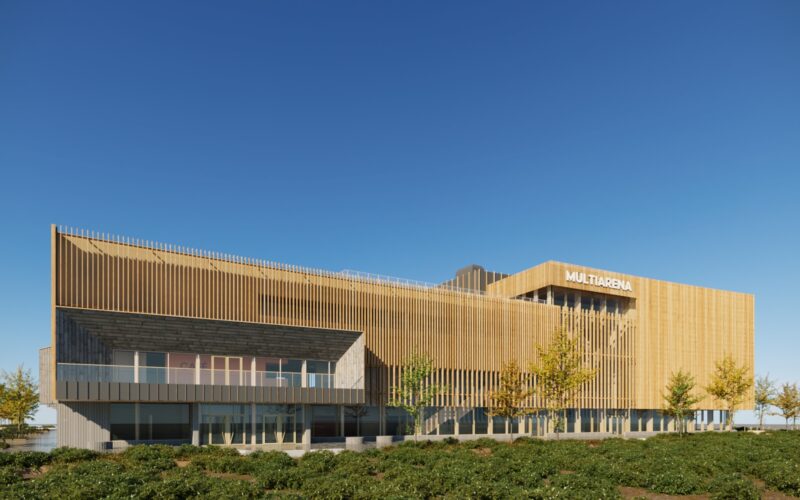
The facade is covered with corrugated, perforated aluminum, bringing a sense of rawness to the building based on how light reflects off it and how transparent it is. Photo: Felix GerlachOn the south end, the ice-skating rink connects to the Carlberg Villa and Carlberg Park.
Kalmar’s old ice-skating rink, which had previously been used for ice hockey, public skating, and figure skating, has now been redesigned and turned into a larger event center for cultural events with space for up to 3,500 people.
“We wanted to build something robust,” explains Johan Kjellnäs, lead design architect at Tengbom. “The building should be made of robust materials that don’t require unnecessary maintenance. The space needs to be durable, with many wet rooms that will see a lot of use from all the different events the center hosts. At the same time, we wanted to pull out all the stops and create a building with a unique design.”
“Kalmar finally has a proper event center!”
Kalmar Residents
The RGB lighting can be changed for different events, transforming the front square into a stage once the sun goes down. Photo: Adam KjellnäsFrom the top of the staircase, you have a view over the entire arena. Photo: Felix Gerlach
An ice crystal greets visitors
“It’s always a good idea to have a clear vision to base the design on. That way, everyone has the same image in mind throughout the project,” explains Johan Kjellnäs.
The vision: an ice block that sparkles in the light. A modern design that both contrasts and harmonizes with the city. Photo: Adam Kjellnäs
The building’s design is reminiscent of an ice crystal that is partly transparent and glitters in the light. Inside, the arena makes up the center of the building. How transparent the building is depends on how the building’s facade is lit up. To reach the arena space, visitors follow a directed path into the building’s center. Visible from far away, the main entrance leads visitors into the arena via a wide central staircase. Following the staircase, a large, warm, red room welcomes visitors with a view overlooking the ice and event space.
The foyer, with its colourful staircase, acts as a preview for the overall arena experience. Photo: Felix GerlachEntry staircase and foyer. Red for passion and black for intimacy. Concrete for robustness and circles for community. Photo: Felix Gerlach
“It’s a classic, but effective trick that architects use. Visitors go from a small room to a large one, where they can easily find their spot, and where the restaurant and bar are visible,” Johan Kjellnäs explains.
Designed to stand out
The exterior is designed with a corrugated, perforated aluminum panel that overlays the building’s transparent facade, adding fragility and delicateness to the structure’s overall effect. The facade is lit up from below, illuminating the building’s face with horizontal lines – almost like a stage with a backdrop. The colour of the lighting can be changed, which helps a lot when matching the building’s facade to the type of event being advertised.
Red for passion
In terms of the design, we’ve been very conscious of both materials and colours. The colour red symbolizes passion, while also being Kalmar’s team colour. Black symbolizes intimacy. The wood detailing creates a sense of warmth, which is woven into the raw concrete that gives the building robustness. The circular patterns symbolize figure skaters’ pirouettes, hockey pucks, movements and community. These patterns are also found in the suspended ceiling, materials and artistic decor.
View of the balconies inside the arena from the restaurant. Photo: Felix Gerlach
The facade is covered by a pleated, perforated alumininum sheet, which with the transparent underlying volume adds fragility and sheen to the design. The facade lighting is directed from the ground and strikes the facade where it creates horizontal lines – almost like a scene with a background. The colour of the lighting can be changed based on the event to be written and help build the right mood.
Hatstore Arena – a place for experiences
Hatstore Arena is now open, giving Kalmar residents a much-needed setting where community and experiences are the focal points. Every city needs a public space for applause and cheers. This is where dreams come true, and where, unfortunately, some dreams come to an end.
“Now we’re just waiting for artistic pieces to be added outside the arena,” Johan Kjellnäs goes on to say, “There are going to be three art pieces in the front square that will help complete the overall design. Following every stage of the project, from the initial vision to the final product, was a lot of fun. And in the words of a passer-by, “Kalmar finally has a proper event center!”
Is it possible to cook several thousands of delicious and nutritious meals a day? With the opening of the Oden commercial kitchen in October 2021, Vänersborg Municipality says yes. In the new kitchen, employees work with smart solutions to accommodate every individual’s food preferences.
In the hot kitchen, employees can use the industrial cooking pots to make large amounts of delicious sauces, mashed potatoes and stews. An ergonomic emptying system above the cooking pots makes it easier than ever to portion out the meals into containers and tins.Ergonomics and simple cleaning is important.
Tengbom’s Malin Ljungblad, who previously worked as a food inspector, headed the project.
“For a project of this size, we prepared by doing a lot of preliminary visits to learn about the space and by going through surveys and reports from earlier projects,” Malin Ljungblad explains. One of our studio’s biggest strengths is our experience – we understand the business, the needs as well as food safety.
The project team also included Magnus Nilsson, a former cook.
“Everything had to be optimized,” says Magnus Nilsson. “From how goods are brought into the kitchen and how food is handled, to workflows surrounding food, safety, and hygiene, as well as cooking to accommodate diets and sustainability.”
The range hoods of the industrial cooking pots collect steam and heat that are then carried to the ventilation system. Cleaning all the equipment and appliances is easy.
Better food and a better work environment
Work on the 2,700-square meter workplace began in 2013. In an investigation conducted by the municipality, it was noted that the work environment for employees in public kitchens needed to be improved. Additionally, modern commercial kitchens had to meet today’s environmental and sustainability requirements. Last but not least, they also had to make delicious food for the municipality’s residents.
“We have been waiting and hoping for a new kitchen,” says Anna-Karin Svensson, catering manager at Vänersborg Municipality.
An important change is that the meals made for elderly care facilities are no longer kept warm after they’re cooked. Instead, employees use a special process to immediately freeze the meals, which preserves both taste and nutritional value. Previously, food would be kept warm until it was served. The reactions from people who eat the food prepared in the Oden commercial kitchen have been positive. They’ve said that the food both looks more appetizing and tastes better.
“The residents think that the food’s gotten better, and that’s pretty much the best part of it all — that, and giving employees a better work environment,” says Anna-Karin Svensson.
There’s a lot of space to pack meals in the cold packing room. Meals are then sent to different facilities and organizations. Packing food in a low-temperature environment ensures both the quality and safety of the food.Cold food is stored in refrigerated carts before it’s sent around the municipality. It’s vital that the cold chain is never broken on the way to the receiver.
Work zones with a severe allergy kitchen and backroom
Every day, the Oden commercial kitchen serves 400 meals on-site to the middle school it’s located in. The remaining 4,200 portions the kitchen makes are delivered to other facilities around the municipality. The new kitchen has been planned out to include work zones, so teams no longer have to go from one work station to another unnecessarily.
“The recipe for a successful commercial kitchen is the ability to combine helpful features with logical workflows for employees and a workspace that isn’t too large”.
Magnus Nilsson
In the diet kitchen, employees cook and prepare meals for various diets. The kitchen is equipped with an industrial cooking pot, oven, griddle, and a separate counter to ensure food is handled safely.
In addition to packing and freezing newly cooked meals, the team has now introduced a diet kitchen. They have also built a severe allergy kitchen to prepare allergy-friendly meals. The new kitchen setup keeps food completely separate from any allergen or contaminant, something that wasn’t possible before. Employees now have a new backroom where they can bake bread for the school restaurant. They also use this space to make timbales for individuals with difficulty chewing and swallowing.
Our mantra is to utilize everything we can to the fullest.
Environmentally-friendliness is baked in
Solar panels were installed on the roof of the new building, generating enough energy to power the equivalent of ten villas. All green waste is converted into biogas, and plans are in the works for a separate composter for food waste.
Can a hotel expand a city center? We think it can. With the opening of the new Clarion Hotel in Sundsvall, the “The Stone City” has gotten a fresh and shiny add-on.
The hotel’s unique location along the Selånger river. Photo: Lasse Olsson
The perfect spot to enjoy a glass of wine. Attend conferences, relax, celebrate or simply escape. With “stone” and “jewel” as its keywords, the new Clarion Hotel in Sundsvall combines traditional and contemporary, bringing life and movement to a block that used to be just a parking lot.
A spectacular street-level bar embellishes the hotel’s center. Suspended above the bar counter as if floating in mid-air, the bar’s overhang perfectly completes the space. Photo: Lasse Olsson
Warm, fresh and dramatic
The Selånger river, Norrland’s rugged nature, and Sundsvall’s industrial past were all sources of inspiration behind the design concept. Playing on the keywords stone and jewel, the decor is a far cry from your classic hotel style.
“As our jumping-off point, we used contrasts like polished and raw, glowing and cool, dark and light. Together, we created an interior design that feels human but still exciting,” says Nadia Tolstoy, design lead at Tengbom.
Warm textiles and shiny brass glow in the cosmopolitan rooftop bar, complete with expertly designed lighting, materials and acoustics. Photo: Lasse OlssonThe countertop of the rooftop bar is inspired by the Alnöite stone found in Sundsvall. Photo: Lasse Olsson
More than a hotel
In 2017, a jury named Sundsvall Sweden’s most beautiful city. People often describe it as a Phoenix rising from the ashes, a nod to the great fire of 1888. With Clarion Hotel Sundsvall, the city takes another step forward. The hotel welcomes guests with a warm and inviting lounge. It features an inspiring conference area, a rooftop restaurant with a terrace, an international spa, and rooms designed for long, lazy weekends. To create the perfect atmosphere, we combined polished brass detailing, natural stone, smoked oak, limestone hues, and wood paneling. We also wove motifs inspired by the Stone City into everything—from the patterns in the carpets to the textures in the bathrooms.
“We wanted to create the exact opposite of traditional hotels’ sterile decor. Using timeless, yet classic materials, with an emphasis on a welcoming design, we’ve created a fresh, lively meeting space for Sundsvall residents and long-distance travelers alike,” explains Claes Pereswetoff-Morath, project manager at Tengbom.
The sun sets over the rooftop bar’s terrace. Photo: Lasse Olsson
Collaborators:
LSI, Input, Ateljé Lyktan, Götessons and Pogm/Organoid
Smaller offices are increasingly common. But how do you scale back without sacrificing comfort? At Tengbom’s Malmö Office, space is the only thing that shrunk.
“We’ve really focused on working creatively with our use of space. It’s important that the place doesn’t feel static; it should be able to change over time. We wanted variation and to be able to adapt the space as needed,” says Josefin Klein, Practice Director.
The calm color palette throughout allows the character of each room to speak for itself, without requiring additional accentuation.
The office isn’t what it used to be. It’s a change that began long before March 2020, but the pandemic has accelerated it and made the adjustment more urgent for property owners and tenants alike. We need to reconsider. Scale down. Think new. For Tengbom in Malmö, that meant finding a brand-new way to use the office.
The interior design can be modified as needed, and there is plenty of space to pin up ideas, set up models or hold temporary workshops.
Our solution: reuse and efficient use of space
The oldest section of the building was a theater in the 1800s, while the newer areas were built in the 60s.
Less space and also more functionality – can this equation really add up? At Tengbom’s Malmö office in the historic building at Stadt Hamburg 13 on Gustaf Adolfs square, the answer is yes. Here, several buildings from different eras have been joined into a single but charming whole. For our furnishings, we emphasized upcycling and reused almost everything from our old space.
The new office – which is 120 square meters smaller than the old one – required several creative solutions in order to fit the bill. Touchdown spaces are interwoven with a mixture of high and low seating arrangements. There are separate rooms, some of which are dedicated entirely to virtual meetings. At the same time, thanks to the central location, more meetings and functions can be carried out in shared spaces.
“It might seem like such a distinctive and varied space would conflict with the classic office landscape. But when the office is activity-based and primarily a meeting place, it’s the perfect venue for creative gatherings”.
For the furnishings, the office emphasized upcycling and reused almost everything from the old space. The ceiling height and eye-catching paintings on the ceiling in the old “Hall of Orders” also make a statement.
From classic office to creative hub
So how do you achieve the creative environment that is so essential to the modern office? Practice Director Emma Nilsby believes it is important to come to a place where you can have fun, and where exchange takes place. The new Malmö office has great conditions for these factors through its numerous and varied spaces. The room that serves as a lounge or break room has softer seating for coffee breaks. It has a big table where meetings can be held at one end and employees can eat lunch at the other – while at the same time, the room facilitates flow and you can see people coming and going.
“The office has become a meeting place. You choose to work from home when you want to focus. When you want to meet up, socialize and be creative, you meet at the office or at a café. It’s a different mindset,” says Emma.
A space for experimentation and prototypes
Why not take synergy a step further and make space for innovations and product development? To take that step in its entirety, one of the rooms at Tengbom’s Malmö Office is a dedicated showroom and testbed space, where employees and suppliers can “test-run” furniture, find new solutions, and increase their knowledge of different work environments.
Through collaboration with various brands, we have been able to experiment with new materials. In the Scenografen meeting room, the walls have a fragrant apple wallpaper from Pogm/Organoid and the space is currently furnished with furniture from Götessons.
“Working together in our showroom has been an experiment for our suppliers, too. This has involved everything from reupholstering furniture to coming up with brand-new products. They’ve found it really exciting to work this way, and it lets them sell it for the next project and use our office as a kind of reference project,” says Josefin Klein.
In the dark center, we have assembled practical functions such as storage, meeting rooms and lockers, as well as a display space for models and materials.
Collaborators:
Ljusrum, Nyréns, AIX, Stockholms Målerikonservering, BK Beräkningskonsulter
With the renovation of Östermalm Market Hall, Tengbom has preserved a part of the city’s history while creating a new way to experience this historic culinary destination. The market hall has undergone the most comprehensive renovation in 130 years, and together with the new market hall hotel, this cultural legacy is ready to welcome visitors for yet another century to come.
The large, curved windows and original entrances were renovated and accentuated with nighttime lighting. Photo: Lasse Olsson
After a little over a century in operation, Östermalm Market Hall was in great need of renovation. Decades of sporadic updates had resulted in a space that was no longer particularly inviting.
Our task: update, accentuate and improve
Restoring the market hall to its original luster involved significant challenges. We looked back in time to put the venue’s history to use, but the building also needed to meet modern requirements, and new additions should enhance the visitor experience.
Restaurants along the building facades in combination with longer opening hours and outdoor seating areas contribute to a thriving outdoor setting. Photo: Åke E:son Lindman
We had to review the building’s technology and consider the complex logistics that take place in and around the hall. Adaptations for accessibility, replacing essentially all technology, and reinforcing the cultural-historic and antiquarian values of the building topped the agenda. Simply put: we wanted to elevate the user experience without corrupting any part of the building.
Respectful adaptation for the future
We have taken a comprehensive approach with great care for the character and details of the building, from technical functions and structural initiatives to restoring the original decoration. The original star-shaped floor plan has been restored to benefit retail and create clearer walkways. Additional features have been added to create new experiences, such as long balconies with seating for restaurant guests. Greater accessibility requirements contribute to a better experience for everyone, with elevators and additional toilets.
The original colour scheme and decorative details have been restored. Photo: Åke E:son Lindman
New additions have a clear contemporary look that is quieter than the bold and colourful cultural-historic environment. In other cases, the choice was to emphasize and enhance the original appearance of the market hall. Paint conservators have carefully scraped away layer after layer of paint to reveal a picture of the building’s history.
The original wood construction of the market hall has been renovated and adapted with low paneling and marble counters with integrated refrigerators and display areas. Photo: Åke E:son Lindman
Today, visitors encounter a more vibrant space, but in the same colours as before. Light also streams through the gable windows once more. The windows had been painted over at one point, but have now been replaced with new windows and an innovative jalousie system developed from boating technology to protect goods from direct sunlight.
Improved flows and new experiences
Today, visitors are met with a uniform and harmonious experience, a market hall that is now inclusive, adapted for accessibility and sustainable. Improved flows, smarter entryway solutions and a new waste and recycling system that reduces the number of truck transports to a fifth of what it was are just some of the elements that make Östermalm Market Hall an ultramodern meeting place. Restaurants along the building’s facades combined with longer opening hours contribute to a bustling environment outside, with greater focus on contemporary needs and behaviors, such as socializing and being seen.
The hotel – a new way to experience this historic culinary destination
A new hotel has opened that is connected to the market hall. Through parametric design and innovative architecture, Tengbom has helped create an extraordinary hotel experience. An old industrial candy factory from 1910 and an Art Nouveau residential building from 1888 have been transformed into a chic hotel. It was a tricky task to chisel a hotel out of buildings in different styles and from different eras. The historic character of the buildings had to be respected, and at the same time, we needed to unite the structures and redesign the floor plan for compatibility as a hotel. To achieve functional flows on each floor, a modern addition in handmade brick was added to the existing buildings. Together, the buildings circle a courtyard.
Together, the modern addition and the original buildings circle a courtyard and create a new meeting place in the city. Photo: Åke E:son Lindman
With the market hall hotel, a new sense of flow and energy have been established on the block.
The addition in handmade brick, perforated with sound absorption underneath to create a comfortable sound environment in the hotel courtyard. Photo: Åke E:son Lindman
A glass roof in collaboration with tech and the sky
We designed the courtyard as a year-round meeting place to ensure both function and enjoyment. To achieve this, we covered the space with a specially designed glass roof. The elegant, undulating shape makes the roof feel like an extension of the sky rather than a glass cover. Placing a glass roof over three buildings with eaves at different heights posed a unique challenge. We also aimed to retain the feeling of being outdoors while preserving the neighbors’ view and daylight. To solve this, we used parametric design—an algorithmic approach that streamlines the construction of complex shapes. This method allowed us to maximize the glass surface, minimize structural elements, and create a slender roof with an open feel.
With minimal structural elements, the undulating glass roof elegantly arches across the three different buildings with eaves at dissimilar heights. Photo: Åke E:son Lindman
Sound – a crucial component
In a large, glassed-in courtyard, acoustics can pose an obstacle to a pleasant experience and the sense of being outdoors. To reduce echoes and excess noise, we chose to cover the addition with a perforated brick facade. By leaving out every other brick and adding sound absorption underneath, we succeeded in creating effective sound reduction. The abstract brick pattern gives the facade a compelling depth while serving an important function. To further ensure noise reduction and a pleasant sound environment, we chose acoustic plaster as a complement when re-plastering the old residential building.
“Now passersby can take a shortcut from Nybrogatan via the hotel and market hall to Humlegårdsgatan – which also benefits commercial activity in both buildings”.
Mark Humphreys, Lead Architect and Office Director
a chic hotel. The passage between the hotel and the market hall now creates a new city flow through the block. Photo: Åke E:son Lindman
The result – a new city flow
The passage features site-cast concrete and terrazzo stairs. This creates a subtle yet contrasting transition between the market hall and the hotel. Photo: Lasse Olsson
We retained and restored an existing passage that leads from the street to the hotel’s courtyard. We also created a new passage to connect the courtyard to the market hall. Together, these changes have introduced a new city flow through the block.
“Now passersby can take a shortcut from Nybrogatan via the hotel and market hall to Humlegårdsgatan – which also benefits commercial activity in both buildings.” The new passage that cuts through the old brick and concrete construction required powerful support frames. We chose to expose these changes in painted black steel and site-cast concrete, while creating an understated, contrasting transition to the colourful, detailed environment of the market hall and hotel.
The new passage now connects the market hall to the hotel. Inside, Leontine Arvidsson’s artwork “Bäst före: torsdagen den 12 mars 2020” (“Best by: Thursday, March 12, 2020”) adds a striking visual element. Photo: Åke E:son Lindman.
Taken together, we’ve created an experience that feels like traveling back in time, while the market hall is relevant for the future once again. Time will tell if we’ve hit the right note, as we did with the temporary market hall. But for now the city, country and world have regained a piece of cultural heritage – and then some.
Footnote: The hotel operator and architect Per Öberg developed the design concept for the hotel.
Awards and Recognitions
In 2021, Östermalm Market Hall won the Swedish Lighting Prize (Interior Category) and Stockholm Building of the Year.
Combine hardiness zones, forest regions, and Småland’s distinctive natural scenery with a brand-new office concept. The result is the Swedish Board of Agriculture and Swedish Forest Agency’s new headquarters in Jönköping, designed by Tengbom.
The building towers in the distance, but up close, it breaks down into a natural part of the urban setting.
Lingonberry, granite and field of rapeseed. These are some of the shades and hues you will encounter at the newly built Dialogen office complex in Jönköping. The Swedish Board of Agriculture and the Swedish Forest Agency are the first to move in to the Skeppsbron district, located beside the beautiful Munksjön lake. Dialogen – which was designed by Tengbom in Jönköping – is one of the first buildings to replace and revitalize the old industrial area.
“An entire neighborhood is emerging here. Right now, it borders the outer edge of town, but the idea is that the Skeppsbron district will gradually become a new center in Jönköping. What we like about the location is how the city meets nature – you get the best of both worlds here,” says Matt Patterson, lead architect at Tengbom in Jönköping.
We’ve reflected hiking through Sweden’s scenery with a base of natural materials like stone and various types of wood.
Folded sheet metal covers the facade, and the colour and shadows change with the light.
The office concept – hiking through Sweden
The Swedish Board of Agriculture and the Swedish Forest Agency have embedded their identity into every part of the building. Colours and materials reflect Sweden’s forest regions and hardiness zones, floor by floor. Småland’s nature comes to life in everything from wood details to common areas. Tengbom Jönköping, in close collaboration with the interior design studio in Stockholm, has designed a workplace with a deep connection to the surrounding landscape.
“We’ve reflected hiking through Sweden’s scenery with a base of natural materials like stone and various types of wood. A broad colour palette supported the design, in which much of the interior decor is reused and needed to be held together to create a cohesive whole,” says Linn Sylvan, lead interior architect at Tengbom Stockholm.
The dining area overlooks Munksjön lake and Jönköping’s city center.The views strengthen the connection to the natural surroundings.
An environmentally certified landmark with the Swedish Board of Agriculture
The new structure is highly visible and an important part of the development of Skeppsbron. The building towers in the distance, and its scale and style make it a beautiful element of the Jönköping skyline. At the same time, up close the building melts into its surroundings, with details like an angled roof, different levels and facade variations in different kinds of sheet metal. Sustainability permeates the entirety, from care for the surroundings to reused furnishings and BREEAM certification with an Excellent rating.
Launching a new area
The entire interior design concept is based on the Swedish Board of Agriculture’s activity-based work method. Employees encounter open areas, zones and increasingly separate rooms the further out from the center they go. Because the building is narrow, it has plenty of daylight and views.
“By daring to focus on a brand-new neighborhood, the Swedish Board of Agriculture and the Swedish Forest Agency have set the stage for growth. Their work has laid the foundation for an expanding, updated Jönköping,” says Matt Patterson.
Dialogen is a highly visible and important part of Skeppsbron – a place where the city and water meet.
Awards and recognitions
Honorable Mention for Good Architecture, Jönköping Urban Design Prize in 2022.
How great can an office really be when you reuse as much as possibly? The team that created Tengbom’s Uppsala office knows. With twice as much space to furnish and ambitions to create an innovative, flexible office that fosters team-based creativity, they successfully combined two offices while championing reuse of the space.
When the historic architecture firm Werket Arkitekter AB merged with Tengbom in 2018, the hunt for a larger shared office began. Moving boxes were soon trucked off to Forumkvarteret, a property in the heart of downtown Uppsala. Furnishing was next on the agenda, and the goal was to reuse as much as possible without sacrificing technology or design.
Photo: Christoffer Skogsmo, Tengbom
A furnishing concept that reflects our values
The furnishing concept was based on Tengbom’s values: humanism, inclusion, collective intelligence and continuous development. The office should be infused with care for the environment and for human beings. It should inspire and encourage sustainable practices and innovation.
Photo: Christoffer Skogsmo, Tengbom
Sustainability and reuse
The space would be decorated and furnished with items that could be reused and integrated into the new concept, including any necessary additions. A large quantity of Tengbom’s own furniture was reused, while refurbished furniture was purchased from suppliers such as Rekomo, Senab and TreCe.
All of the suppliers we worked with have a strong environmental focus. Furniture that was not used was bought by Rekomo, or donated in partnership with the charity Stadsmissionen.
– Intuition and patience are essential for incorporating so many recycled furnishings.
Eva Brännvall, Project Manager
An environment for well-being and efficiency
The office had an open, unexpected and inclusive floor plan. Using clear spaces within the rooms as well as plenty of varied environments in which to spend time and work, strolling through the office was a bit of a journey of discovery.
Areas for collaboration were centrally located to promote creative processes. Other, more relaxed areas encouraged spontaneous meetings and conversation. The idea was for employees to be able to choose where to work based on their current assignment.
The mix of furnishings created a laid-back and welcoming atmosphere. It merged history and the present in a dynamic yet harmonious way.
Photo: Christoffer Skogsmo, Tengbom
The result?
A bustling meeting place where the key rule was that there were no rules. It was a furnishing solution with a reuse rate of 90 percent.
1 less journey around the earth by car
Rekomo bought up older, big desks instead of purchasing new ones. They added used adjustable table legs and recycled desktops. In CO2 emissions, this has saved the equivalent of one journey around the earth by car.
In the summer of 2018, the doors reopened to the Capitol movie theater, Stockholm’s most luxurious cinema experience. Tengbom developed the interior design concept in the same celebratory spirit.
You can watch both new movies and old classics here.
From 1926 to 1985, Capitol was Vasastan’s largest (initially) and most beautiful movie theater. Now, as the movie theater opens its doors once again following a comprehensive renovation, that history is being re-created with a new concept.
With Art Deco as a base, Tengbom was tasked by E/S-A as architects to come up with an interior design concept. It had to deliver a more grown-up movie-going experience, for theater-goers who dine and drink in the auditoriums while enjoying the culture of new and classic films. The interior decor is framed with bold details, striking colours and custom-designed patterns.
Take the magic with you
The roaring 20s are easy to recognize in the preserved original details, such as arches, columns, railings and stucco, and at the same time, the overall look is brand new. Consistent with settings from this era, new and old elements are present in both the materials and the design.
The idea is to re-create the magic of the movie theater and the feeling that going to the movies is an event – but in the era of conscientiousness
Particular care has been paid to the bar at the entrance, because it is the vibrant hub of the theater. Here, the goal was to work mainly with various exclusive natural materials. This creates an environment that will stand the test of time and age beautifully with the movie-goers. Standout materials include solid wood, stone and brass.
Sandra Wall designed two different rug patterns for the auditoriums.
Hand-drawn patterns and a burst of colour at the Capitol theater
Inside the auditoriums, Tengbom’s interior design architect Sandra Wall designed two different rug patterns to give the otherwise dark theater a strong identity. One auditorium features a rug framed by a prism pattern, reminiscent of projector lights. The other showcases a majestic blue floral pattern that echoes the design of the arch in the auditorium.
“The rugs are showstoppers in the auditoriums”
The colours also have a distinctively Capitol quality. The auditorium walls feature turquoise and Bordeaux tones. Green and blue velvet fabrics enhance the space. Together, they bring out a surprising and more striking palette from the 1920s.
“With a modern twist on the palette, we’re stepping away from classic movie theater red. Instead, we’re bringing history into the present. Since opening, many pictures of the theater have been shared on social media. The carefully chosen colours have truly strengthened the theater’s identity. It should be clear that this is Capitol and only Capitol, not any other theater,” says Filip Svensson, who developed the interior design concept with Sandra Wall and Kjerstin Björck at Tengbom.
Offices will continue to be a permanent fixture in the changing way we work. However, they will have to meet the high demands of both functionality and comfort now that technology enables us to be increasingly mobile. EY Headquarters and it’s new Stockholm office aim to move its business into the future with efficient spaces, technical innovations and, not least, interior design with a touch of personality.
EY’s main office has emerged in Stockholm city center in a reborn area around the Sergels Torg landmark.
Work from home or feel at home in the office? Developments in recent years – not least the pandemic – indicate that we will do both. When EY commissioned Tengbom to furnish their new Stockholm premises, “living room” was one of the key words.
“It is important for the office to offer something that is not available at home,” says Sofia Dahlén, lead architect for the assignment. “That something includes the interaction with colleagues. A workplace should be a source of inspiration and input from others, and the environment should really promote that.”
“The aspects of our sustainability footprint that we can control are travel and the physical premises. It’s a big step to reduce our spaces but increase the number of workspaces – making it more optimized and multifunctional.”
Jessica Schmidt, management consultant and project manager, EY
The main lounge with its wide variety of seating creates a homely feel. Easy to find your favorite spot!Wood and warm tones in the lounge form a link to Stockholm’s natural landscape.The harmonious color palette in subtle natural tones together with the copper colored ceiling add warmth. Standing up – table designed specially by Tengbom.
Efficient and versatile spaces
The new office is part of a larger, more wide-ranging change at EY – which involves integrating new ways of working into the global strategy. A contemporary workplace is a key part of recruiting and retaining employees and attracting new customers.
“These are issues we help our clients with, so we should practice what we preach and have a modern, vibrant office,” says Jessica Schmidt, Management Consultant at EY and Project Manager for the transformation.
EY Headquarters occupies four floors in a new building in the heart of Stockholm, with views over the busy streets, shops and walkways. Multifunctional spaces allow for better use of a smaller footprint, fewer square feet, in an activity-based office. The work areas are divided into zones, which lets employees chose whether they want a quiet, focused place to work or would prefer to interact with colleagues. They can also interact with others in the many lounge areas which form an important part of the floor plan. At the same time, there are individual meeting rooms, the majority of which are set up for digital meetings.
Holistic approach to promote health
It is highly likely that the way we work has changed for good: digital meetings are here to stay and the office will play a greater role as a collective hub where company culture is formed. Being innovative and effective at work is essential for a business, as is providing a health-promoting environment in the form of good ergonomics and a well-lit environment with good lighting – something that is often missing when we work from home. At Tengbom, we are passionate about creating dynamic and healthy environments. And the best results are achieved when there is trust and commitment between all parties. Especially in a project like this which was commissioned right at the start of the pandemic.
“From the outset, we could see that it was not just a question of finding a few pieces of furniture. The client was fully committed; they wanted to get more out of the office. We put trust in each other’s professionalism to find common solutions,” says Tove Prahl, Project Manager at Lindelöf, who was responsible for buying the furniture.
The unique interior design at EY Headquarters is unusual for a large office. It is intended to feel more like a comfy living room than a stylish office. Variety is the key to this, with plants, rugs, textiles and accessories.
All the furniture in the internal hub are specially designed by us at Tengbom. Or picked out to last over time – both aesthetically and based on function.If you want some privacy in an otherwise active environment, you can sit down in one of the meeting booths. The lighting and the graphic elegance collaborate to frame the area.The sofas are specially designed for the internal hub in the office.
Islands with strong connections
As an international company, EY Headquarters also wants its offices to feel local – as soon as you step into the office, you should be able to see that you are in Stockholm, even if you miss the Sergels Torg landmark in the urban landscape outside. Stockholm is a city of opposites, and the design concept reflects this encounter between cityscape and landscape. The result is an office that is technically at the cutting edge but also embraces timeless and beautiful natural materials that capture the all-encompassing concept of Stockholm, City of Islands.
The connection to islands continues in the staircases, which link floors and zones like the city’s bridges. The aluminum expanded metal ceilings are partially painted in copper tones. They draw inspiration from Stockholm’s idyllic sunsets—or perhaps its more frequent cloudy skies. Light, muted pastels and natural shades of gray, brown, and beige transport you through the city. The journey moves from the heights of the southern city island of Söder to the warm cliffs of the archipelago.
Variation in a work zone otherwise largely filled with desks is created through this island. An inspirational, harmonious and inviting area for a break.Sofas, tables and podium – all specially designed by Tengbom.We designed a low piece of furniture with distinct level differences. It creates a space for still life and offers a break from the efficient workspace. We used a mix of natural stone, ash, and walnut to add warmth and texture. The island frames the exit, leading to one of the office terraces with a magnificent view.
EY Headquarters – an office you want to return to
The driving idea was to create a timeless design that lasts and encompasses the entire office, not just the public areas.
“The focus of the office isn’t just the external lounge,” says Tove Prahl. “We wanted to create a workplace centered around the people who work here, not just provide small, cramped areas for them to work in. The workplace of the future will be more employee-friendly.”
Every cloud has a silver lining. If employees are to return after working from home during the pandemic, the office must offer an environment that truly suits them. Jessica Schmidt believes this is exactly that—a workplace many want to come back to as soon as they can.
Tengbom paid attention to every detail, even in the sign. They carved it from solid copper in the shape of an archipelago island, aligning with the design concept “Stockholm, City of Islands.” The shelf on the left, featuring a solid limestone countertop and high-quality materials, is also a custom Tengbom design.
Replace messy cords with Swedish design. Iris Powerhub is challenging the traditional power strip, setting a new industry standard for design and functionality.
“No one likes cord chaos.” This is the essential insight behind the project. Even before 2020, a shift was underway in our offices and workplaces – and that includes our day-to-day electricity use. We’re seeing a transition from fixed workplaces to flexible co-working spaces and portable electronics. But the development of smart and stylish electric solutions seems to be trailing behind – who hasn’t tripped over a poorly placed cord?
“At Tengbom, we start every assignment by addressing a relevant question. In this case, we considered how to conveniently manage the messy cords that so often dominate environments that demand a lot of flexibility,” explains Sofia Dahlén, interior design architect and head of product development at Tengbom.
Winner of the Red Dot Award in Product Design 2021!
From boring power strip to stylish design object
Tengbom and Kondator joined forces to get to the bottom of the problem. Together, they created a handy and understated electric solution, without compromising on functionality or style. Iris is a union of aesthetics, technology, innovation and sustainability. The result is a brand-new kind of power hub for elegant, portable charging.
Technology should also be beautiful
“Electricity is one of our most important functions, but we usually do everything we can to hide cords and boxes. At Kondator, we think that’s the wrong way to go – technology should be beautiful, too. When we realized together with Tengbom that there were no attractively designed power strips out there, we seized the opportunity and designed the Iris Powerhub. With its soft shape and understated style, Iris is a flexible, beautiful solution to messy cords in any setting,” says Anders Axéen, head of product development at Kondator.
User-friendly design and recycled materials
Iris premiered at the 2020 Stockholm Furniture Fair and has quickly become a favorite among everyone from companies to individual customers. “Modern, minimal, simple and understated” are key words behind its success. Plastic and sharp edges have been replaced by a curved design covered in beige or gray felt. With four electrical outlets, two USB sockets and a hidden cord winder, Iris truly shines when it comes to user-friendliness and attention to detail. The entire design process has focused on sustainability: Iris consists of carefully chosen materials, such as felt made from recycled PET. The Iris Powerhub is the exception that proves the rule – an electronic gadget that actually contributes to a calmer, more stylish workspace.
Iris Powerhub is not the only item in our product design portfolio
Look HERE if you’re curious about more of our product designs.