Archives

Bellevuegården

Living room between courtyards
Landscape
Parks, Play & Public Spaces
Client: Stena Fastigheter
Location: Malmö
Year built: 2019
Photographer: Mads Frederik

At Tengbom, we excel in transforming courtyards into green, multifunctional spaces. For Stena Fastigheter in Malmö, we revitalized two 1970s courtyards in Bellevuegården, creating lush, sustainable environments where residents can thrive for years to come.

The mature greenery in the courtyards is both essential and guiding – it helps visitors discover new inviting spots for play, exercise, gardening, and relaxation. Photo: Mads Frederik

With thoughtful planning and design, the outdoor spaces near residences become an extended living room for both residents and passersby. These outdoor environments play a crucial role in residents’ health and well-being. They enhance safety and comfort and can also help reduce turnover in housing areas.

“A well-designed residential and outdoor environment is a profitable investment—socially, ecologically, and economically,” says Cecilia Parin, project lead and landscape architect at Tengbom.

The color scheme of the residential buildings served as inspiration and a starting point for the orange hue that recurs in the outdoor furniture, structures, and even the blooming plants. Photo: Tengbom

Dialogue and collaboration with residents

“Our design for the two courtyards began with a resident dialogue and the existing spatiality, greenery, and topography,” explains Cecilia Parin. “Collaborating closely with Stena Fastigheter’s property managers, project managers, and the contractor, we devised smart, sustainable solutions”.

“Focus on greenery, cultivation, exercise, socializing, and play.” That was the brief from Stena Fastigheter when transforming the courtyards of the Svansjön and Hålsjön blocks in Bellevuegården. The work began with an in-depth dialogue as part of Stena’s relationship management. Residents, interest groups, and experts in exercise, accessibility, and cultivation were invited to develop ideas collaboratively.

“We’ve had a great and close collaboration with Tengbom,” says Anette Simonsen, property manager at Stena Fastigheter. “By listening to residents, we’ve created courtyards where people want to spend time. They know best what their courtyards need.”

We put great care into integrating the courtyards with the existing environment, allowing the characteristic hills to be revitalized and preserved. Photo: Mads Frederik

A park of possibilities

The renovated courtyards retained their expansive lawns and hills, elements that define the blocks’ identity and were highly appreciated by residents during the dialogue. Each courtyard, shaped by its distinct built environment, topography, and vegetation, has been thoughtfully enhanced to offer two unique spaces with varied features and experiences.

Residents can play ball games and organize events on the lawns, while the public is invited to join exercise sessions led by local associations. A gravel exercise track connects the two courtyards, with activity nodes along the way for gardening, play, exercise, and social interaction—all enveloped in both existing and new greenery. Improved lighting enhances safety.

From dialogue to design: crafting courtyards where communities thrive.

A community hub around cultivation

Spacious courtyards offer plenty of room for larger gatherings or quiet moments in the sun or shade. Shrubs and perennials complement mature vegetation, creating inviting seating areas. Each courtyard also has a designated space with garden boxes available to residents, fostering a vital social hub that promotes beauty, joy, and ecosystem services.

The cultivation area in Bellevuegården, where residents can apply to tend a garden box, also enriches the green courtyards. It’s an important meeting place, complete with seating and a grill in the perfect spot to enjoy the evening sun. Stena Fastigheter hosts harvest gatherings and gardening workshops here. Photo: Mads Frederik

“Today, residents use the cultivation boxes. Stena Fastigheter has even organized harvest gatherings and inspirational events with gardeners,” Cecilia notes. “It’s gratifying to see the residents utilizing ideas we developed together.”

Equal outdoor environments

The goal was to create outdoor spaces that encourage activity and social interaction—an essential aspect of enhancing the design of neighborhoods facing socio-economic challenges. The measures contribute to attractive, functional, equitable, and safe environments. The project was conducted in collaboration with Svenska Landskap AB.

“As landscape architects at Tengbom, we combine technical and artistic expertise. Whether working on new construction or renovating outdoor environments, we take a comprehensive approach. We tackle challenges like stormwater management, planting beds, lighting, traffic, and waste management. At the same time, we create inviting places where people want to be. Bellevuegården is a prime example,” Cecilia concludes.

Contact person

Cecilia Parin

Landscape Architect
+46 406 41 31 16

Ersta’s New Hospital

A landscape for healing
Ersta hospital
Landscape
Client: Ersta diakoni
Location: Södermalm, Stockholm
Completion year: 2023
Environmental certification: Miljöbyggnad Silver
Collaborator: Milford
Photographer: Felix Gerlach

For the new Ersta hospital, our landscape architects designed lush courtyards and environments to promote recovery. On the new terrace of the palliative care unit, patients can reach out from their hospital beds to pick a wild strawberry or brush their hands across herbs to release their scent. In close collaboration with Ersta diakoni, the result is a hospital focused on healing – with people at the center.

Ersta Hospital was founded by Marie Cederschiöld, Ersta diakoni’s first director and Sweden’s first nurse. She trained in Germany alongside Florence Nightingale. Upon returning to Sweden, she brought new knowledge about hygiene and the importance of caring for patients in beautiful environments. This vision guided the exterior and interior design of the new hospital, which was a topographically challenging project due to the significant elevation difference between Folkungagatan and Fjällgatan.

“Winner in the Best Healthcare category at the Monocle Design Awards 2024”

The team blasted and removed 38,000 cubic meters of rock. They dried and repurposed trees from the former hospital park, which had been cleared for the new building, turning them into reception desks and seating inside the hospital. The design seamlessly integrates the listed original building with the new structure.

Integrated green spaces

Low granite walls, inspired by the “Stockholm style” found in the city’s functionalist-era parks, border the new park area outside the hospital. Between these walls, intimate pocket parks frame the site and offer spaces for rest and pause.

“We aimed to create a sense of small scale within the urban setting, at the bustling Folkungagatan,” says Anders Brandstedt, lead landscape architect at Tengbom. Because of the underlying deck structure, the plantings had to be elevated and framed with steel edges. These areas now feature perennials, flowering trees, and other greenery.

Healing through greenery

The outdoor areas draw inspiration from the classic hospital park, historically an essential element of hospital architecture but neglected in recent years. Traditionally, such parks played a role in patient rehabilitation. Anders credits Patrik Grahn, a landscape architect and environmental psychology researcher at SLU, for influencing the design of the Ersta hospital park and other green spaces.

“Research shows that being in a green environment, with its small-scale elements and growing things, benefits recovery,” Anders explains. He references a study comparing two patients with the same diagnosis: one with a view of a brick wall, the other of a green space. The latter recovered faster.

Exceptional collaboration

A key to the successful landscape work at Ersta’s new hospital was the close partnership with the client.

Anders says, “Ersta diakoni took an active role and committed to incorporating abundant greenery both on and within the hospital grounds.”

“Patients can reach out to pick a wild strawberry or rub herbs between their fingers”

Shifting focus from illness

Ersta’s vision places people – and nature – at the center of the healing process. This includes attracting birds and insects, enhancing biodiversity, and providing patients with something to focus on beyond their pain.Ersta hospital

Familiarity for recovery

Plant selection emphasized familiarity. Recognizing a flower or berry can spark positive associations and strength. Patients can reach out to pick a wild strawberry or rub herbs between their fingers to release their fragrance.Ersta hospital

Challenges and solutions

The underlying deck structure posed challenges, resolved with elevated planting beds and lightweight, moisture-retaining soil. “We designed everything in 3D, allowing us to account for the structural elements and integrate them seamlessly,” Anders notes.


A green park for everyone

The result is a healing and soothing environment for patients and visitors alike. The hospital also offers the public access to its green courtyard – a generous gesture by Ersta diakoni.

Awards and nominations for Ersta Hospital

Stockholm Building of the Year 2024, Monocle Design Award 2024. Winner of Vårdbyggnadspriset 2025, category “Spaces for Care”.

Contact person

Anders Brandstedt

Lead Landscape Architect
+46 704 02 79 60

The National Archives in Härnösand

A place for democracy and cultural heritage
Architecture, Landscape
Offices, Parks, Play & Public Spaces
Client: Specialfastigheter
Area: 35 000 sqm
Project duration: 2020 – ongoing
Collaborators: PEAB
Sustainability certification: Miljöbyggnad Guld
Photographer: Felix Gerlach

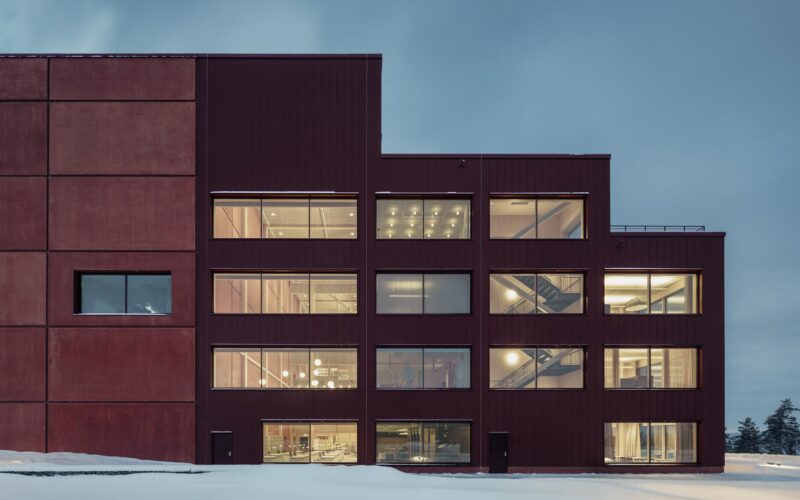
Set amidst the blue-tinged heights of Höga Kusten, the National Archives in Härnösand draws its identity from the surrounding landscape of pine forests, red granite, and wood. This new landmark is not just a repository of records but a bastion of democracy and a celebration of cultural heritage.

The artwork Behållarna by Salad Hilowle is carved into the wooden walls.

Located in Saltvik, north of Härnösand, the site boasts a commanding view of Älandsfjärden. Approximately 100 employees will work here alongside 258,000 shelf meters of archived material.

“Our vision revolves around timelessness,” says Pontus Eriksson, lead architect at Tengbom. “Sustainability and openness are core values in this project. We designed a timeless structure linking the archival section with an office building through an atrium and a welcoming visitor area.”

A historical site modeled in 3D

The exterior design combines classical aesthetics with a modern touch. The archive section, constructed of concrete, ensures compliance with fire and climate control requirements and allows for future expansion.

“This is a substantial building set in a sloping natural landscape,” explains landscape architect Jenny Söderling. “We used 3D modeling extensively to ensure it integrates harmoniously and sustainably with its surroundings.”

The interplay between the building and the landscape is further emphasized in the facade design and the patterned paving.

Höga kusten’s red granite

The concrete incorporates Ångermanland’s red native stone, Nordingrå granite. Its red hue is visible from a distance, guiding visitors to the right place. The surrounding landscape is reflected in the interplay between the building and nature, both in the facades and the repetitive patterns on the ground.

“Incorporating local stones into the paving brings Höga Kusten’s rugged cliffs to life,” adds Jenny. “Irregular stone slabs were used in the paving, evoking a sense of nature breaking through the structured surfaces.”

Warmth in wood and greenery

Contrasting the concrete archive section, the office portion features wooden construction with a glulam facade stained in reddish tones.

“Tengbom has beautifully captured the essence of our natural surroundings,” says Håkan Viklund, Project Manager at the National Archives. “It’s a landmark for both Härnösand and the entire region.”

The exterior features a diverse range of natural elements and vegetation, with green spaces around the building designed to mimic nature. Rain gardens—lush, soft areas—will manage stormwater and provide contrast to the harder surfaces used for heavy transport and deliveries. A layer of crushed stone and gravel softens the parking area.

Climate-smart and high-tech at the National Archives

Solar panels, green roofs, and the aim to certify the National Archives under the Miljöbyggnad Guld standard are key components of its sustainability ambitions. High-tech solutions ensure optimal indoor climate control and fire safety. The Swedish Tax Agency will also share the premises, allowing two government agencies to work flexibly under one roof. The public area on the ground floor includes an auditorium, conference rooms, and a four-story reading room.

“This is a response to the pandemic. Many government agencies are now rethinking their spaces to accommodate hybrid meetings, hybrid work models, and the ability to offer remote work,” explains Håkan Viklund. “Personally, I’m glad we can still meet in person, and Tengbom has made that possible for us.”

A democratic memory bank

Archives may seem outdated today—are we really still collecting paper? Yet, under Swedish constitutional law, archives are a vital tool for ensuring public transparency. Making materials accessible and digitized also supports research and development.

“In today’s world, where democracy is under pressure in many places, an archive is a democratic institution,” says Pontus Eriksson. “It preserves the world, serving as a cornerstone of democratic society.”

Contact person

Pontus Eriksson

+46 8 412 52 60

Inre Hamnen pergola

37 meters of room within a room
Landscape
Parks, Play & Public Spaces, Residential environments
Client: HSB Östra
Assignment: Residential courtyard, Inre Hamnen, Norrköping
Construction years: 2023-2024
Contractors: Tegelstaden, Bygg & Schakt
Photography: Jansin & Hammarling

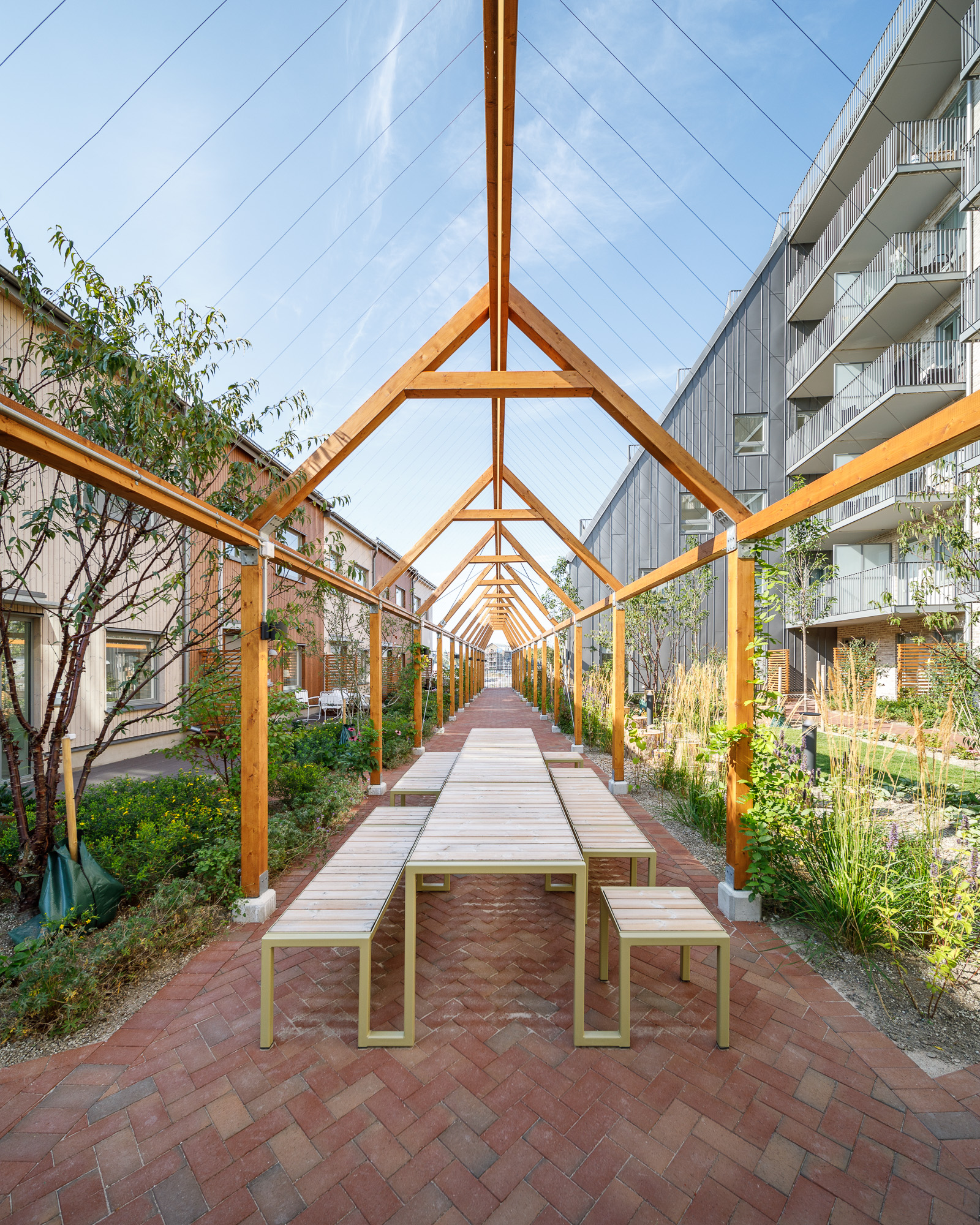
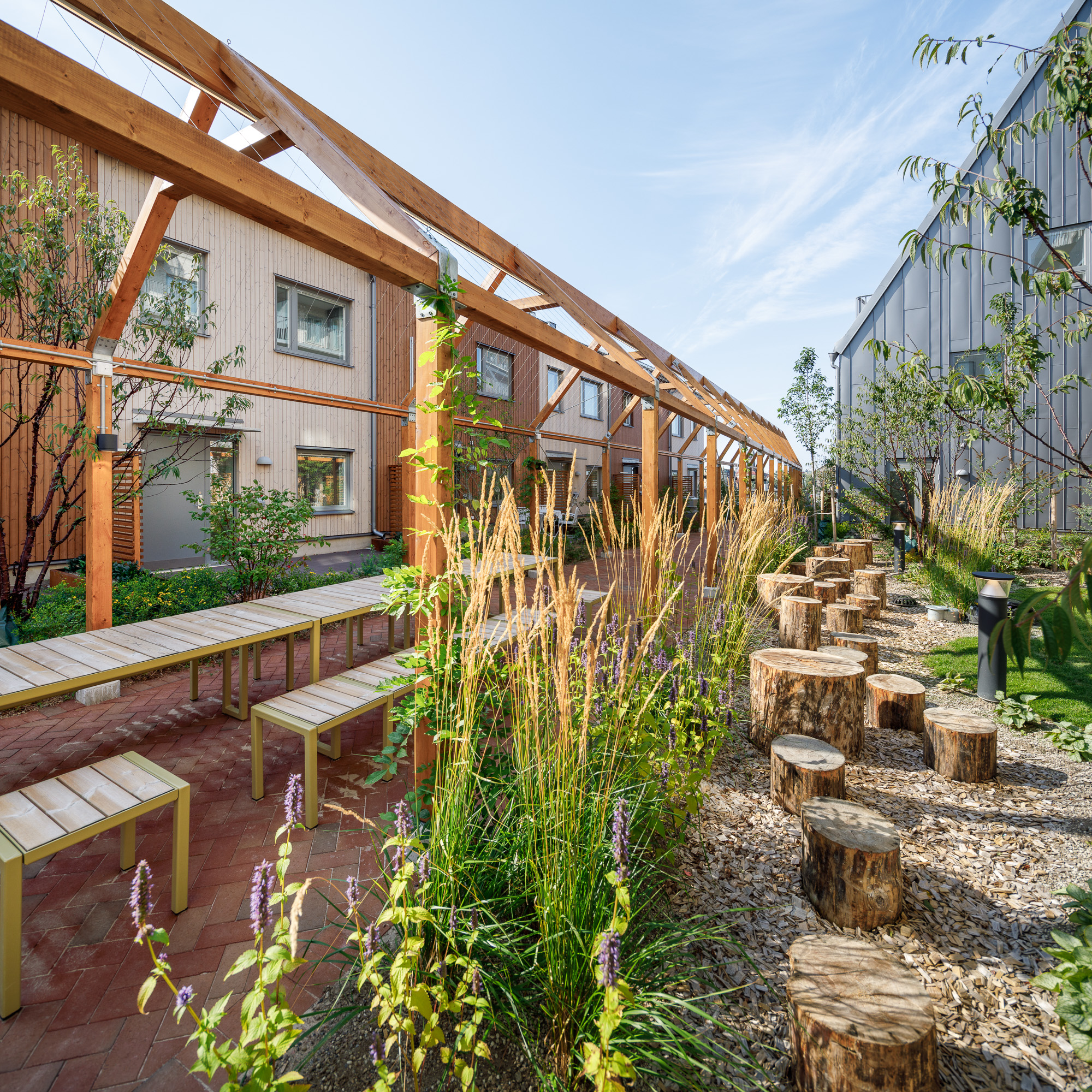
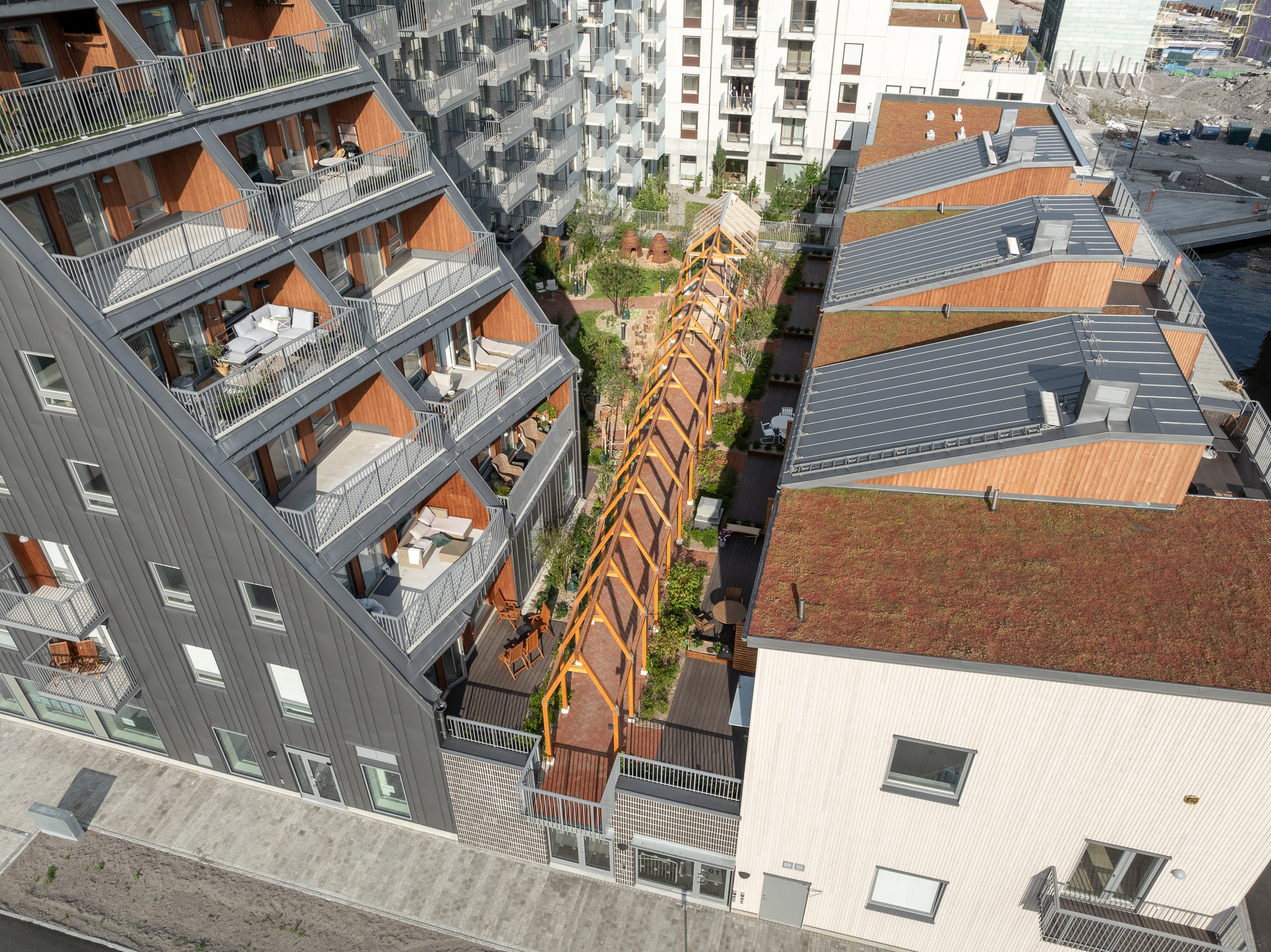
Can a pergola define an entire courtyard? In Inre Hamnen, Norrköping, a playful 37-meter-long wooden pergola now stretches across a residential courtyard. Acting as a central feature, it connects different parts of the courtyard and encourages festivities, relaxation, gardening, and long evenings filled with conversation. Simply a shared green room.

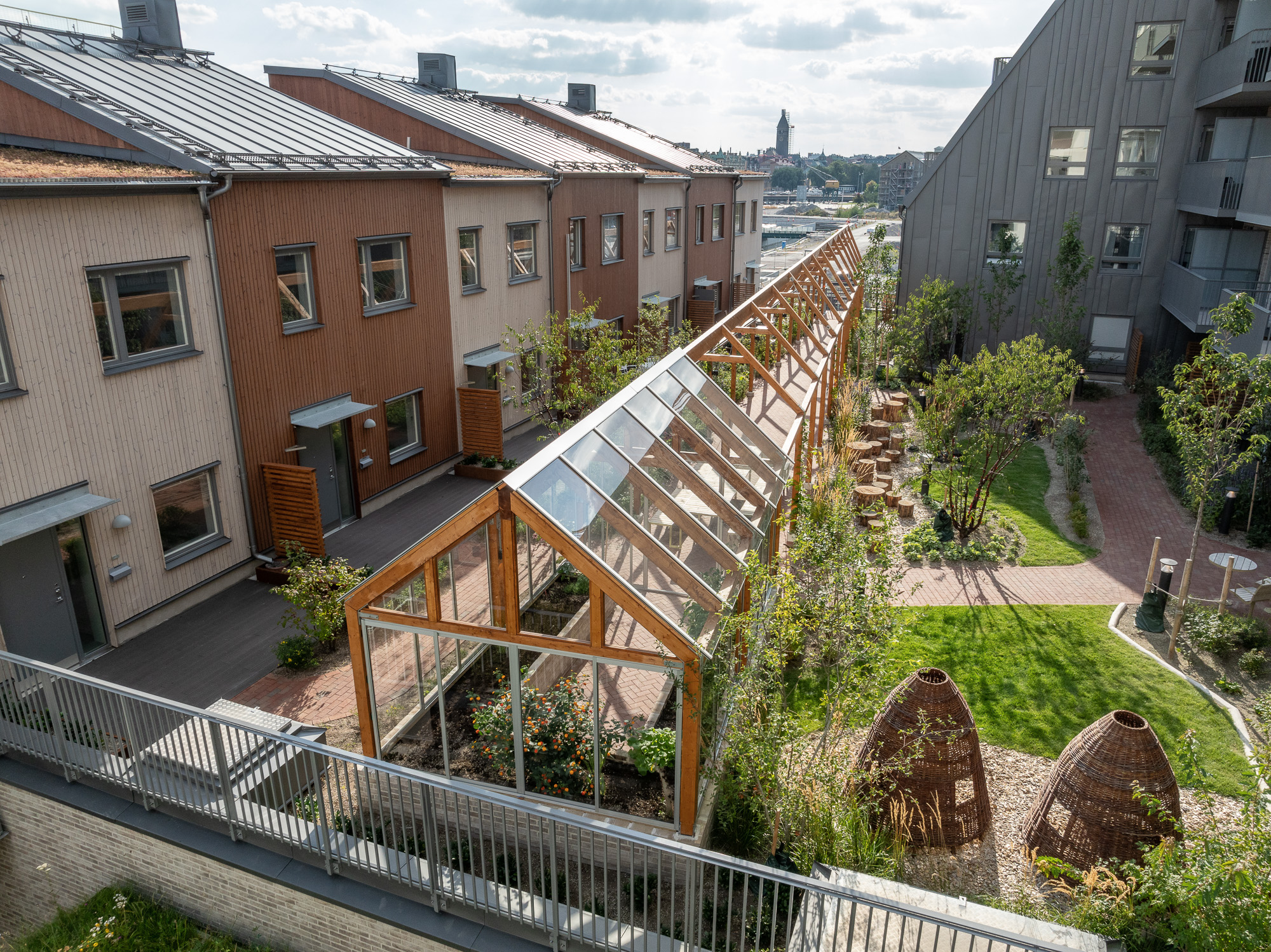
As one of Norrköping’s newest neighborhoods, Inre Hamnen is rapidly taking shape. Among the first completed buildings, Tengbom’s landscape architects in Linköping designed a verdant courtyard situated four meters above ground, overlooking a park and water. At the heart of this courtyard stands a 37-meter-long pergola made of solid pinewood. A striking centerpiece that serves as both a privacy shield and a meeting place.

The core of courtyard life

“Our aim was to create a unifying element for the courtyard that provides privacy between the houses but also serves as an obvious gathering spot for the residents,” explains Helena Hasselberg, lead landscape architect. “The pergola is a playful addition inviting various activities, from parties to relaxation and gardening.

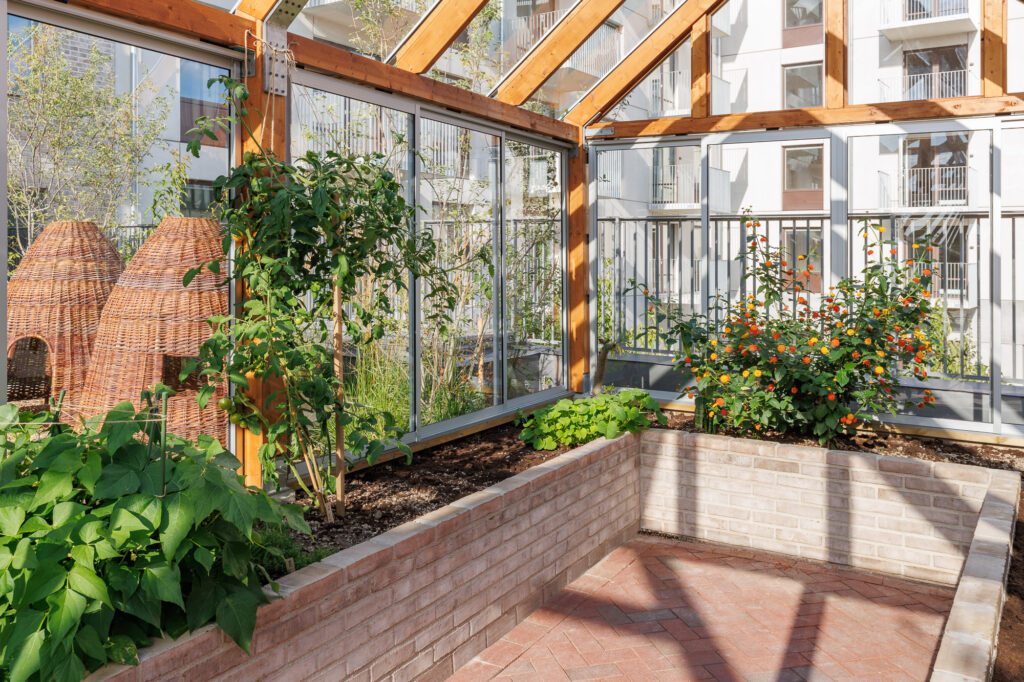
Eastern end: a greenhouse in use

The pergola’s eastern section is enclosed in glass, functioning as a greenhouse. Residents have already begun cultivating and harvesting crops. The structure also houses a long table for communal meals and courtyard parties. The western end concludes with a balcony offering scenic views of Inre Hamnen’s waterways.

A playful visual experiment

Constructed from untreated pinewood and treated with tung oil to maintain its warm tone, the pergola’s design plays with proportions. Its saddle roof gradually rises, becoming taller and narrower towards the west, creating a captivating visual effect while blending seamlessly with the courtyard’s architecture.
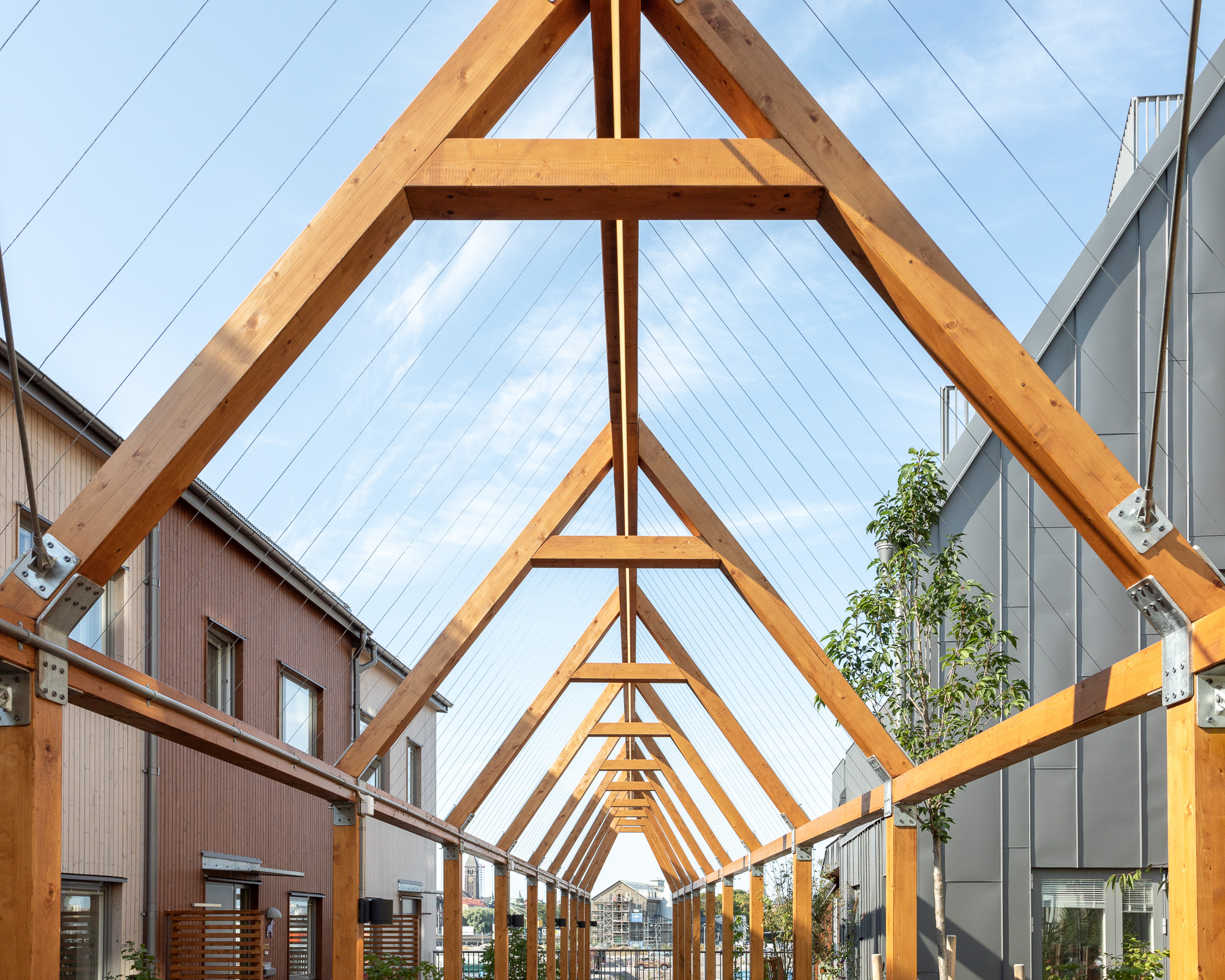
“Working with a design without right angles was a fascinating challenge,” says Helena. “We collaborated with a structural engineer for calculations, especially for the intricate glass sections of the greenhouse. Almost every part of the pergola is unique.”

Bringing the sketch to life

The courtyard itself features lush greenery and winding paths made of clay bricks, leading to seating areas and play zones. Children can jump on wooden stumps, explore small hideouts, or watch adults tending plants in the greenhouse. Ground-floor apartments with private patios add to the lively atmosphere, encouraging neighborly interaction over garden beds and outdoor coffee breaks.

“The elevated courtyard with the pergola is a unique selling point of the project,” says Per Nordin, Head of Construction and Real Estate at HSB Östra. “It’s an aha moment for first-time visitors. The pergola shapes the courtyard into a social space while providing privacy for individual entrances and patios. Tengbom has done a fantastic job designing a courtyard that adds significant value to the entire project.”

With sustainable materials and a thoughtful design addressing both scale and function, the pergola sets a new standard for future courtyards in Inre Hamnen.

Contact person

Helena Hasselberg

+46 13 35 55 34

Lindö Strand

Nature-inspired recreation
Lindö strand
Landscape
Parks, Play & Public Spaces
Client: Norrköping Municipality
Years: 2018–2021
Contractor: Svevia
Construction period: 2020–2021
Awards and recognitions: Nominated for Östergötlands Arkitekturpris 2024
Photographer: Patrik Ekenblom

Lindö Strand in Norrköping is expanding with new housing, making it the perfect time to revitalize and enhance the area. With Tengbom’s landscape architects, the site has transformed from forgotten play equipment and abandoned football fields into a beloved recreation area for people of all ages and during every season.

Lindö Strand is a popular destination for both visitors and residents of Norrköping. It’s where the city meets the sea. The beach and marina invite activities and relaxation, and it’s easily accessible from Norrköping’s city center.

“Our mission for Lindö Strand encompassed the development of the park, square, and beach, with a particular focus on play and activity values,” says Helena Hasselberg, lead landscape architect.

By working with the natural conditions and qualities of the site, the ambition was to integrate the old and the new in an exciting yet natural way. A new town square connects to the pier. The park has gained new play and sports areas as well as additional trees and greenery.

Community engagement delivered results

The design of public spaces greatly affects how people perceive and navigate a city. Input from community dialogues led to the integration of new functions at Lindö Strand, aiming for a cohesive experience prioritizing accessibility, safety, and inclusivity. A key aspect of accessibility was avoiding special solutions specifically for individuals with disabilities.

“We wanted to make the entire area as accessible as possible for everyone,” Helena explains. “The goal was to create activities for all ages, along with quiet spaces for rest and recovery. Everyone should find their place, regardless of gender, age, or interests.”

Safe environments with improved lighting

Good lighting with illuminated activity zones and walkways was also crucial for accessibility. Clear sightlines and visibility create safe environments.

“Often, we work with perceived insecurity—how people feel about moving through an area,” says Helena. “An area can statistically have low crime rates but still feel unsafe to many.”

By using gradients of light, we avoided harsh contrasts between lit and unlit areas.

Strong contrasts between light and dark make it harder to see in darker areas, creating a sense of insecurity.

A new square brings the area together

The new square by the water serves as a hub linking the area’s different parts. The hope is that Lindö Square will become a gathering place where people can meet, enjoy a coffee, buy ice cream, or simply sit and take in the view. The square features a raised, star-shaped stage for events.

“When there’s no event on the stage, it becomes a generous seating area where you can sit facing different directions depending on what you want,” Helena adds.

Grill, train, or relax on the docks? You decide

From the square, the pier stretches northward, forming a boundary between the marina and the beach. Along the waterfront, the Stråket walkway passes the marina, the square, and continues eastward. Along the way, you’ll find sports areas for basketball, floor hockey, boules, and beach volleyball. The beach features a dock now accessible to everyone. Further east, the walkway leads to outdoor gyms and barbecue spots, where new circular docks invite rest and socialization.

“It was important to use materials that harmonize with the site, such as wood, galvanized steel, and mulch,” says Helena. The turquoise accents also recur in structures within the marina.

Find solitude in the treehouse

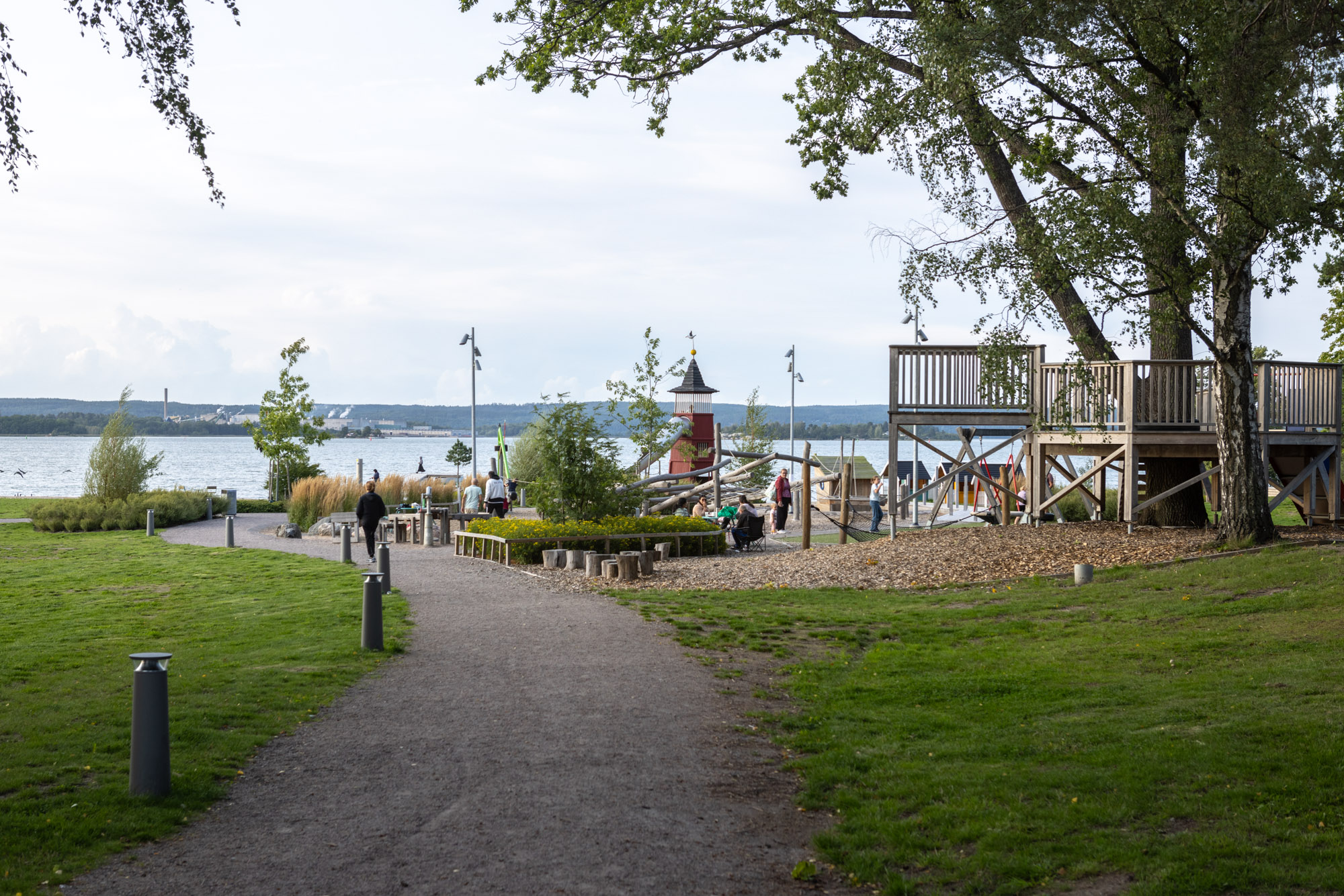
The play area is located on the edge of the open grassy field and forest in the southeast. Its maritime theme with lighthouses, boats, docks, and boathouses connects to the seaside location. Larger trees provide shade and create “islands” between the play features.

“You can swing, climb, slide, or crawl up into a treehouse for some quiet and privacy,” Helena shares.

The ground materials include sand, mulch, and rubber asphalt. Wooden walkways link or separate these materials. In the water play area, water is pumped and channeled through a stone-lined creek back to the sea, connecting play to the beach.

At the forest’s edge, enticing trails with birdhouses, insect hotels, and balance paths encourage natural play, such as building dens or other adventures.

Lindö strand lekyta

Insects and greenery for biodiversity

West of the play area lies Lind-ön, a raised circular area with five species of linden trees, tying the space to its name.

To enhance biodiversity, birdhouses, insect hotels, and deadwood have been added.

“During a visit to Lindö Strand for a photo session, we met a family from outside the area who were grilling by the dock. They shared how they often come here because it’s so pleasant now,” Helena recalls. “That’s exactly what we hoped for – it’s very rewarding.”

Contact person

Helena Hasselberg

+46 13 35 55 34

Fornudden School

Building in a park
Architecture, Landscape
Education
Client: Tyresö Municipality
Location: Tyresö, Stockholm
Assignment years: 2015-2021
BTA: 11 000-12 000 sqm
Photographer: Felix Gerlach

Access to the park and flexible spaces on the ground floor that can be used by the general public add a distinctive touch to the new Fornudden School. We combined landscape architecture and pedagogy to design the building and site at the north end of Fornuddsparken in Tyresö, southern Stockholm.

Fornudden
The stairs to the second story double as a gathering place with bleacher-style seating. This feature is part of the scaffolding and sunshade that runs along the building’s southern side.

Tyresö is growing and becoming denser, making a new school essential. Fornudden’s new school and schoolyard opened in fall 2021. Children from preschool to year nine now have access to a full-sized athletics center. The design of the ground floor and athletics center allows for use by the wider community, even outside school hours.

Fornudden

Blending into the park

The school is a backdrop and clear delineation point to Fornuddsparken.

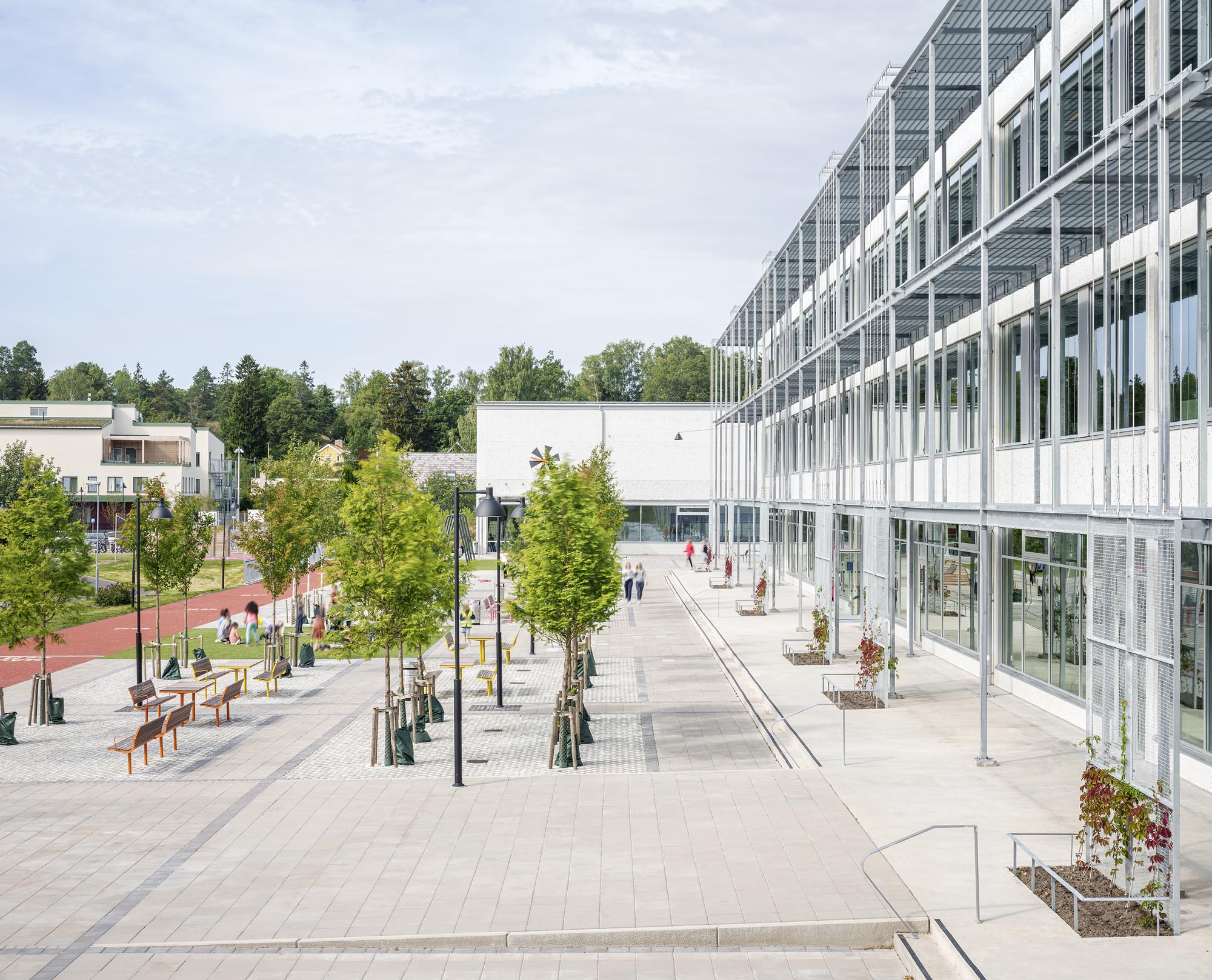
Fornudden School and the separate athletics center are situated in the heart of Fornuddsparken. We aimed to weave the building, schoolyard and park together with a more rigid design near the houses and street that loosens up as it merges with the park. Among other ways, this is evident through the precision of the trees lining the street and the checkered pattern on the ground. Planted areas meander from the park into the schoolyard. The sunken areas between the retaining walls have playground equipment, while the understated spaces encourage spontaneous socializing among older students. To prevent the parking lots from disturbing other activities, they are partially concealed behind short walls and planted areas. A lighting designer developed the lighting concept to create a welcoming atmosphere and an enhanced sense of safety.

“Getting the building to blend in with the park was a major design task,” explains Lina Swanberg, Studio Director Education/Heritage at Tengbom. Part of the solution was the visual scaffolding out toward the park, which breaks up the scale and dissolves the boundary between indoors and outdoors. It also serves as a trellis for climbing plants, which helps the school merge with the park setting and provides some sun protection outside. The school provides a backdrop and a clear stopping point where the park borders Gärdesvägen road.

Good athletics centers are valuable

Fornudden
Large glass panels in the classrooms have kid-friendly windowsills that welcome in the green surroundings – outside moves in, and inside moves out.

Education indoors and out

The pedagogical design facilitates education in several ways. The teaching spaces vary in size, from traditional classrooms to smaller group rooms and study spaces. There is also a mini auditorium with a stage and riser seating where students can perform and present to one another, or gather in large groups for film screenings as an after-school activity.

The team planted a school garden with fruit trees and berry bushes facing the park. The garden and outdoor stage serve as examples of outdoor educational features.

Fornudden
Common functions and spaces, like the cafeteria and the library, are located on the first floor and near the main entrance.

A safe setting for kids and adults

“So much of designing a school is about creating a safe work environment for staff and kids,” explains Lina. “We’ve focused on safety, with the presence of adults near the entrance, where we’ve located the library, cafeteria and administration. Glass panels offer transparency and safety, and make it easy to see which rooms are available and which are occupied.”

The materials are robust and simple. Inside, the false ceiling consists of aluminum slats. The terrazzo concrete exterior with black diabase creates a soft, friendly façade and entryway. This look is echoed in the speckled painted walls indoors. Birch plywood and industrial parquet cover the walls and floors. Pops of yellow, red, and pink add accent colours. The floors are soft for tumbling children. Low windowsills offer views of the park’s treetops from the classroom.

Fornudden
View towards the entrance and the café.

Flexible use

Flexibility has guided the project from the start. The design allows the ground floor to function beyond school hours. The library, mini auditorium, and craft rooms welcome the general public and other organizations when needed.

“In particular, the full-size athletics center needed to be accessible outside school hours,” explains Lina. Afternoons, weekends, and holidays should provide opportunities for use. Many municipalities benefit from good athletics centers, but some remain empty because their design doesn’t support independent use.

Contact person

Mark Humphreys

Practice Director Stockholm
+46 8 412 53 43

Bergius Botanic Garden

A chlorophyll-filled assignment
Cultural Heritage, Landscape
Accessibility, Culture, Heritage Expertise, Parks, Play & Public Spaces, Renovation & Transformation
Client:
Year: 2019 -
Area: 60 hectare
Assignment type: General consultant assignment
Builder and partners: Statens Fastighetsverk
Photography: Felix Gerlach

A plant museum. That’s one way to describe Stockholm’s Bergius Botanic Garden, where Katarina Enekvist at Tengbom is in-house architect on behalf of the National Property Board of Sweden. Here, you can visit the giant Victoria water lily, learn about everything from Nordic to tropical plants, or simply give your eyes a momentary break from the asphalt.

The Italian terrace gives space to Mediterranean flora.
View of Brunnsviken from the Italian terrace, one of the garden’s most important vantage points.

Science, botany and relaxation. The beautiful scenery of Bergius Botanic Garden is located near Brunnsviken beach in Stockholm. Visitors can discover plants from around the world: fruit and berry orchards, as well as plant taxonomy areas that show how the plants are related.

In-house architect who puts valuable environments to use

Katarina Enekvist, Restoration Architect at Tengbom, has been an in-house architect for Bergius Botanic Garden since 2019. She has many years of experience leading complex assignments in environments of cultural-historic value. As an in-house architect, it is not enough simply to be skilled in design, or to have knowledge of cultural history. It is also important to balance the historic environment with today’s demands.

Since the year 1900, the Victoria House has vaulted its glass dome over an imaginative tropical world.

Preserve and improve with subtlety

The world’s largest water lily comes from the Amazon but now also has a home in the pool in the Victoria House.

The assignment of in-house architect entails long-term responsibility. And a great deal has already happened since 2019. The team has developed the old Utsiktstornet lookout tower to bring the authentic nineteenth-century environment to life. At Victoria House, they have reviewed the construction and carried out maintenance on the glass. They will restore the garden director’s overgrown garden by the Bleket building. Workers have made difficult-to-access areas of the garden accessible by installing new, specially made iron railings and restoring the stairs and walkways. The team has created a project plan for Naturens Hus in Finnstugan, an educational space for schools and kids. Designers will clarify Bergius Botanic Garden’s various entryways with a new design, and sketches are in the works.

Builders constructed the old orangery in 1926 for the garden’s tropical plants. Today, it houses a popular restaurant.

Maintenance of the grounds and wooden buildings

In addition, working in collaboration with tradespeople and painting conservators, Katarina Enekvist has carried out antiquarian reviews and consultation on the restoration and maintenance of all wooden buildings at Bergius Botanic Garden. This work has resulted in an important knowledge base, including a care program for the grounds and buildings.

“The garden should be a place for everyone, with a connection to both the past and the present. I look forward to continuing to contribute to developing this place,” says Katarina Enekvist.

Bergius Botanic Garden and Brunnsviken seen from above.
Bergius Botanic Garden, the Stockholm Botanical Garden and the Royal National City Park.

Contact person

Mark Humphreys

Practice Director Stockholm
+46 8 412 53 43

Uddevalla Golf Club

A golf course for everyone
Landscape
Sports
Client: Uddevalla Golf Club
Location: Uddevalla
Assignment years: 2014–2015
Project:: Golf course
Collaborators: Swedish Golf Federation

According to Uddevalla Golf Club’s mission, everyone should get the chance to play golf, no matter their physical ability or disability. For that very reason, the club has spent many years working on making the golf course more accessible. Their goal is to become Sweden’s, and maybe even Europe’s, first fully accessible golf course.

We are proud that we were able to partner and collaborate with the golf club throughout the entire project. The project in Uddevalla began in 2014, at which point we predominantly worked on the planning and design of the golf course under the direction of golf course architect, Johan Henrikson, as well as contributed to issues of accessibility thanks to our certified accessibility competencies . The new golf course was completed and ready to use for golfers in the 2015 season.

Uddevalla Golf Club

Modern and exciting design

Our challenge was to change parts of the layout and create new green spaces for the 18-hole course using qualitative architecture. The greens needed to provide an optimal golfing experience, while also meeting accessibility requirements. We got a lot of help from golfers and experts with disabilities from the Swedish Golf Federation in order to have a more holistic picture of how to make our course more accessible without losing any attention to detail in its design. With the new green spaces, the course feels fresh and exciting, while also meeting all accessibility requirements. The experience that visitors have is vital to us, regardless of ability or disability.

Accessibility was engineered into every inch of the golf course, from the parking lot and the restaurant, to the golf course itself.

Uddevalla Golf Club

An Uddevalla Golf Club that’s accessible to everyone

Everyone should be able to enjoy and use the Uddevalla Golf Club. The team has designed accessibility into every inch of the club, from the parking lot and restaurant to the golf course itself. They have adapted paths, spaces, and slopes to improve accessibility, with a strong focus on clear signage. Everything should be easy to find, and everyone should receive great service. The project was partially financed by funds from the Swedish Inheritance Fund. By completing the work in stages, the team ensured that golfers could continue playing throughout most of the construction process.

Contact person

Johan Henrikson

Golf course architect
+46 31 761 64 27

Hemvärnets Park

A green slalom course for everyone
Landscape
Parks, Play & Public Spaces
Client: Norrköpings kommun
Location: Norrköping
Assignment years: 2015-2018
Building years: 2019-2020
Photo and video: Patrik Ekenblom

When life gives you lemons, make lemonade. If your job is to make a public park out of a gravel hill in a densely populated part of town, make a slalom course filled with life, plants and fun. Today, the area between the old industrial neighborhoods and the newly built apartment buildings in central Norrköping is a verdant place for outdoor gatherings and activities. Say hello to Hemvärnets Park.

Densely built apartment buildings with very few playgrounds and green spaces dominate the area south of Holmentorget in central Norrköping. Naturally, Hemvärnets Park needed to meet many needs, with accessibility for everyone as the top priority. One major challenge was the 7-meter north-facing slope between St. Persgatan and Kvarngatan, which significantly impacted accessibility. Another challenge was an old graffiti-covered transformer station that was too expensive to move.

Hemvärnets Park
Aerial view of the park, viewed from the north.
Hemvärnets Park
The “prairie” with jumping stumps, and the fountain on the right.

“Sometimes, the limiting features of a site can actually be a good thing for creativity. That was the case here,” says Helena Hasselberg, project architect at Tengbom. Instead of seeing the lack of flat ground as a problem, that feature became the backbone of the park’s design. A slalom course with some expertly placed shortcuts was the solution.

A serpentine path encircles each level of the park

By designing the park as a large, winding slalom course or a switchback, we created a path down the slope that never gets too steep, for example, for a wheelchair. At the same time, anyone in a hurry can take the stairs as a shortcut. Retaining walls, lined with greenery, chisel out the different levels that are all encircled by the winding path. These levels form unique spaces with varying features. In the entry space, there’s a fountain that people can splash around in on a hot day. There is a prairie with tall grass, perennials and jumping stumps. Higher up there is a larger grassy area for lounging, as well as two play areas with different features.

No one is left out – the park is meant for everyone

The idea of a park for everyone guided the brainstorming process around the graffiti-covered transformer station. By making the roof flat, we transformed it into a raised platform. A walkway leads up to a tube slide that takes you back down to ground level. Who doesn’t want to run around, then up to the raised platform, and then down the tube slide? Just like with the area’s natural slope, the transformer was turned into an opportunity rather than a problem.

Hemvärnets Park
Jumping stumps in “the prairie grass”.
Hemvärnets Park
The raised platform on the old transformer roof with a tube slide down to the lower play area. The stairs in the foreground connect the two play areas.

Hemvärnets Park – a popular meeting spot

Trees and vegetation line Hemvärnets Park. We deliberately avoided planting tall trees in the middle of the park to keep the beautiful industrial landscape visible. Along the serpentine path, we placed evenly spaced benches, each facing a different direction and offering a unique view.

Hemvärnets Park
The central part of the park viewed from the west.

Contact person

Joao Pereira

Practice Director Kalmar and Linköping
+46 708 79 99 38

Mimer’s Staircase

A staircase weaving together the past and the future
Landscape
Culture, Education, Parks, Play & Public Spaces, Squares & Streets
Client: Akademiska Hus, KTH Campus
Location: Osquars backe, Mimir’s Staircase KTH Campus, Stockholm
Assignment years: 2018-2021
BTA: 550 sqm
Photographer: Jansin & Hammarling
Collaborators: Bosse Ericsson, Ahrbom and Partners. Henke Gustafsson, uk, Ahrbom och Partners. Per Tinglöf och Nikki Bone, Ramböll. Claes Reichmann, Reichmann Antikvarier AB. Christer Kjellén, Stenutveckling Nordiska AB.

A staircase isn’t just a passageway — it’s a meeting place, a transition between two places, the bleachers of life. With that outlook in mind, we designed Mimer’s Staircase at the KTH Royal Institute of Technology as a place built around students’ behavior.

A wide bicycle ramp runs along the staircase’s raised terrace.

I think stairs may be one of the most emotionally-malleable physical elements that an architect has to work with. Those are the words of the architect David Rockwell in his TED talk, The hidden ways stairs shape your life”. At KTH, that theory rings true in every sense.

Mimer’s Staircase
The staircase’s flat slope and elongated design leave an unobstructed view towards Alfvénsalen, KTH’s largest auditorium.

A staircase designed for hanging out and activities

How do you create a modern, yet classic staircase that complements and celebrates KTH’s rich architectural history and student life?

“Tengbom has a long tradition of working with cultural environments. But this time, we flipped the process and started the project from the user’s perspective,” Nejra Lagumdzija, Pia Englund and Hannah Marschall, the brains behind the project, explain.

Mimer’s Staircase
Together with the landings and the granite cladding along the lower section, the varying facades, terraced ledges, and steps form a quilt-like pattern. This result comes from meticulous attention to detail in every corner, surface, and colour.

Mimer’s Staircase replaces a short, old building between Sing-Sing and the main building that previously blocked both traffic and sunlight. The staircase is a place for hanging out and for creativity and activity.

“The large field at the top of the stairs by Sing-Sing is a heavily trafficked spot, especially for architecture students. They use the field to make large-scale models and display prototypes. They also gather there for meetings and events. We hope that they will use the terraced steps of the staircase as podiums and let activities and events spread across the stairs and down towards Osquars backe,” explains Pia Englund, lead landscape architect.

Attention down to the smallest detail – tradition meets innovation

Every inch of the staircase, which is an expression of Modernism in itself, is built with the highest quality. The Swedish granite anchors the staircase in the country’s historical heritage.

“The KTH campus is filled with amazing masonry. Since the staircase consists only of granite, our design approach has been to mix different types of granite with different treatments and colours, as well as use recycled stone from the campus to really bring the staircase to life. Almost like a colour palette where every hue serves a specific purpose,” explains Hannah Marschall, landscape architect.

Mimer’s Staircase
The overarching design concept, bidirectional angular architecture and funnel-shaped staircase, where the granite slabs connect the two buildings, both recognized for their cultural historical value.

Mimer’s Staircase features four flights of stairs, framed by terraced steps. These steps connect to the buildings on either side at a 90° angle, forming a funnel-shaped stairway. The result is a modern take on KTH’s traditional style, with incredible attention to both shape and materials. We designed the staircase with an elongated and flatter structure to maximize sunlight. This creates the perfect spot for activities, relaxation, and enjoying an unobstructed view of the surroundings and sky.

With a deep focus on materials, craftsmanship, and student life, we have created a place where old and new blend seamlessly.

It represents modern expression, skilled techniques, and timeless design.

Mimer’s Staircase
At night, soft spotlights and recessed lights illuminate the staircase along the lower section.

Awards and recognitions

Mimer’s Staircase got nominated for the Stone Prize in 2022.

Contact person

Jenny Söderling

Studio Manager Landscape
+46 8 412 53 95