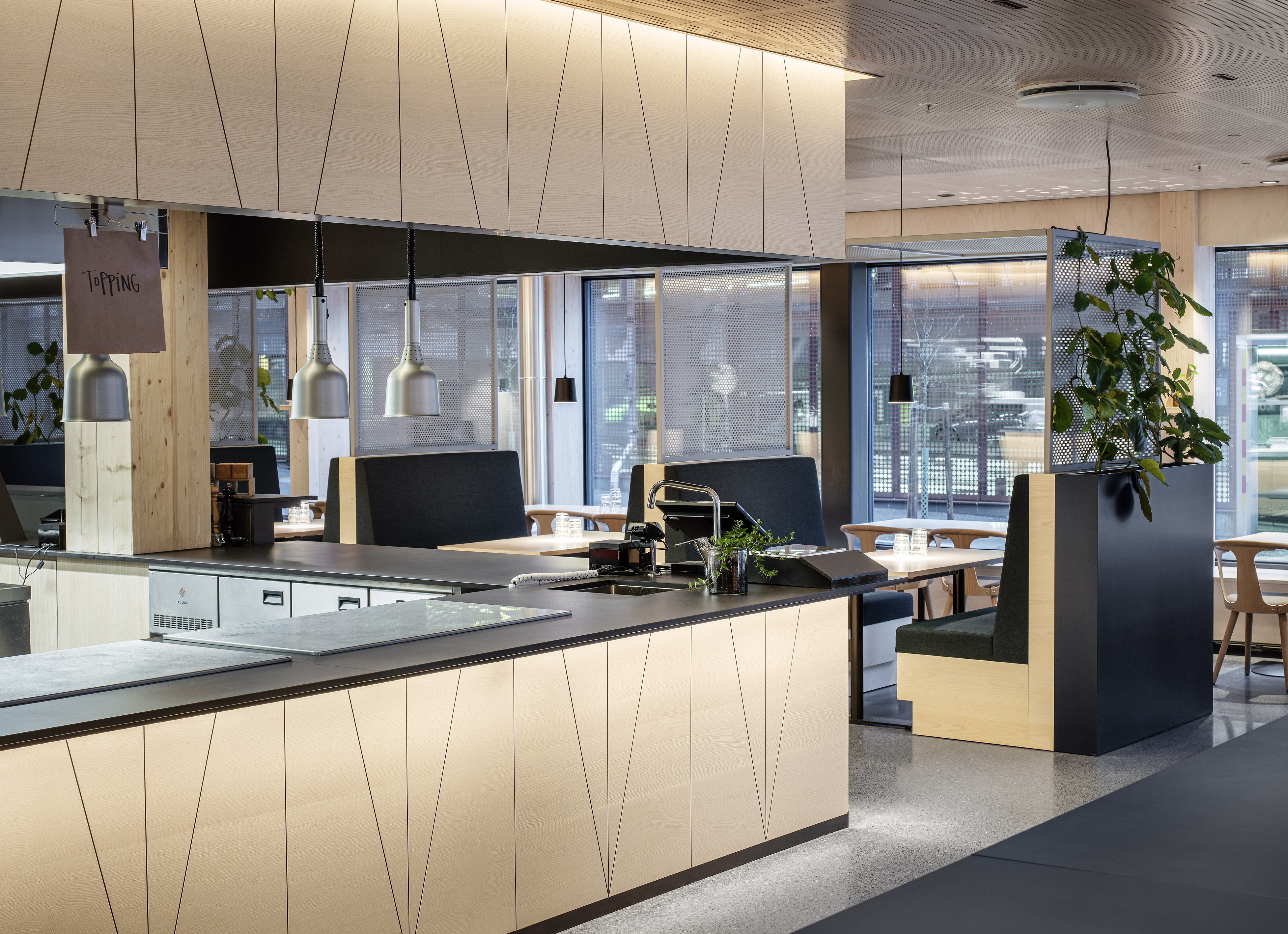
The Trikåfabriken building in Hammarby Sjöstad exemplifies how contemporary architecture can connect the past with the present while adding a new layer to the city’s history. In 2015, Tengbom won the architectural competition announced by Fabegé, and today, a completed hybrid building demonstrates how architects will need to work in the future.
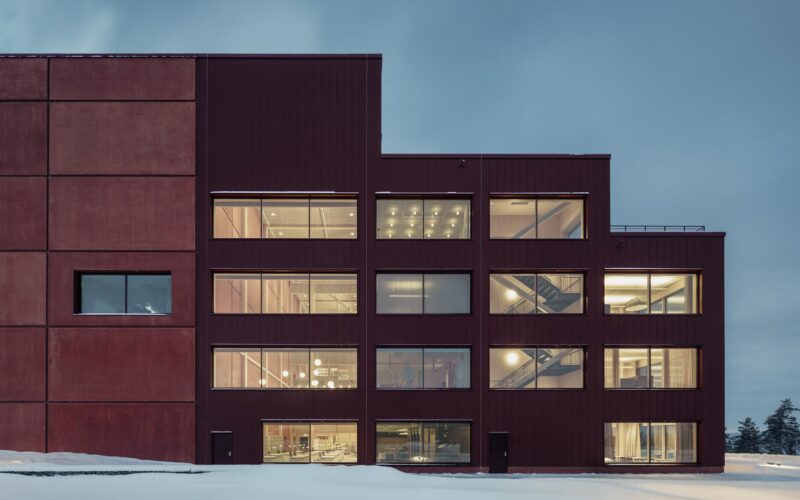
Trikåfabriken is located in Hammarby Sjöstad, in southern Stockholm. Photo: Felix Gerlach
A changing neighborhood
Trikåfabriken is a 25,000-square-meter office building located in the former industrial district of Hammarby Sjöstad, an area undergoing significant transformation. The building and its neighboring properties retain a distinct industrial character, which has been carefully preserved and highlighted in its redevelopment. The original brick structure from 1929 has been expanded with a five-story wooden extension. The project also included a complete interior renovation of the entire block. After demolition, only the structural frame of the original building remained.
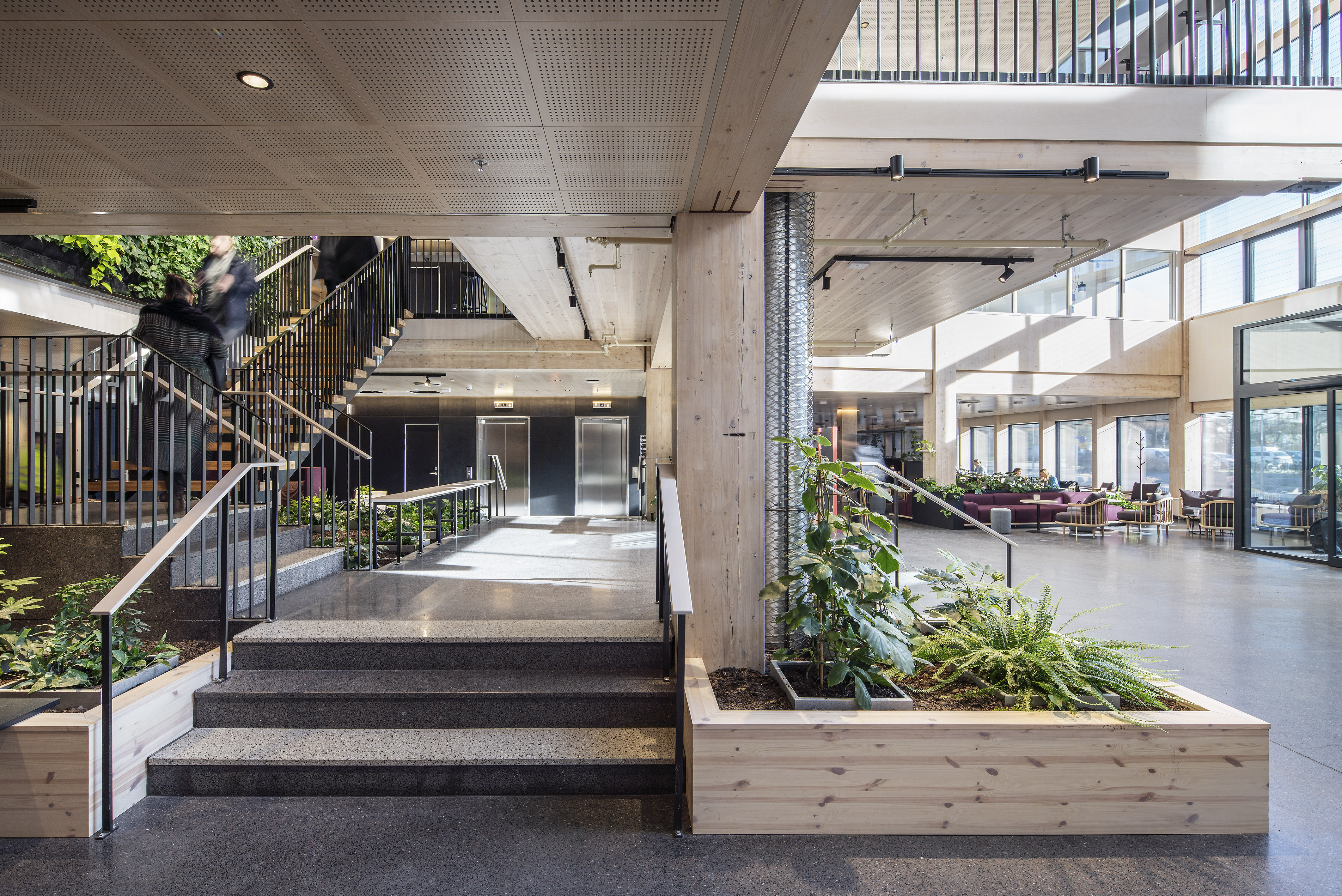
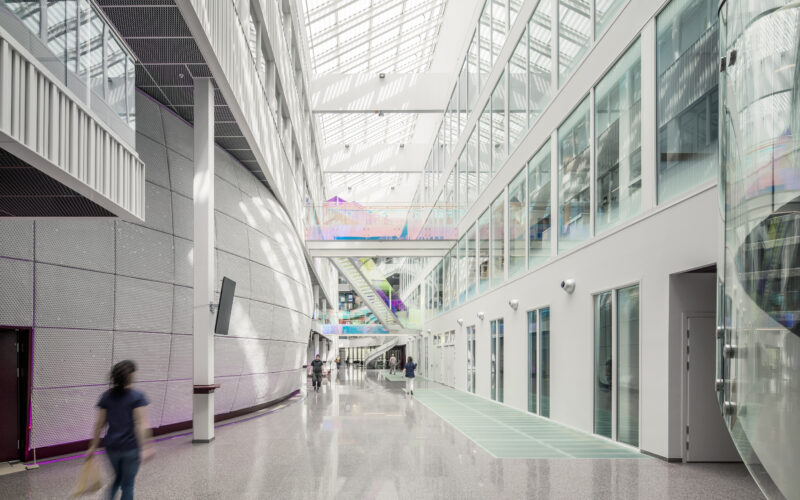
The team merged the previous separate entrances into one main entrance. The atrium now serves as the central hub for all tenants and welcomes the general public to the heart of the complex. Photo: Felix Gerlach
Central atrium
Entrances via bridges enhance flexibility. Photo: Felix Gerlach
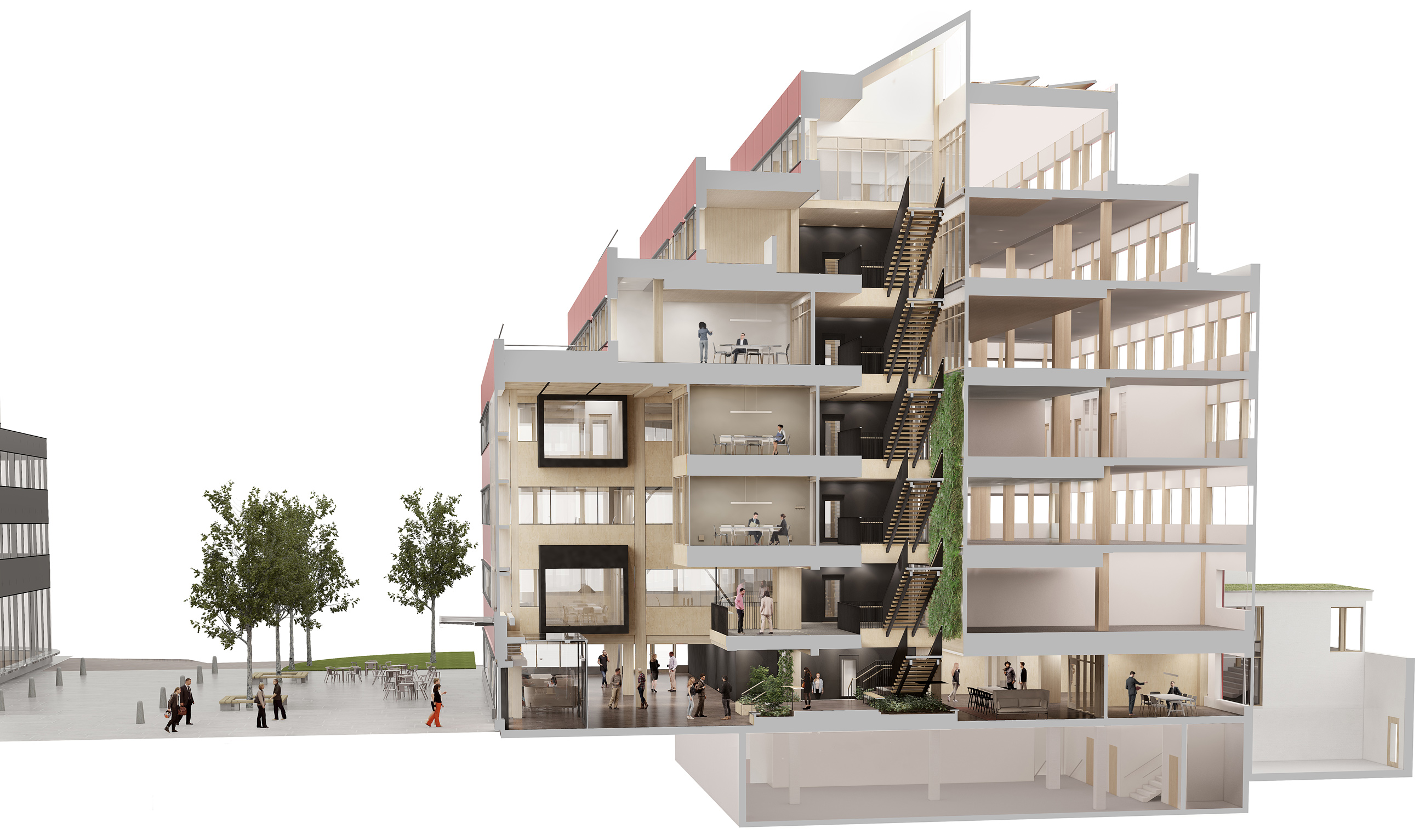
The design centers the building’s internal communication around a main staircase with elevators in the new atrium. To maximize flexibility, the team added bridges to each floor. These bridges provide views over the newly designed, plaza-like space.
All entries are accessed via these bridges, creating a dynamic setup for tenants who prefer shorter leases or need flexibility in their spaces. Co-working areas also act as adaptable zones, accommodating varying needs and functions between tenants.
Tengbom has provided tenant adaptations and interior design for the Swedish Environmental Protection Agency, Hyper Island, and the ground-floor café, Yume.
Wood is wonderful
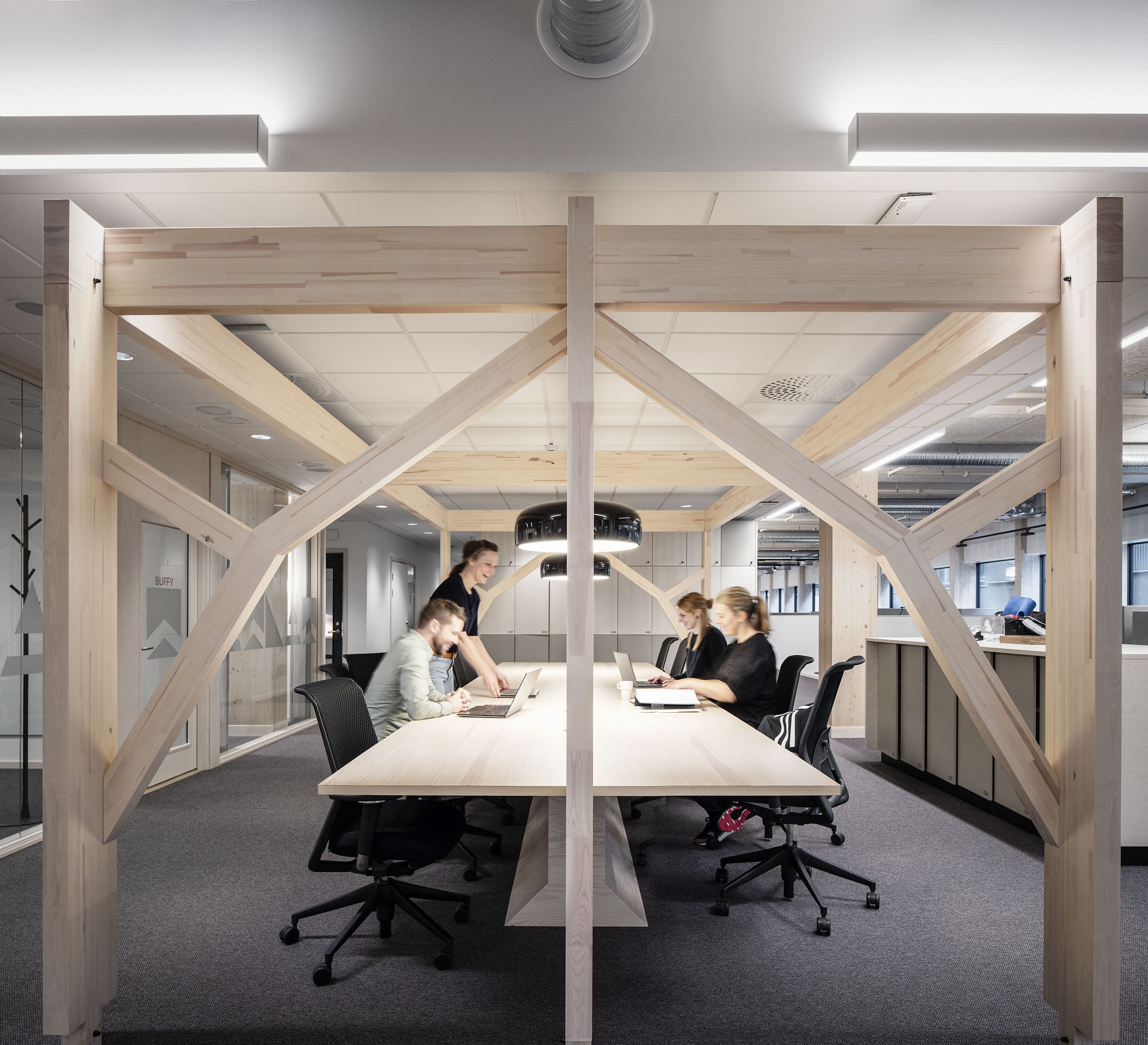
Wood is a prominent material in Trikåfabriken, offering both a tactile and educational experience. It reflects an honest design philosophy where nothing is hidden or artificial. The ambition is to make the connection between old and new as clear as possible, which is why the wooden framework is exposed internally and visible from the exterior, showcasing both columns and floor slabs.
Trikåfabriken’s wooden frame generates 50% less CO2 than steel or concrete would, and also helps balance indoor humidity levels. Photo: Robin HayesPhoto: Robin Hayes
Wood is sustainable
Wood is a material that most people can relate to, and many find it pleasant to interact with. Beyond giving Trikåfabriken a strong identity and character, it is, of course, an environmentally smart choice and a contributing factor to its BREEAM Very Good certification. A wooden framework binds carbon and is lighter than both steel and concrete, enabling a lighter extension that required less structural reinforcement.
Contemporary design in Trikåfabriken
The façade of the extension features corten steel, a material with a strong character. It complements the original brickwork without mimicking it. To highlight the connection between old and new, the design includes a visual break. An entire floor made of glass creates this separation.
The Corten steel roof and façade consists largely of recycled material and is maintenance-free throughout its lifespan. Photo: Felix Gerlach
Kitchens, Offices, Parks, Play & Public Spaces, Residential environments
Client:Wihlborgs Fastigheter
Contractor:
Peab Sverige AB
Location:
Lund
Years of commission:
2011–2014 (detailed plan) 2014–2017 (projection) 2016–2018 (tenant adaptions)
BTA:
16 500 sqm
A rolling concrete façade nowadays cradles train travellers to Lund Central Station. Here Tengbom has created a sought-after office space which varies both in architectural expression and relation to the site. Meet Posthornet office building.
On behalf of Wihlborgs Properties, Tengbom has confronted the challenge of building on a narrow plot of land close to Lund’s central station. The result is modern office space, which is very sensitively coordinated with housing in the neighbourhood. The office building, called the Posthorn, is what you might call a dream project. Here Tengbom, along with the architect responsible, Charlotte von Brömssen, has been the driving force from detailed plan to tenant adaptation.
We have decided for ourselves in this project what is the possibility and breadth of the architect’s role.
“We have decided for ourselves in this project what is the possibility and breadth of the architect’s role. Through timing and pedagogy, we have paved the way for the quality of the built project in a variety of ways. Here, a clear design manual has been an important success factor to focus on,” says Charlotte.
In addition to architecture and strategic advice, Tengbom has provided services in landscape architecture, interior architecture, visualisation and catering.
Head entrance facing the square.
Character and materiality
The neighborhood is designed to interact with adjacent urban spaces. It rises and falls in dialogue with surrounding buildings. The main façade faces Lund’s town hall and rail bridge, gradually sloping down toward the main entrance on the southeast corner. Inside the block, a narrow and semi-public space features a rounded design where various practical functions come together.
To generate interest in the site, the design team crafted a story for the property owner. They chose the postal horn and stamp as symbols, inspiring the façade’s design language. Brass became a recurring material, while the yellow brick connects to the surrounding 1940s architectural style.
Well-arranged for tenants
The extent of Tengbom’s assignments has ranged from following up on the building on site to coordinating the work of tenants. We drafted contract and building documents for all tenants, and coordinated interior design projects. Tengbom also made the décor for three of the tenants: Folktandvården, Trivector and the law firm Trägårdh.
We have designed an extension to the Alingsås District Court from 1899, clad entirely in zinc. The jury for the PLÅT prize considered that it was so spectacular and unique that they gave us the award. What do you zinc?
Architect Adrian Crispin Pettersson designed the District Court in Alingsås, a classic brick building from 1899. It stands a few blocks from the town centre, surrounded by large villas and a school from the early twentieth century. In the late 1950s, a brick wing was added. Just over half a century later, Tengbom designed the next extension. Another milestone in Alingsås District Court’s history came in 2016 when we won the PLÅT prize for the new zinc-clad addition. The annual PLÅT seminar is a major event dedicated to metal sheeting and architecture.
Photo: Felix Gerlach
We joined the project after it was already underway, when a brick extension by architect Börje Falemo had been proposed. The District Court, however, wanted to explore alternative facade solutions, giving us the opportunity to present a design based on the existing floor plan. Drawing inspiration from the surrounding buildings with their steep roofs, we proposed a structure with a saddle roof and curved bay windows. With a compact plot and thin walls, it made perfect sense to extend the zinc sheeting from the roof down the facade, creating a sleek, protective outer layer.
“This design gave us both flat and steep roofs, so we needed a material that could handle both — leading us to zinc. The old building has thick, solid walls, while the extension relies on thinner curtain walls. Here, zinc sheeting worked perfectly as exterior cladding. We could wrap the entire building in a single material, making it clear what was new and what was old,” says architect Fritz Olausson.
The result, a monolith in zinc, cannot be ignored. The sheeting accentuates the building’s shape and shows its own annual ring at the same time as it ages with dignity — much like a grey and wise judge.
Photo: Felix Gerlach
A contemporary take on traditional craftsmanship
“Zinc is a fine old classic material which was used extensively as roofing during the last century. We simply brought in down onto the facade and it fits beautifully with the granite foundation wall which is a common denominator for both buildings,” says architect Magnus Almung.
Even with its expressive form, the building maintains a restrained volume to avoid crowding the old one.
“The design represents our time, perhaps primarily thinking of the expressive volume. Monolithic buildings are typical these days with the same material for walls and roof. You can even see buildings without eaves. In the same way saddle roofs have come back into fashion in the past few years, something we didn’t see much of previously. The difference is perhaps that this building is constructed using craft techniques that are the same as at the beginning of the twentieth century. All the sheets are put up with great care and precision,” continues Olausson.
A living facade
The roof is clad with standing seam sheeting while the facades are covered with sheets of different widths placed in a set “random pattern” from base to ridge. Variation provides a living facade and by working with four different widths we could work round the predetermined window locations which were dictated by the internal functions. The entrance doors are also clad in zinc and fall into the pattern.
Photo: Tengbom
“Over time the facade will age as beautifully as the adjacent brick buildings. That´s when runnels and patination make their mark on the sheeting,” says Almung.
The team carefully chose the grey zinc sheeting, valuing its robust and confidence-inspiring aesthetic. Alingsås District Court emphasized the need for a dignified environment. Since the Court handles sensitive and serious cases, the surroundings must both show respect and instill confidence in visitors.
“A good client is key to a successful result. The requirements of the Swedish National Courts Administration and the District Court were decisive for the building’s appearance.”
Fritz Olausson, architect
Photo: Felix Gerlach
Metaphors and problem solving
Raising the roof wasn’t just a metaphor — it was a real challenge. High ceilings weren’t part of the original plans, but they allowed for two new courtrooms with a height matching the large courtroom in the old building. We refused to compromise on this. Some suggested lowering the ceilings to improve acoustics and recording conditions. Instead, skilled acousticians tackled the challenge together with sound and light engineers. Otherwise, the building’s exterior and interior would have clashed. Something we were determined to avoid.
Designed-in stories
Another aspect which the presiding judge liked was a building that told stories. Tengbom has also designed the interior and Carl Olofsson saw an opportunity to incorporate the courthouse’s history in the interior. There was an existing decision that the courtroom doors should be of walnut with elements of oak. Olofsson’s solution was a striped pattern with references to the five key years for the building. At the bottom of the doors is a code with lines that form the year. Tengbom has a frame contract with the Swedish National Courts Administration and designs interiors for courts throughout Sweden. Karin von Geijer designed the interiors of Alingsås District Court.
“We started in both the original and new buildings when we designed the courtroom furniture. The rooms are characterised by wood-panelled walls and floors. We wanted to get a feeling that the tables were growing out of the wooden floor. It was like a jigsaw getting the tables right bearing in mind the mass of technical equipment such as cameras and recording equipment that they contain. The interiors need to be beautiful and dignified since life-changing events will take place here. The rooms must be perceived as neutral as much by the public as by the parties and witnesses,” she says.
Furniture that elevates the space
The generous ceiling height made even higher demands on the technical installation, which influenced the furniture. The courtrooms have a lovely sense of space which must be reinforced, not supressed, by the furniture required. One solution to this, among others, is office chairs with semi-transparent backs which make the back wall behind the Court’s bench visible. The wooden frontals of the furniture have references to the facades in brick and zinc. Another unusual detail in the context of courtrooms is that they have direct daylight. If hearings are in camera then curtains can be drawn across the windows.
Now and then
The jury for the PLÅT prize stressed among other things that Alingsås District Court is “a building that arouses feelings (…) The designers have been insistent in their choice of material which shows a very good understanding for materials. A familiarity which has provided the finest details as well as space for great craftsmanship. Alingsås residents should confidently follow each annual ring on this solid building.”
Photo: Felix Gerlach
The District Court officially opened in September 2016.
Mästerhuset is a 30,500 sqm, new, international office block in Stockholm City. The challenge was to create modern and flexible offices of high international class and at the same time breathe new life into the Hästen block, the area around the southern side of Mäster Samuelsgatan.
The building sets a new standard for quality and sustainability for commercial properties in central Stockholm and is the first office building to achieve LEED Platinum certification in the City.
We set out to create a lively, safe, and well-structured streetscape. A new walkway between Mäster Samuelsgatan and Smålandsgatan adds movement and activity. The passage creates a direct connection to the galleria in the PK building. From there, it continues toward Hamngatan and Kungsträdgården. High-quality materials now enhance both pedestrian and driving surfaces. Upgraded lighting improves comfort, experience, and security.
Photographer: Per Myrehed
Sustainable and qualitative architecture
Key words such as quality, sustainability and flexibility have been present throughout the process. The building is permeated by a choice of high quality materials. The design is based on a Scandinavian pallet of wood and stone with accents of glass and metal. The façade of the building is based on the classic stone façades of the city that highlight sustainability, and solid construction expertise. The choice of granite of different colours was inspired by colours from the old Stockholm, its façades and stone paving.
Photographer: Per Myrehed
Flexible office space with optimal natural light intake
A DNA molecule from backtraven, a small cruciferous weed, inspired the seemingly random pattern of floor-to-ceiling windows. This idea transformed into an “architectural barcode.” Three-meter-high windows and a central atrium with a glass roof flood the building with natural light. Ten flexible floors, each offering up to 3,500 sqm of continuous office space, adapt to a variety of needs. Two generous stairwells enhance accessibility and flow. A light double-glazed façade tops the building. Varying heights, recesses, and terraces create the illusion of dissolving into the sky, softening the otherwise distinct volume.
Commercial street level contributes to a living environment
The atrium is a reflection of the shape of Kungsträdgården and has been filled with a “light sculpture” in the form of a central staircase and walkways for further maximum flexibility. Mästerhuset’s open and glazed ground floor with lobbies and double ceiling height as well as a concierge service, provides an international feel and offers the tenants excellent service and security. In addition to offices, Mästerhuset also contains a commercial street level with a high-end restaurant with over 400 seats, which further contributes to a living environment.
The building sets a new standard for quality and sustainability for commercial properties in central Stockholm and is the first office building to achieve LEED Platinum certification in the City.
Close partnership
The building’s considerable and complex conditions required special care and closeness in the development and design collaboration between client, architect and contractor. This has meant that much of the implementation planning has been done in common site offices.
At the corner of Arenagatan – Hyllie Allé in the emerging new community of Hyllie, there is a brand new office building, The Hermod Block, which we have designed. At the end of 2015, our new Malmö office relocated its activities to the building, which was the plan ever since the start.
Midroc’s motto, “People in focus,” shaped our vision for the building. Unlike many of Hyllie’s large-scale structures, we aimed for a more human scale. The design creates a welcoming and easy-to-navigate environment. Visitors enter through a glass cube at the heart of the building. From there, lifts lead out to the yard, connecting to two wing buildings framed by warm brick. Solid, tactile materials define the atmosphere. Concrete, glass, and pine add honest architectural qualities. These elements create experiences, giving the building both presence and directness.
Photo: Andreas Svenning
The interior is flexible and can easily be adapted to the way people work. The floors normally house two to three tenants each but can generate up to nine different sizes of rooms. The building is L shaped and a social junction is created inside the glass cube on every floor with the opportunity for an open lounge and meeting area with exposure towards the street. Even the brick shanks are light and airy, designed to take in as much daylight as possible and offer a view of the exterior environments. The boundaries between in and out are erased not least by the entrances where the brick floor sneaks past the glass facade and out into the court yard.
To create a sustainable building both for the environment and for our colleagues has been very important to us and to Midroc.
Photo: Felix Gerlach
Sustainability for the environment and colleagues
We prioritized creating a sustainable building—for both the environment and our colleagues. Together with Midroc, we aimed for a BREEAM certification of excellence. The project included several key environmental initiatives. We carefully selected materials, implemented automated climate control, and installed solar cells on the roof. Sedum plantings and birdhouses on the communal roof terrace further enhanced sustainability. These additions help manage stormwater and increase biodiversity.
In a sustainable work environment, the health and well-being of our colleagues is important. In addition to the qualities of the office spaces, every floor level offers a so-called Green Room, which may be used as a balcony with fresh air coming in through the open window in the otherwise climate controlled office. At the basement level there is a sports depot with a bicycle garage and locker rooms for storage and showers. For anyone who does not get to the office using public transport and Hyllie station, located just around the corner.
To develop Hyllie – and to develop there together
Hyllie is a crossroads in the expansive Öresund region. Also it is an important international meeting place where architecture and town development issues are high on the agenda. Tengbom Malmö’s establishment in the neighbourhood of The Hermod Block is an investment in the development of Hyllie as a vibrant and sustainable community On our own offices, we want to highlight and inspire both future architecture and innovative working methods. The interior design concept reflect the different services that we offer, interpreted in a variety of colour schemes and materials in the different areas and becomes a living arena where we develop together.
An office built for innovative collisions. A Working Lab, located on Chalmers Campus in Gothenburg, was awarded the title of West Sweden’s smartest property. With sustainable and inclusive solutions down to the finest detail, it challenges the traditional office environment.
A Working Lab is more than just an office. The building — previously named Johanneberg Science Park Phase 2 — is better described as a multifunctional laboratory environment. Public and private spaces blend into one another from the ground floor all the way up through the building. The aim is to create unexpected meetings and collisions between companies, researchers, and students from around the world. It is a space for the exchange of ideas and knowledge between academia, industry, and public stakeholders.
Flows and communication within the building are crucial to realizing this vision.
Architecture that generates new ways of working
The building is characterized by multifunctional and adaptable spaces with advanced digital technology. The open floor plan enables flexible work, research, and interdisciplinary collaboration. One can sit down practically anywhere for spontaneous meetings. The ground floor is designed as a fully public street-level space connecting the campus with the business community. The atrium includes areas for workshops as well as cafés and restaurants.
“Here, tenants have the opportunity to influence and develop the premises, to test new functions and materials. It should be a place for learning,”
— Kerstin Sandholt, Lead Architect
Focus on sustainability led to environmental certification
A Working Lab is certified according to Miljöbyggnad Gold. A core principle of the project was to design a sustainable building — down to the smallest detail. From the structural frame to interior surfaces, wood — a renewable material with no carbon footprint — has been used. Wood is also health-promoting, providing a calm, warm indoor atmosphere — ideal for inclusive collaboration spaces.
Stored energy powers electricity and ventilation
Numerous innovation projects are being conducted within the building in collaboration with tenants, suppliers, and researchers. A Working Lab functions as a so-called test bed — an open platform for development, testing, and innovation. Research topics include timber construction, acoustics, embedded sensors, and digital twins.
Discarded ingredients become restaurant meals
Beyond research initiatives, the sustainability concept runs like a red thread through countless details in the building. For example, the ground floor restaurant “Waste” serves meals made from discarded food ingredients. The coffee cups are made from the inner husk of coffee beans, which is normally thrown away. The coffee itself is Zero Water Coffee, made from sun-dried beans — unlike a regular cup, which typically requires 140 liters of water during production. Solar panels, green multifunctional spaces, and integrated electric public transport are three more environmentally smart solutions that embody the sustainability thinking behind every function.
An algorithm designed the ceiling with no straight lines
Creating an organic pattern of dots without straight lines is a challenge with pen and paper. So is manufacturing a product with such a pattern. However, digital technology simplifies the task. The lighting was to be integrated into the ceiling through a pattern of perforations — without any straight lines between the holes. The organic pattern in the wooden ceiling was intended to reinforce the experience of the building’s core concepts: research and sustainability. The ceiling is divided into sections, and we developed an algorithm that generated non-linear patterns within each section. These sections can be rotated relative to each other to form a large, organic pattern across the entire ceiling. Parametric design makes this kind of challenge more feasible and efficient than traditional methods.
A Working Lab – a new growth ring at Chalmers
To contrast the surrounding brick architecture, the building’s façade is red. However, the color was adapted for environmental reasons, as the original idea of a bright Jaguar red shade couldn’t be achieved with eco-friendly components. Together with the two completed buildings from Johanneberg Science Park Phase 1, and our adjacent parking structure, A Working Lab has formed a new growth ring on Chalmers Campus since 2019.
Väla Gård stands as a beautiful listed granite barn and a landmark at Helsingborg’s main entrance. In 2011, we joined an architecture competition and won the exciting challenge of transforming the rural farm environment into a vibrant workplace and meeting hub with a strong eco profile.
The starting point for the structure and character of the area was to let the stone barn remain the principal building. Through a modern revamp of the barn theme, we were able to create a structure that continues to build on the qualities that are already there in the old buildings and environment.
Interaction with forest and road
The historically interesting environment has largely influenced this project. We have developed the buildings’ location, shape, roof pitches and materials based on existing buildings and their location along an old forest road. The new buildings have been given both a façade and a roof made of black-painted wooden panelling, with integrated solar cells facing south. On the short ends, we have placed a grid of perforated cortén steel plate with a tree motif that interacts with the forest and the extension of the forest road.
Photo: Torben Åndahl
On the short ends, we have placed a grid of perforated cortén steel plate with a tree motif that interacts with the forest and the extension of the forest road.
Transparency and integration
The building’s structure follows a spatial concept with two long volumes framing a central room and foyer. Large windows create transparency towards the beech forest, entrance, and highway. At the same time, cross-views and movement between work zones encourage interaction. The design actively fosters social meetings and collaboration between departments. The buildings match the barn’s roof angle, ridge height, and the width of its wooden wing but have their own architectural identity.
Photo: Torben Åndahl
Skanska’s elevated environmental objectives were central to the development of the project which has led to the first office block in Scandinavia with plus energy house standard.
Energy efficient and modern office
Previously, Skanska Helsingborg spread its departments across the city, but now they operate together at Väla Gård. Skanska aimed high with its environmental goals and created Scandinavia’s first office building with plus-energy house standards. Geo energy and 450 m² of solar panels provide heating, cooling, and electricity. Any surplus goes back to the grid. The project also meets key sustainability targets. The team eliminated phase-out substances, avoided landfill waste, and prioritised locally produced materials. They also reduced water consumption and improved accessibility.
Photo: Torben Åndahl
Award-winning and sustainable architecture
The office block has reached the highest level within the eco rating system LEED. This is the first project to receive Skanska’s highest “deep green” rating. In 2013, the Solar Awards and Solenergipriset 2013 recognised Väla Gård as a winner. Sweden Green Building Awards selected it as This Year’s Green Building. The World Architecture Festival nominated the project in two categories—Office and New and Old.