Awards and recognitions:
Nominated for the Red Paint Award 2020
Photographer:
Sten Jansin
Säby Gård is situated next to Säby lake in western Järvafältet’s nature reserve. The farm is listed, of great historical value and an important destination for visitors in Järfälla municipality. Today, the farm is used as a riding school among other things. For this project, we developed proposals both for a new stable block and a preservation and maintenance plan for the long-term management of the listed monument.
Säby Gård‘s manor house was erected in the 17th century from drawings by Nicodemus Tessin senior. The beautiful farm comprises of two wings from the 17th century as well as outbuildings and warehouses from the 19th century. The manor also features a baroque park with a pond and a tree-lined avenue. The facility houses horse riding stables, a pre-school, a home and a café.
Modern stables with a foot in the past
We planned the project and prepared work descriptions for the restoration of several key areas. The work included the old stables and the factor’s house. As antiquarian consultants, we also guided the replacement of pipes. In addition, we oversaw the restoration of the gallery and the stone portals of the manor house. To support the farm’s future management, we developed a preservation and maintenance plan. This plan covers the entire historical environment.
To preserve but also to develop
We planned the project and prepared work descriptions for the restoration of the old stables and the factor’s house. As antiquarian consultants, we also guided the replacement of pipes and oversaw the restoration of the gallery and stone portals of the manor house. To support future management of the farm, we developed a preservation and maintenance plan for the entire historical environment.
Preserving the historical building in the best way is a complex task. At the same time, developing it to meet today’s requirements and challenges requires both knowledge and experience.
Our project leaders and specialists in building preservation and antiquarian services worked closely throughout the project.
Building Preservation & Restoration, Culture, Heritage Expertise, Renovation & Transformation
Client:Private
Years of construction:
2014–2022
General contractor:
Miljöbyggarna Entreprenad i Linköping
Developer:
Slottstornet AB
Building antiquarian and conservator:
Tyréns Sverige AB
Photographer:
Felix Gerlach
Stjärnorp Castle Ruins is not only an important cultural heritage site but also a beautiful example of how contemporary architecture can enhance and highlight historical buildings. Led by Erik Wikerstål from Tengbom as the chief architect, the project has been praised for its sensitive balance between preservation and renewal.
Since 1789, Stjärnorp Castle Ruins, located just north of Linköping, stood unprotected following a devastating fire. Through extensive restoration and modernization, it has been safeguarded against further decay and prepared for future generations. Today, the ruins play a significant role in the cultural and tourism landscape of Östergötland.
Award-winning craftsmanship
The restoration of Stjärnorp Castle Ruins has received widespread recognition, earning the Östergötland Architecture Prize in 2023. The jury commended it for “exploring the boundary between restoration and architecture and how we approach our cultural heritage.” Indeed, the restoration has been characterized by exceptional craftsmanship, with every detail executed with great care and respect for history.
“The work at Stjärnorp is about more than preserving walls and building components. It’s about creating an experience and breathing new life into the ruins – without losing their historic character.”
Erik Wikerstål, Lead Architect
Protective roof and elegant interiors
The ruins have been fitted with a discreetly integrated roof that shields the historic walls without impacting the exterior aesthetics. Inside, visitors are greeted by an elegant interior where modern materials such as wood, corten steel, and glass emphasize the original architectural features.
The large window openings now feature individually designed glass panels. Each panel is precisely tailored to fit the uneven shapes of the walls. The balance between history and modernity is both striking and subtle. This is evident in the newly added spiral staircase in the tower and the carefully crafted corten steel details.
“We aimed to create something that feels contemporary while rooted in the ruin’s history. The goal was for the old and the new to enhance one another, and I’m very pleased with the result,” explains Wikerstål.
Good architecture makes cultural heritage accessible
The restoration of Stjärnorp Castle Ruins shows how architecture can make cultural sites more accessible. Careful interventions have given the ruins a new function as a destination. More visitors are drawn to the area, while the project demonstrates sustainable restoration in practice.
“We hope that Stjärnorp Castle Ruins will become a place where people can meet and experience both the past and present in a unique way,” Wikerstål concludes. “By securing the ruins for the future, we ensure that coming generations can share in our collective cultural heritage.”
Awards and nominations
Stjärnorp was shortlisted for the EUmies Award 2026 – Mies van der Rohe. The EUmies Awards were established in 1988 by the Fundació Mies van der Rohe and the European Union to recognise architecture that strengthens the interaction between culture, society, and creativity in Europe. The award celebrates projects that, in various ways, bring together the built, the human, and the natural, enhancing the quality of the environments in which we live. Stjärnorp Castle Ruin also received the Östergötland Architecture Award 2024.
Client:Gällivare Municipality, Samhällsbyggnads- och teknikförvaltningen (SAMT)
Completion year:
2024
BTA:
24 000 sqm
Assignment:
Program design, Systems management, Final collaborative project design
Developer and collaborators:
MGA Michael Green Architecture a Katerra Design Partner in collaboration with MAF Arkitektkontor AB
Illustrations:
MGA Michael Green Architecture
The town of Gällivare, north of the Arctic Circle, is going through changes. Two centers will merge into one as much of the neighboring area of Malmberget moves due to mining. Following extensive preliminary work in dialogue with local residents, the municipality has developed a vision for a “small Arctic town of world renown.” Among other things, we have created a multi-activity center here.
The multi-activity center is part of the new Gällivare, which also includes Kunskapshuset, Vassara square, the Ice and Events Arena and the new athletics center. The building will be a hub for people of all ages and with interests of all kinds. The multi-activity center will be ready in 2024 and was designed by Michael Green Architecture in Canada. We were in charge of the program design, systems management and final collaborative project design.
“The municipality wanted a welcoming landmark building with architecture that has a link to the area,” says Mats Jakobsson, our lead architect on the assignment. “It should be a unique center that makes Gällivare an attractive small town to live in, and that spreads interest well beyond the municipality’s borders.”
Warm and flexible with local materials
We have gathered culture, a library, a pool, youth center and an indoor sports center inside this complex building that occupies an entire block. The underlying idea is based on the concept of the unifying space – a meeting place for residents, pathways through the building, and a division into comprehensible spaces that match the scale of the region.
“We wanted to make the building warm, simple and flexible. As much as possible, we wanted to use local materials like wood and copper. The building should also be able to meet high environmental targets”.
Mats Jakobsson
The heart of the project is a central space for the community to gather, called the hearth. The multi-activity center is designed to be a shared space for all seasons. In winter, the central area turns inward to create a warm and welcoming environment, which is transformed in summertime and reaches out toward the city. An important part of the design was to connect people inside the building and create opportunities to socialize through a central gathering space between the building’s various areas of use (sports, art and the library). A restaurant, café and bar surround the hearth.
Pavilions for the people
To fit the building into its surroundings, the design team divided the complex structure into a series of small pavilions. This choice of smaller building blocks helps the architecture blend naturally with the town setting, making it feel both unassuming and accessible. Furthermore, the layout creates cozy spaces alongside larger areas for gatherings.
The pavilions are designed to respond to local environmental factors such as sunlight, wind, and scenery. Varying spaces between them provide diverse options for light and air. They also differ in size and height, with two identified as “lighthouses.” The library lighthouse stands outside the southern square, while the pool lighthouse marks the northern square. Both are long and transparent, featuring glowing signs that welcome and guide visitors to the building’s core.
Where nature and landscaping meet
Landscaped areas of different sizes and orientations create diverse outdoor spaces beside the building. By integrating the landscape, nature becomes part of the entire space. This design also ensures direct access to fresh air and natural light.
With a blend of wow-factor and understatement, majesty and an ability to melt into the rich cultural landscape, The Bergs Locks Visitor Center in Linköping will be a magnificent place to visit.
A beautiful view awaits visitors at the top of Göta Canal’s biggest staircase lock. And it is precisely up here that a new visitor center is to be built at Berg Locks. Below are the seven locks that carry ships and boats up from Lake Roxen. In the other direction, the canal continues through the landscape of historical remains from the Iron Age, through centuries of agriculture to the beginning of industrialization and the leisure boats of today.
A new must-see on the tourist map
The new visitor center consists of three connected buildings inspired by the natural landscape and the old farmhouses in the area. Eventually a viewpoint will be added, along with exhibition spaces, a conference facility and a restaurant for one hundred guests.
“The visitor center will harmonize with the cultural-historic construction of the Göta Canal, and it will attract local as well as national and international visitors”.
Roger Altsäter, CEO of AB Göta Kanalbolag
Extending the scenery
The simple gable roof mirrors the traditional buildings of the region. At the opposite end, the roof follows a natural curve, extending into the scenery through open gables that frame the view. The buildings blend into the landscape during the day. At night, the open glass sections make them stand out, glowing like a lighthouse for boats navigating the locks.
A lighthouse in the dark night
“The soft curves from the hills of the region let the buildings enfold the farm,” says Antonio Minto, Project Lead at Tengbom. “But while the traditional Swedish courtyard is oriented inward, forming a closed space, the curves here allow the buildings to open out toward the surrounding view instead.”
The canal as identity marker
This division into multiple buildings helps adapt the scale to the traditional buildings in the area. The visitor center also mirrors the vibrant channel and the little harbor. With the curve of the buildings and angled gable roofs, the buildings resemble upside-down boats.
Climate-friendly (wood) construction
The wood construction is not only a part of the building traditions in the area, it is also a part of the sustainable mindset behind the buildings. Wood can be acquired nearby, and this further reduces carbon emissions. The lightness of the construction also facilitates avoiding having to dig in culturally significant land. That reduces emissions while building, as well as damage to the environment.
“Wood also makes the buildings more flexible and futureproof. It allows for modifications, disassembly, and even relocation if needed,” explains Antonio.
Awards and recognitions
Bergs Locks Visitor Center got nominated for World Architecture Festival, Future Projects/Competition Entries in 2022
Accessibility, Building Preservation & Restoration, Culture, Education, Renovation & Transformation
Client:
Year:
2018-2020
Area:
3 100 sqm
Type:
Preliminary study and interior design
Builder and partners:
Klövern, Ulestedts snickeri & inredningar
Photography:
Felix Gerlach
When Kalmar City Library moved into the city’s new cultural quarter, the focus was on children’s love of reading and joy of discovery. This three-story former post office is now a modern, accessible library.
The city library in the old post office from 1947, designed by architect Lars-Erik Lallerstedt.To the right of the main entrance, the large window lets light into the children’s studio.
At Tengbom, we are passionate about preserving old buildings – and carefully upgrading them to meet the needs and conditions of today. We had the opportunity to create the interior design for the new city library and to transform the old post office and subsequent market hall into a vibrant space for readers of all ages.
From the balcony you can look out over the family section where the story tent enthrones itself in the middle of the room.
Kalmar City Library won Kalmar Municipality’s architecture and urban design award in 2021. From the jury’s statement:
“With a careful, sustainable renovation that qualitatively adds value, this project contributes to developing a good living environment for all residents of Kalmar and serves as a meeting space. The project visually communicates care for the overall whole and in the exterior and interior details, with a balance between form, function and sustainability in order to achieve excellent architecture.”
It started with a horseshoe
The head architect of Posten, L.E. Lallerstedt, designed the post office building in Kalmar in 1947. In the original space, the counter was built into a horseshoe-shaped depression in the floor. Today, this depression, as well as the floor and shapes, serve as a starting point rather than a challenge.
“We wanted to preserve the details, and at the same time we needed to give the space a new sense of flow,” says Hanna Philipsson, architect at Tengbom. “We had the horseshoe to work with, so we went from there and we also used an octagonal pattern from the original floor and the façade.”
Custom interior decor preserves and renews
The library has three stories, and the atmosphere becomes calmer the higher you go in the building. The beautiful entryway has been preserved in its entirety.
Rooms for older children create space for individual reading but also function as a meeting place for smaller groups.Place-built forms for smaller children offer play and reading.
“We’ve created a lot of custom furniture,” says Hanna. “Interior architects don’t get to design furniture very often. Here, we’ve really gotten to think about it and head to the drafting table. We’ve worked to preserve older aspects while creating new functions.”
Unlike a classic library that naturally encourages silence, Kalmar City Library now invites play and socializing for all ages. Swings and slides add to the fun, while smaller seating areas offer families and kids a place to read, get cozy, and create their own little worlds. In the center of the room stands a light and transparent fairytale tent, inspired by the copper tent in Stockholm’s Haga Park.
The story tent is the heart of the family section. The form interacts with Lars-Erik Lallerstedt’s design.
Open spaces and rooms within rooms
New openings in walls create space and tie the interior together. The balcony offers a view down towards the fiction department.
Interior design ought to be felt and experienced. Naturally, the library also includes spaces for adults. Secluded areas with good lighting create perfect spots for reading and concentration – little rooms within rooms.
The horseshoe shape plays a role throughout the children’s area of the large hall. The room is lined with bookshelves in rounded shapes, with books on the outside and private seating arrangements on the inside.
The palette features blue and brown. The deep blue upholstery, bookshelves, and soft carpeting blend beautifully with the rich, dark-glazed wooden ceiling. In the center, a light brown checked floor adds warmth and harmony.
“We wanted to take the aesthetic perspective for kids seriously, and not use the classic signal colours that are so common in children’s design. The shapes and functions, and the colours of the books, contain a playful element”.
Hanna Philipsson
In addition to the interior design, Tengbom also carried out the feasibility study for the project. The library opened in 2021.
Kalmar city library is a q-marked building that will become part of the cultural quarter of the future.
Collaborators:
Ljusrum, Nyréns, AIX, Stockholms Målerikonservering, BK Beräkningskonsulter
With the renovation of Östermalm Market Hall, Tengbom has preserved a part of the city’s history while creating a new way to experience this historic culinary destination. The market hall has undergone the most comprehensive renovation in 130 years, and together with the new market hall hotel, this cultural legacy is ready to welcome visitors for yet another century to come.
The large, curved windows and original entrances were renovated and accentuated with nighttime lighting. Photo: Lasse Olsson
After a little over a century in operation, Östermalm Market Hall was in great need of renovation. Decades of sporadic updates had resulted in a space that was no longer particularly inviting.
Our task: update, accentuate and improve
Restoring the market hall to its original luster involved significant challenges. We looked back in time to put the venue’s history to use, but the building also needed to meet modern requirements, and new additions should enhance the visitor experience.
Restaurants along the building facades in combination with longer opening hours and outdoor seating areas contribute to a thriving outdoor setting. Photo: Åke E:son Lindman
We had to review the building’s technology and consider the complex logistics that take place in and around the hall. Adaptations for accessibility, replacing essentially all technology, and reinforcing the cultural-historic and antiquarian values of the building topped the agenda. Simply put: we wanted to elevate the user experience without corrupting any part of the building.
Respectful adaptation for the future
We have taken a comprehensive approach with great care for the character and details of the building, from technical functions and structural initiatives to restoring the original decoration. The original star-shaped floor plan has been restored to benefit retail and create clearer walkways. Additional features have been added to create new experiences, such as long balconies with seating for restaurant guests. Greater accessibility requirements contribute to a better experience for everyone, with elevators and additional toilets.
The original colour scheme and decorative details have been restored. Photo: Åke E:son Lindman
New additions have a clear contemporary look that is quieter than the bold and colourful cultural-historic environment. In other cases, the choice was to emphasize and enhance the original appearance of the market hall. Paint conservators have carefully scraped away layer after layer of paint to reveal a picture of the building’s history.
The original wood construction of the market hall has been renovated and adapted with low paneling and marble counters with integrated refrigerators and display areas. Photo: Åke E:son Lindman
Today, visitors encounter a more vibrant space, but in the same colours as before. Light also streams through the gable windows once more. The windows had been painted over at one point, but have now been replaced with new windows and an innovative jalousie system developed from boating technology to protect goods from direct sunlight.
Improved flows and new experiences
Today, visitors are met with a uniform and harmonious experience, a market hall that is now inclusive, adapted for accessibility and sustainable. Improved flows, smarter entryway solutions and a new waste and recycling system that reduces the number of truck transports to a fifth of what it was are just some of the elements that make Östermalm Market Hall an ultramodern meeting place. Restaurants along the building’s facades combined with longer opening hours contribute to a bustling environment outside, with greater focus on contemporary needs and behaviors, such as socializing and being seen.
The hotel – a new way to experience this historic culinary destination
A new hotel has opened that is connected to the market hall. Through parametric design and innovative architecture, Tengbom has helped create an extraordinary hotel experience. An old industrial candy factory from 1910 and an Art Nouveau residential building from 1888 have been transformed into a chic hotel. It was a tricky task to chisel a hotel out of buildings in different styles and from different eras. The historic character of the buildings had to be respected, and at the same time, we needed to unite the structures and redesign the floor plan for compatibility as a hotel. To achieve functional flows on each floor, a modern addition in handmade brick was added to the existing buildings. Together, the buildings circle a courtyard.
Together, the modern addition and the original buildings circle a courtyard and create a new meeting place in the city. Photo: Åke E:son Lindman
With the market hall hotel, a new sense of flow and energy have been established on the block.
The addition in handmade brick, perforated with sound absorption underneath to create a comfortable sound environment in the hotel courtyard. Photo: Åke E:son Lindman
A glass roof in collaboration with tech and the sky
We designed the courtyard as a year-round meeting place to ensure both function and enjoyment. To achieve this, we covered the space with a specially designed glass roof. The elegant, undulating shape makes the roof feel like an extension of the sky rather than a glass cover. Placing a glass roof over three buildings with eaves at different heights posed a unique challenge. We also aimed to retain the feeling of being outdoors while preserving the neighbors’ view and daylight. To solve this, we used parametric design—an algorithmic approach that streamlines the construction of complex shapes. This method allowed us to maximize the glass surface, minimize structural elements, and create a slender roof with an open feel.
With minimal structural elements, the undulating glass roof elegantly arches across the three different buildings with eaves at dissimilar heights. Photo: Åke E:son Lindman
Sound – a crucial component
In a large, glassed-in courtyard, acoustics can pose an obstacle to a pleasant experience and the sense of being outdoors. To reduce echoes and excess noise, we chose to cover the addition with a perforated brick facade. By leaving out every other brick and adding sound absorption underneath, we succeeded in creating effective sound reduction. The abstract brick pattern gives the facade a compelling depth while serving an important function. To further ensure noise reduction and a pleasant sound environment, we chose acoustic plaster as a complement when re-plastering the old residential building.
“Now passersby can take a shortcut from Nybrogatan via the hotel and market hall to Humlegårdsgatan – which also benefits commercial activity in both buildings”.
Mark Humphreys, Lead Architect and Office Director
a chic hotel. The passage between the hotel and the market hall now creates a new city flow through the block. Photo: Åke E:son Lindman
The result – a new city flow
The passage features site-cast concrete and terrazzo stairs. This creates a subtle yet contrasting transition between the market hall and the hotel. Photo: Lasse Olsson
We retained and restored an existing passage that leads from the street to the hotel’s courtyard. We also created a new passage to connect the courtyard to the market hall. Together, these changes have introduced a new city flow through the block.
“Now passersby can take a shortcut from Nybrogatan via the hotel and market hall to Humlegårdsgatan – which also benefits commercial activity in both buildings.” The new passage that cuts through the old brick and concrete construction required powerful support frames. We chose to expose these changes in painted black steel and site-cast concrete, while creating an understated, contrasting transition to the colourful, detailed environment of the market hall and hotel.
The new passage now connects the market hall to the hotel. Inside, Leontine Arvidsson’s artwork “Bäst före: torsdagen den 12 mars 2020” (“Best by: Thursday, March 12, 2020”) adds a striking visual element. Photo: Åke E:son Lindman.
Taken together, we’ve created an experience that feels like traveling back in time, while the market hall is relevant for the future once again. Time will tell if we’ve hit the right note, as we did with the temporary market hall. But for now the city, country and world have regained a piece of cultural heritage – and then some.
Footnote: The hotel operator and architect Per Öberg developed the design concept for the hotel.
Awards and Recognitions
In 2021, Östermalm Market Hall won the Swedish Lighting Prize (Interior Category) and Stockholm Building of the Year.
Awards:
Karlstad Municipality Architecture Award 2020
A building for greater meaning, security and integration. The Kronoteket center has been welcoming kids and adolescents in Karlstad since January 2021. The center offers 1,500 creative square meters of space, with everything from a library to a DJ corner.
By cutting out a triangular area, we created an urban space in conjunction with the building. The shape also provides a visual connection to the sports arena across the way.The facade consists of glulam panels painted with black flour paint. The five-meter-tall entrance is clad with a contrasting wood veneer, and the window niches have awnings in the same shade of orange.
Hang out with your friends. Sew a tote bag. Choreograph a dance routine or study for an exam. Whether you want to be creative or just hang out, Kronoteket is open Monday through Saturday. With its slanting walls and distinctive colours, Kronoteket makes a statement – and encourages local kids to do the same. Since 1986, Karlstad Municipality’s city planning committee has presented an architecture prize and in March 2021, it was announced that the new Kronoteket building had won.
Social sustainability in focus
Kronoparken is a classic Million Homes Program area in northeast Karlstad. The area neighbors student housing and Karlstad University. There was a significant need here for a multicultural gathering place for kids and adolescents. The idea behind Kronoteket was developed in dialogue with residents and together with representatives from the library, community center, playgrounds and the Ett Öppnare Kronoparken association (“A More Open Kronoparken”). With improved integration and security, and a goal of greater meaning, the neighborhood now has a brand-new meeting place.
At the highest point of the building, a striking entrance unfolds, also serving as a weather-protected meeting place.
Inclusiveness through modern wooden architecture
Solar panels and CLT – sturdy materials and an environmental mindset have permeated the project from start to finish. Three sides of the building are clad in black glulam panels and the fourth in untreated sheet metal. The materials on the exterior continue all the way inside the building, where warm wood and industrial parquet flooring take over. The lead architect of the assignment was Astrid Prinzler who, together with her team, worked on the project all the way from sketch and design through to interior decor and signage.
“We wanted to create a building as inspiring as the activities that go on inside of it”.
Astrid Prinzler
“We wanted to create a building as inspiring as the activities that go on inside of it. We chose a strong concept featuring angled walls, bold, welcoming colours and wood materials. The building simultaneously stands out and fits in – just like all the activities inside,” finishes Astrid.
The three black “public” sides are angled toward the city, while the fourth side facing the youth center’s own outdoor space is in a different style. A lighter facade of untreated Rheinzink brightens up the north-facing exterior.The three-meter-tall windows can open all the way up and transform the indoor space into a theater or concert stage with audiences standing outside.
Architects:
Wingårdhs with Tengbom as subcontractor
Awards and recognitions:
Årets Betongarkitekter, Stenpriset, nominated for Kasper Salin
Through Erik Wikerstål, formerly Wikerstål Architects, Tengbom, as a sub-consultant to Wingårdhs, has carried out restoration, renovation, and updating of the Swedish National Museum of Art. On October 13, 2018, the doors were reopened to the public, and it is in every way a lighter museum that is met by the visitors.
It took five years with much respect, finesse, and expertise to dismantle the Swedish National Museum of Art and then reassemble it in an updated, modern, and accessible version. For 150 years, the museum has been rebuilt time and time again based on various prevailing ideals. They have built windows, lowered ceilings, and changed the floor plan. Now, on behalf of the National Property Board of Sweden, Tengbom, in collaboration with Wingårdhs, metaphorically opened the museum’s eyes, let in the light and re-established contact with the city and world outside.
“We approached the mission as restoring Friedrich August Stüler’s vision for the building to the original, but adapted it to today’s ideal for museum activities in combination with the needs and expectations of a public building.”
Erik Wikerstål, responsible architect from Tengbom
Above all, the work has entailed a major technical renovation focusing on personal safety, fire safety, climate, and accessibility. The result is a museum that is better for the visitor, better for the art, and better for the staff who work there.
All the light in the courtyards
The team raised the courtyard floor to accommodate new ventilation equipment placed in Blasieholmensberg. They then lowered the church hall floor to its original level, creating an accessible entrance on the same plane. To improve accessibility, they also converted eight windows around the courtyards into doorways.
The southern courtyard has received an expressive addition in the form of a lift tower. It is designed to be a large sound-absorbing box with the function of an altar cabinet where the screens and technology for seminars are hidden behind two large doors.
Erik Wikerstål in front of the elevator tower.
“The only new form we have introduced is essentially a wickerwork structure on the lift tower,” Erik says. “We also added a small concrete service building at the back of the museum.”
The concrete servicebuilding.
Both courtyards now open up to the museum’s interior and the sky. New glass roof domes let in daylight and improve the acoustics. Sound travels up into the ceiling, where small glass pyramids on the walls help distribute it. Stained acoustic plaster absorbs the sound, preventing it from bouncing back.
In 2013, Wingårdhs and Wikerstål Architects won the contract for the National Museum on behalf of the National Property Board of Sweden. Wikerstål Architects became part of Tengbom in 2017. The project has already received several award nominations, including Stenpriset 2018, Betongpriset (extension), and Construction of the Year.
Project type:
For musicals, concerts, events, conferences, televised galas, and more
Awards and recognitions:
Nominated for the World in Property Award 2024
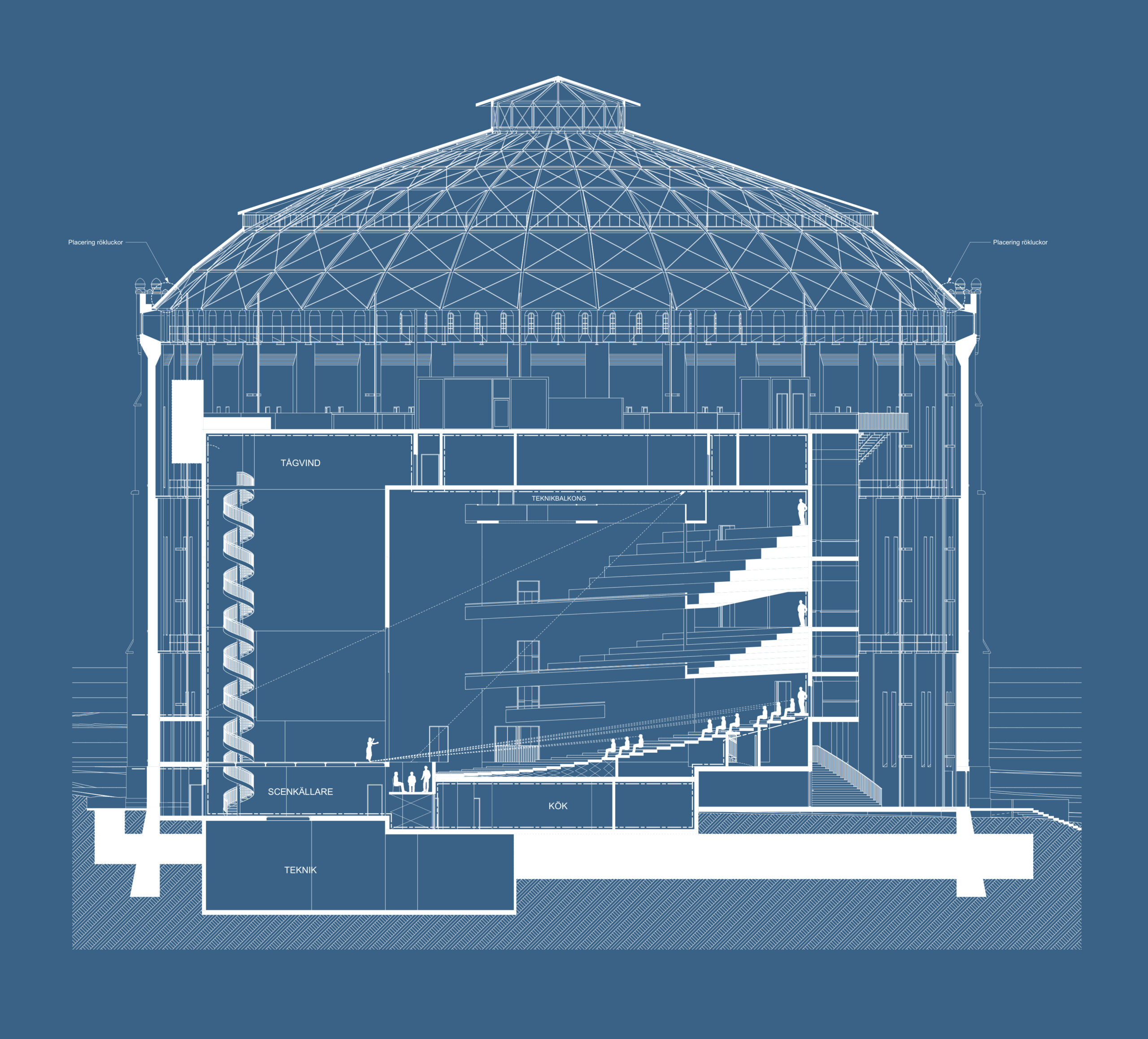
Commissioned by the City of Stockholm’s Development Office, Tengbom has proposed transforming Gas Holder 2 in Hjorthagen into a state-of-the-art cultural venue with a banquet hall. The concept for the Gasometer – a “box within a box” – offers future visitors a spatial experience like no other.
Hjorthagen undergoing major development
Located just outside Stockholm, Hjorthagen is an area undergoing large-scale transformation. Once an inaccessible industrial zone, it will soon become home to around 15,000 new residents. The broader development includes approximately 6,000 apartments and 100,000 square meters of commercial space.
From gas holder to Gasometer
In 2017, Tengbom won a tender and we were entrusted with designing an international performance venue within Gas Holder 2. Now known as the Gasometer, the venue will host up to 2,300 guests, offering world-class concerts, musicals, and theater productions. At the top of the inner “box,” there will also be a banquet hall accommodating 1,000 seated guests.
Ferdinand Boberg designed the unique and historically listed gas holder in 1899. The exterior will remain in its original state, while the interior will transform into a space with spectacular spatial experiences. The performance hall will float within the larger structure, encapsulated by an outer shell.
Optimized for audience and acoustics
By stacking the audience over three levels, the design maximizes capacity while ensuring the best possible acoustics. Visitors will undoubtedly experience something extraordinary. The project is led by Tengbom architect Jan Izikowitz, whose previous work includes the Gothenburg Opera House.
“The ambition with Gasometer is to become a landmark for Stockholm’s vibrant cultural life. Both for residents and visitors from around the world.”
Architect Jan Izikowitz
Gasometer in the larger context of Gasverket Västra
Gas Holder 2 is part of the Gasverket Västra development plan, which also includes a museum, school, preschool, sports hall, and office spaces.
Competences:
Building preservation, Interior Design
Years of commission:
2002–
Our specialists in building preservation have assisted in the restoration and construction of the The Solliden Stage, on the basis of Skansen’s ambition to create Northern Europe’s most modern outdoor stage. The fairground was also improved through renovations and additions. We weighed various qualities in the project, such as the location’s view of the entrance to Stockholm and the historic building value of the original stage, against expectations of modern stagecraft and acoustics.
The Solliden Stage. Photographer: Tove Falk OlssonPhotographer: Tove Falk Olsson
Perhaps you yourself have sat at this classic location and gazed out over one of Stockholm’s most beautiful views. Or at least heard of the popular outdoor TV show Allsång på Skansen?
The Solliden stage (Sollidenscenen) was designed by Nils Einar Eriksson in 1938. It was at that time technically and acoustically of a very high quality. The audience sat facing the view and listened to acoustic music that was amplified through the spiral form of the stage.
But today’s concert situations and stagecraft, especially for TV broadcasts, place new demands on the stage environment. To meet these needs, we designed a completely new stage. We also developed related ancillary buildings in cooperation with the Stockholm Beauty Council and Skansen’s own curators.
The team carefully restored the original stage, Snäckan (“The Shell”), preserving its cultural value and keeping it at the centre. They designed the new stage around it, raising and deepening the stage floor while extending the roof to cover the entire stage. Built with thin ship-building plate on a steel structure, the roof enhances both function and form. The new annexes feature façades of untreated oak, which will naturally age over time to match the adjacent Öland Windmill.
Photographer: Tove Falk Olsson
Photographer: Tove Falk Olsson
Photographer: Tove Falk Olsson
New and better audience space
We redesigned the fairground to offer more and better space for the audience. Seats now stand centrally in front of the stage, framed by wooden benches made from Skansen’s own oaks. To improve accessibility, dedicated spaces for wheelchair users were added at an elevated spot near the mills. More spaces are also available beside selected rows at Sollidenplan. Removing the front row at the stage opened up the view towards Stockholm’s entrance, creating a more inviting experience.
The Solliden Stage and its new stage and fairground debuted in 2013 during Skansen’s National Day of Sweden celebration on June 6th. The following weekend, a dedication concert featured Radio Sweden’s Symphony Orchestra, Tommy Körberg, and Amanda Sedgwick.
Ironmonger’s building: The ironmonger’s building in the town quarter was completed in keeping with Skansen’s ambitions as a copy of an existing building from the 1880s in Hudiksvall.
The Skansen Shop: In 2010-2011, we renovated The Skansen Shop, previously the Alhambra restaurant, in order to create more appropriate premises for office, storage and accommodation rooms.
Lill-Skansen: We participated in a parallel engagement for a new Lill-Skansen children’s zoo.
New buildings for wild boar and European bison: We designed a new building in 2007 for two wild boar families and a building for European bison.
Dressing-room building: Design of a new dressing-room building at the Galejan dance pavilion is under way in 2016.




 The team carefully restored the original stage, Snäckan (“The Shell”), preserving its cultural value and keeping it at the centre. They designed the new stage around it, raising and deepening the stage floor while extending the roof to cover the entire stage. Built with thin ship-building plate on a steel structure, the roof enhances both function and form. The new annexes feature façades of untreated oak, which will naturally age over time to match the adjacent Öland Windmill.


 The Solliden Stage and its new stage and fairground debuted in 2013 during Skansen’s National Day of Sweden celebration on June 6th. The following weekend, a dedication concert featured Radio Sweden’s Symphony Orchestra, Tommy Körberg, and Amanda Sedgwick.
