Archives

Trapparken

Steps to the top
Landscape
Parks, Play & Public Spaces, Residential environments
Client: Bonava
Location: Tollare, Nacka
Years of commission: 2014-2016
Contractor: Bonava
Photographer: Jansin & Hammarling
Nomination and awards: Nominated for Nacka Urban Design Award in 2021

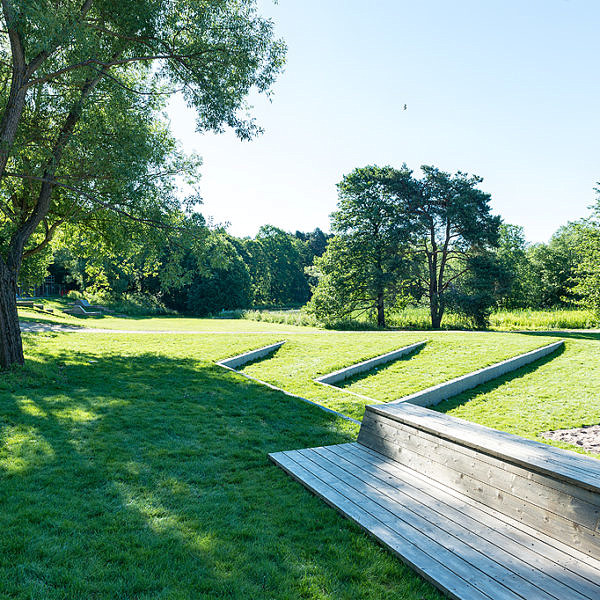
In Nacka, just outside of Stockholm’s city centre, the new neighbourhood of Tollare is emerging. On the steep cliff down to the water, between residential buildings that have yet to be built, we designed Trapparken, the Stair park. This is something unique, a park, a staircase and a destination with a fantastic view all rolled into one.

In 2014, we were given the task by Bonava to develop a long and narrow strip of land in Tollare, which runs from Tollare square on top of the hill down to Hamntorget, Harbour square down by the water. The area is very unusual and there are many complicated factors to keep in mind. How do you design a park which a height difference of 35 meters including a series of flight of stairs between houses that do not yet exist so that it becomes space appreciated by the residents and an exciting destination for excursions? This was important questions for the members of this project group. We wanted to turn this challenge into something very special. A real experience for visitors.

The tension and drama of the height difference are enhanced by the viewing platforms, offering a breathtaking wow-factor.
Trapparken
The area is spectacular, with stunning views of the water and the undulating terrain.

“Where would people want to sit and eat ice-cream?”

To turn the Trappark into something other than simply a way from A to B, we needed to make use of both the unique qualities of the area but also add some new. We needed to try to imagine what it would feel like to move about here. How many steps are people willing to ascend? Where should the resting places be? What could we expect in the way of surprises?

Not just a walk

To understand movement and interaction, we studied staircases across Stockholm. We examined how people walk in pairs and what happens when they pass each other on stairs of different widths. In Tollare, the staircase needed to climb significant heights quickly. This created high, stepped walls. We asked ourselves how it would feel to walk alongside them. How could we shape them to keep the space light, green, and open?
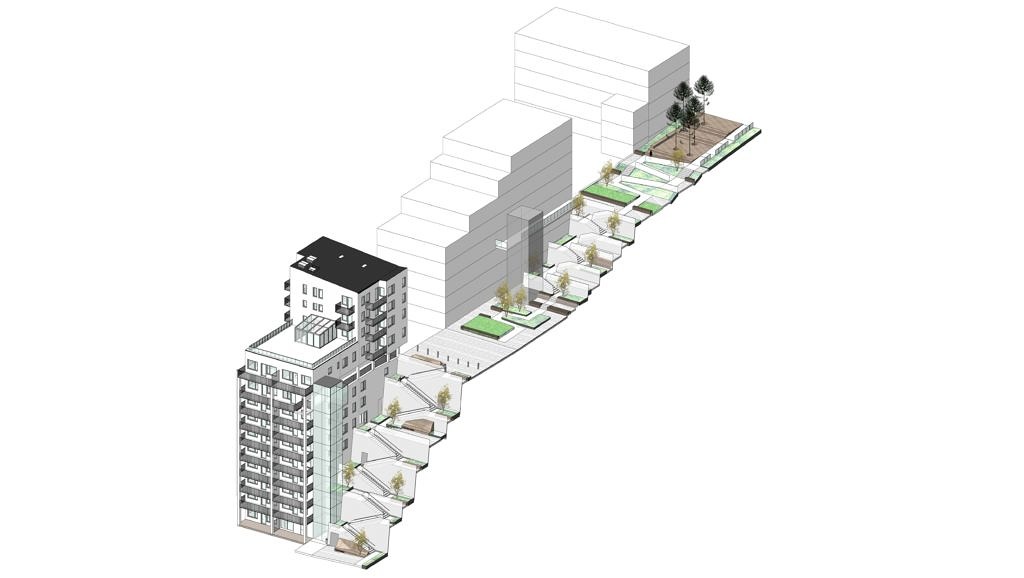
Illustration: Tengbom

The light was an important aspect. We studied the movement of the sun across the park in a new and unusual way. Instead of just making a general survey of the hours of the day, we based our design on how the light spreads when it is time to go to work, when you would want to have a picnic lunch, an afternoon ice cream or go for an evening walk. We chose leaning brick walls and light materials to take advantage of the daylight as much as possible

Many details with a maintained balance
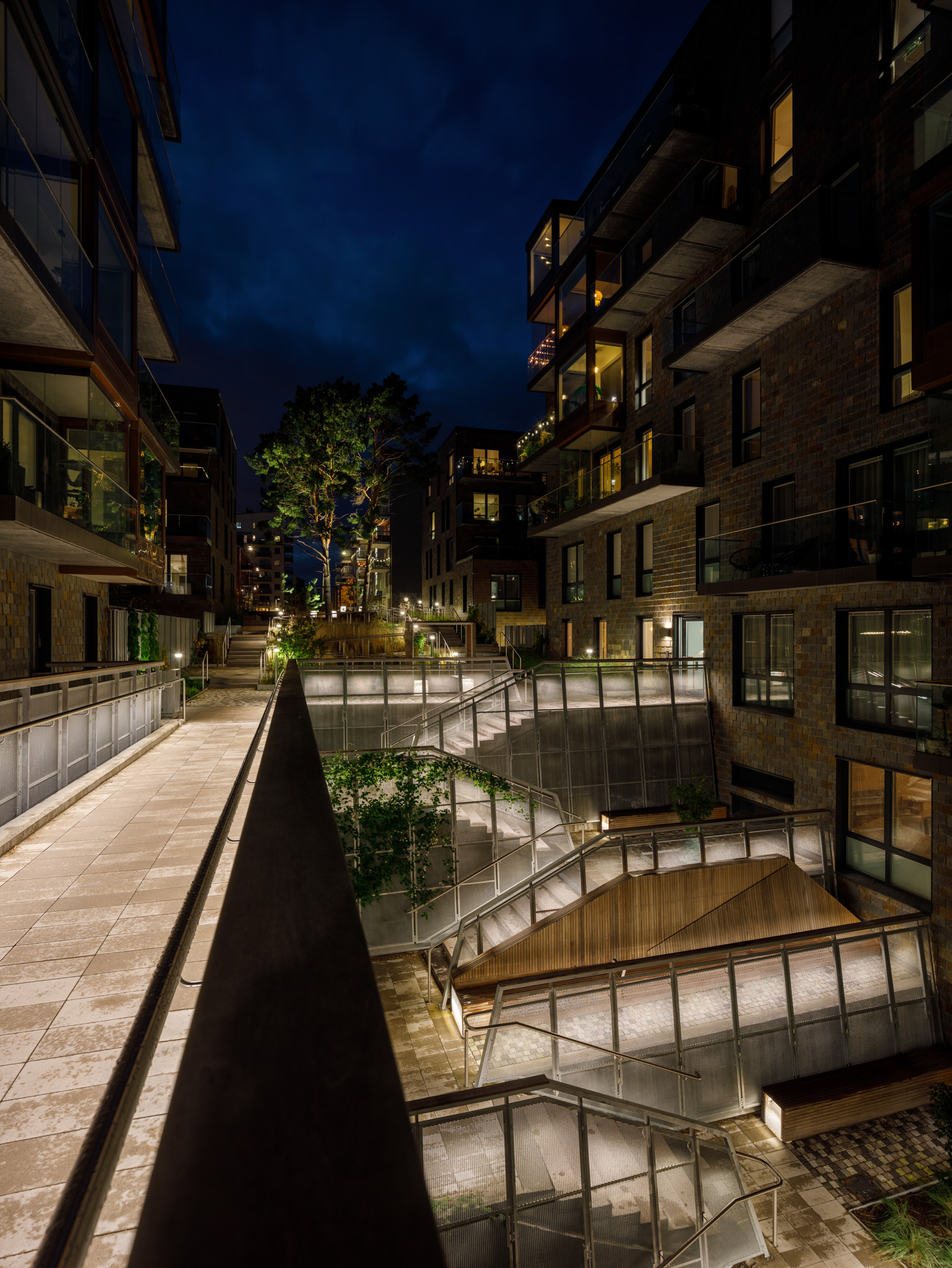
The joy of discovery became a key word for the project. When you move through the park, there are interesting details to look at. The concept for the stairs takes you on a journey from the water to the forest or the other way around. The vegetation climbs up the angled walls from raised beds.

A great challenge was to find the balance between details and the whole and between function and aesthetics. There is a lot going on in the narrow space and a lot of stuff that needs to be there. At the same time, it was important that Trapparken felt harmonious and beautiful. Multi-functional design was a large part of trying to find the solution, to find elements that could fulfil many requirements and that did not disturb either the overall impression or the views. The expanded metal that covers the walls continues and becomes a fall protection railing, with recessed lighting in the handrails. Seats are integrated in the walls or become an extension of the raised beds. This is compact living – the park version.

“We have worked hard at trying to anchor the park in the character of the place. We have been inspired by both colours and materials from the surrounding environments that we have developed further – we really have thought of everything so that the person that moves around here shall experience something really special,” says Jenny Andersson, landscape architect.

A long-term perspective and simple management have been core considerations for the project. Therefor, we have selected robust materials, artificial irrigation. In addition, we chose plants that add dynamics year round and that become more beautiful with time.

Trapparken
Reflections and repetitions in a cohesive design language create harmony and balance in the Stair Park, exemplified here with the railing and lighting.
Trapparken
The serpentine path winds its way through the park, distinct in material and form from the surrounding surfaces, tying the park together. Bands of plantings, walls, and seating areas lining the path create a striking contrast.

Clear dialogue through design in 3D

Trapparken took shape in Revit, enabling direct collaboration with Bonava and the house architect for the surrounding residential buildings. Working in 3D models provided an incredibly precise overview. Visualizing both concepts and ongoing changes became much easier for everyone involved. The tool also brought invaluable clarity to the project—for us, the client, and all other participants.

Contact person

Jenny Söderling

Studio Manager Landscape
+46 8 412 53 95

Boulognerbadet

Where everyone can swim and hang out
Boulognerbadet 2015
Landscape
Parks, Play & Public Spaces, Sports
Client: Gävle municipality
Location: Gävle
Years of commission: 2013–2015
Contractor: Bonava
Competences: Landscaping, Culture, Sport, Lighting Design, VA

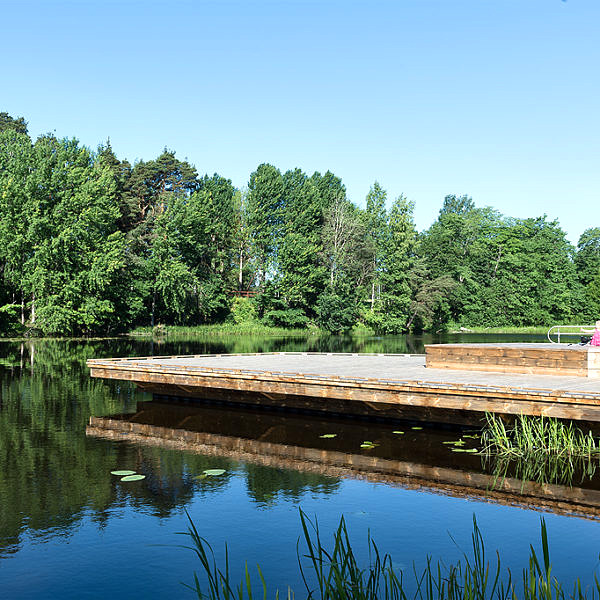
In 2013, we were asked to develop a proposal for an entirely new public baths in the Gävle river, right next door to Gävle’s city park Boulognerskogen. Gävle municipality liked our concept of a pontoon, park routes and gym as well as changing rooms and a family area with a sandy beach, and the project started. Today, Boulognerbadet, the public baths, is a lively and well-loved meeting place for children and adults of all ages.

The site by the Gävle River started as a large lawn with beach volleyball courts, park benches, and a trail for hiking and jogging. To make the most of the location’s many qualities, we created a proposal divided into three stages.

First, we wanted to create a deck along the water with viewing platforms and stairs in the sight lines in order to get closer to the qualities of the river. In the next stage, we proposed a park next door with an outdoor gym and changing facilities. In the last stage, our team wanted to create a real sandy beach for the whole family where even the youngest of the family can swim. Today, stage one and two are complete.

Boulognerbadet
Photographer: Göran Ekeberg

Beautiful deck and swimming for all

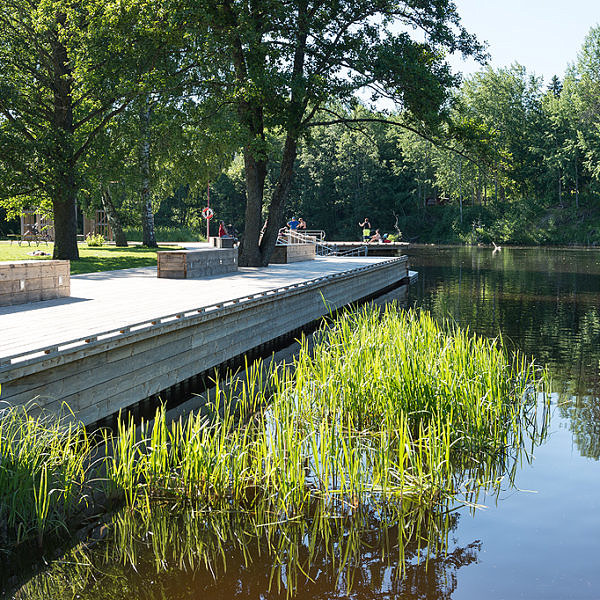
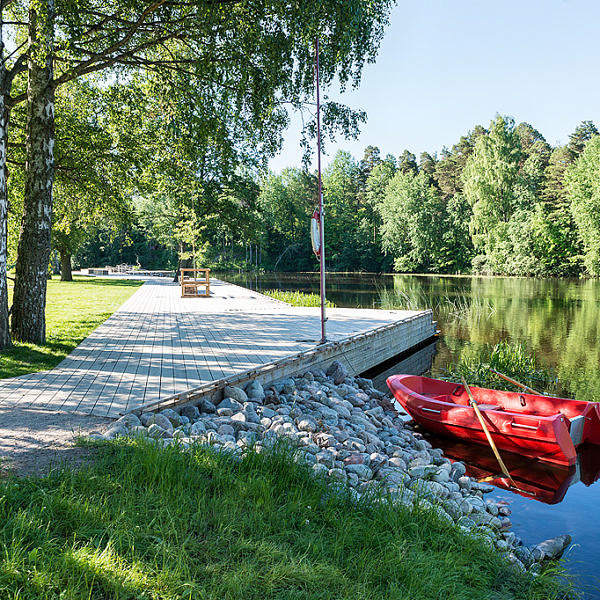
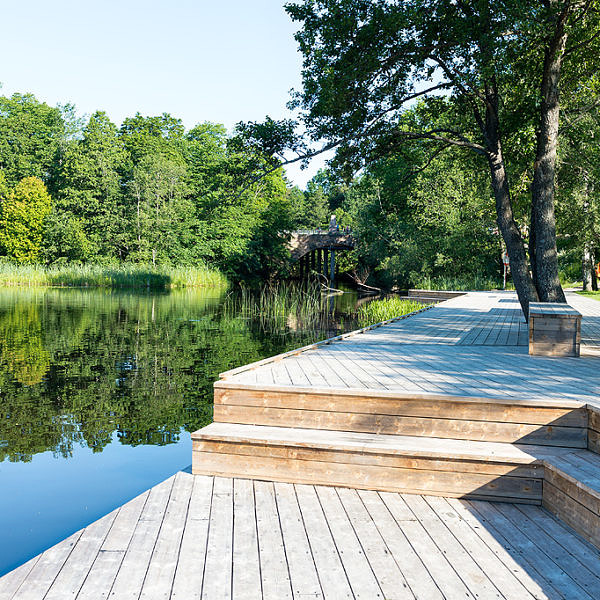
In the summer, the seven meter wide deck is full of visitors. Both those who just want to hang out in the sun for a while and those who are a little braver and don’t mind getting into the water. There is an access ramp so that anyone who wants to can get into the water.

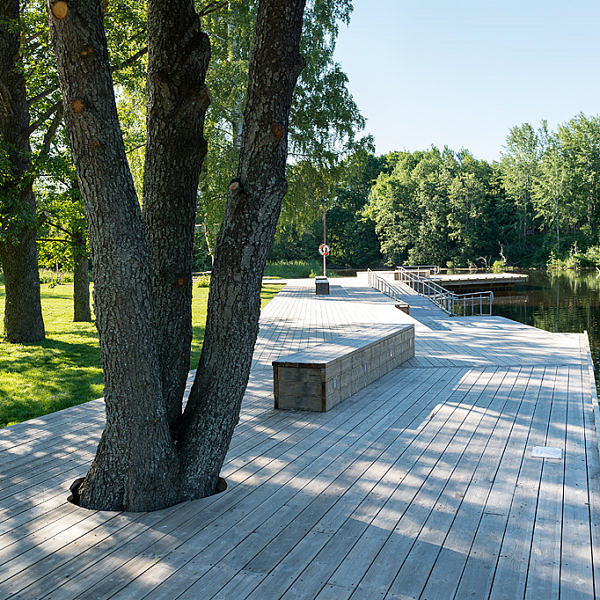
The deck is constructed of treated pine, which ages well and takes on a grey patina with time.

The large trees that grow along the beach have been kept and been allowed to grow through the deck. Their crowns create a roof here and there and provide some welcome shade on the warmest days of the summer. A raised stage or a seat acts as a focal point at the southern end of the deck. Close by, we have created a grill area with rain cover in the shape of a green roof.

Many places to hang out

To create a larger, continuous lawn, we have moved the beach volley pitch. On the adjacent slope, there is now a variety of seating to hang out on with a view of the water – terracing, a small stand and new sun benches. A little bit further away is the new outdoor gym. In this area, we have also included some changing rooms with a façade of the same pine as the deck.

The last stage of the project, the family area with a sandy beach has not been started yet.

Boulognerbadet
Photo: Göran Ekeberg

Contact person

Jenny Söderling

Studio Manager Landscape
+46 8 412 53 95

Pop up park Humlegårdsgatan

Temporary oasis in busy street
Pop up park
Architecture, Landscape
Parks, Play & Public Spaces, Squares & Streets, Temporary
Client: Gamla Liv
Location: Stockholm
Years of commission: 2016
Type of project: Temporary street park
Joinery: Klöver Knekt
Competences: Infrastructure, Landscape

Hey! A pop up park. In the middle of Stockholm’s shopping district, we have created an oasis and transformed a formerly anonymous street into a destination for socializing and hanging out. Welcome to the livingroom of the city.

There are references to the High Line in New York and the benched landscape of Roppongi Hills in Tokyo; at least if you chose to believe what visitors to our Pop Up Park on Humlegårdsgatan say about the experience. Here, on the street’s lower 50 meters we have created a temporary street park, commissioned by the life insurance company Gamla Liv, and the City of Stockholm. We feel it’s like the living room moving out into the street, to meet Danish sand dunes and Italian sorbet.

Four similar Pop Up Parks will be created in Stockholm during the summer of 2016 with the ambition to highlight the potential of a handful of specific streets and their surrounding area.

Danish sand dunes meets Italian sorbet.

“Our analysis of Humlegårdsgatan is that it’s quite a narrow, dirty and noisy street. Despite being busy it’s quite anonymous, with little-to-no space for relaxation.

Pop up park
Photo: Tekla Evelina Severin

Pause, play, and stay

The aim with this project is to strengthen the path between the popular Stureplan and Östermalmstorg Squares, and also highlight Humlegårdsgatan as a destination with a character of its own. We wanted to brighten it up, give it air and add places to pause – rather than simply pass by. A room to live in,” says Åse Larsson, architect in charge at Tengbom.

A cluster of wooden platforms, painted in mint green and pink, actively reduces the pace on the street, where all traffic by car is forbidden during the time the park is open. The wooden furniture become urban stylized islands, with seats in different levels and in all directions. By docking them to the pavement we extend the width of the ‘outside room’ and erase the borders between street and pavement. So far, the islands have been used for both morning meditation and as a buffet stand when the park was inaugurated.

“We’re happy to see passersby and people in the area already making the park their own, using it for their own purposes. We wanted to create a space that is easy going, democratic and filled with activity, so it’s really fulfilling our vision,” says Oscar Malmerberg and Anders Brandstedt, landscape architects at Tengbom.

Pop up park
Photo: Tekla Evelina Severin

Summer vibes on the street

Greenery fills the islands, and sorbet-colored paint enhances the summery feel. Even the ground features a sprinkle-like pattern, adding to the playful atmosphere. A careful analysis of the traffic flow and current conditions shaped the concept. The goal was to find ways to improve the area while bringing in a sense of fun and relaxation. If the initiative proves successful, the Traffic Office and the City of Stockholm may see potential for more Pop Up Parks. Larger, perhaps even permanent, versions could appear across the city. Together, we reclaim the streets.

Gamla Liv initiated the project. As the property owner on both sides of the street, they played a key role in making it happen.

Contact person

Jenny Söderling

Studio Manager Landscape
+46 8 412 53 95

Ursvik Waste Vacuum Terminal

An unexpected architectural gem
Ursvik
Architecture, Landscape
Industry, Parks, Play & Public Spaces
Client: Stora Ursviks KB
Location: Stora Ursvik, Sundbyberg
Years of commission: 2012-2014
Type of project: Industry building
Collaborative partners: SWECO, COWL, Tyréns
Competences: Infrastructure, Industry, Landscape, Sustainability

The new waste vacuum system terminal in Stora Ursvik is run completely by computers and is covered by a large wall of vegetation irrigated by sensors controlled from London. Welcome to a highly technological and environmentally friendly industrial building that – rather unexpectedly – has become a true architectural gem.

Is it possible to create a waste vacuum system to be proud of?

It was an exciting challenge we took on, to create the waste vacuum terminal in Stora Ursvik. We wanted the building to add aesthetic value to the area and become an appreciated part of the surroundings for the residents. It also had to be efficient both from a functional and environmental perspective.

Ursvik
Photo: Åke E:son Lindman

Based on our vision, rational volumes emerged with few but clear effects produced. Industrial architecture with unexpected elements. The sloping façade of the largest volume covered in sheet metal contrasts with the adjacent volumes, that we covered in concrete and decorated in part with a shadowy forest motif. Offsets on the façade, a minimalist window distribution and a beautiful chimney in Corten steel plate gives a strong character to the building. It is exciting for a viewer to see both close up and at a distance.

The first BREEAM-certified industrial building in Sweden

A plant wall for cleaner air

The most effective contrast however, is probably the 250 m2 plant wall which covers the largest volume on one side. The wall consists of more than 2 000 plants and the irrigation is controlled from London using sensors. The green wall, meant to compensate for the land used also extends the life span of the building, filters pollution and cleans the air around it.

BREEAM-certified – and odour free

The waste vacuum terminal is the first BREEAM certified industrial building in Sweden. Fully functional, the system will serve approximately 6 000 flats. Through underground pipe systems several hundred meters long, food waste, packaging and paper is transported to the waste vacuum system from the homes surrounding it. The system is a closed one that keeps out both pests and insects. It does not smell either.

The building in Ursvik is normally unmanned and fully controlled by computers. The containers are emptied once a week. Heavy waste and recycling transporters use the nearby E18, keeping local traffic to a minimum. As a result, the streets become safer for both adults and children.

Contact person

Mark Humphreys

Practice Director Stockholm
+46 8 412 53 43

Waldemarsudde

The legacy of Prince Eugen
Waldemarsudde 2015
Architecture, Cultural Heritage, Interior Design, Landscape
Accessibility, Building Preservation & Restoration, Culture, Heritage Expertise, Renovation & Transformation, Residential environments
Client: The National Property Board of Sweden
Location: Djurgården, Stockholm
Years of commission: 2013–2015
Type of project: House architect
Collaborative partners: LEB, Tyréns, Projektel, Brandskyddslaget
Areas of expertise: Heritage, Landscape

Waldemarsudde is a unique environment filled with great experiences. It has beautiful countryside, fascinating historical buildings and fantastic art. Waldemarsudde is primarily associated with Prince Eugen – botanist, landscape painter and art collector – who lived here in the early 1900s.

The legacy of Prince Eugen

The palace was commissioned by Prince Eugen and designed by the architect Ferdinand Boberg, and was built between 1903 and 1905. The gallery building was added in 1913 to house the Prince’s extensive art collection. Upon Prince Eugen’s death, the entire Waldemarsudde estate was bequeathed to the state, which was to manage it as a museum. Waldemarsudde is one of Sweden’s best known and most visited art museums and has been a listed building since 1993.

Waldemarsudde Tengbom 2015
Photo: Nina Broberg

Responsibility for maintenance and development

Tengbom had the framework agreement as building architect and general consultant for Waldemarsudde between 2013-2015. This meant that we were responsible for the listed building’s maintenance and development, in collaboration with the National Property Board of Sweden and the Prins Eugens Waldemarsudde Museum. We primarily worked in the areas of architecture, conservation and technical matters, as well as regulatory requirements. In conjunction with the consultant group, as building architect we carried out project planning as well as investigative assignments. We were consultants and handled such things as permit issues and long-term plans for maintenance and restoration.

Adaptation and visions for the future

One of the projects we worked on at Waldemarsudde was the extensive rebuilding of the museum shop and entrance hall, including improvements to accessibility at the main entrance, both inside and out. We focused on environmental aspects, lighting, acoustics, and both interior and exterior maintenance. The park and gardens was also part of our work. Additionally, we developed a proposal to open the old linseed oil mill to the public.

A complex project with specific challenges

The project at Waldemarsudde presented constant challenges. Working in an art museum means tackling environmental, technical, logistical, and programming demands. The focus was on adapting and refining the design to meet today’s needs while carefully preserving Waldemarsudde’s cultural value.

Close collaboration is essential

Collaboration was key throughout the process. Technical consultants and specialists joined early on. Each project within cultural environments involves close contact with managers, tenants, and authorities. Craftsmen, contractors, and other consultants also play a vital role. This demands flexibility, coordination skills, initiative, and a keen sense of the bigger picture.

Contact person

Josefin Larsson

Business Developer
+46 72 183 02 34

Gottsunda center and square

Colourful meeting place for all
Gottsunda, Uppsala, 2013
Landscape
Parks, Play & Public Spaces, Squares & Streets
Client: Uppsala municipality & Uppsala kommunala fastighets AB
Location: Gottsunda, Uppsala
Years of commission: 2011–2013
Type of project: Square & Centre
Contractor: JM (square), PA Bygg (centre)
Areas of expertise: Landscape, Lighting Design

Design of a colourful environment in the centre

Our project in newly renovated Gottsunda town centre involved developing a design proposal for the outside spaces. The town centre houses both shops, a theatre, a library, restaurants, a public swimming pool and offices. We created an area for mingling for soft users that now runs in front of the three main entrances to the centre, furnished with seating arrangements, green hills, flowers, lighting, bicycle parking and signage.

Gottsunda, Uppsala Tengbom 2013
Photo: Sten Jansin

A flexible and raw cultural area

A playful winding pattern in the ground moves along the surface, and continues past the entrances to the culture centre and the public swimming pool, connecting the entire area around the front of the Centre. The location of the raised flower beds breaks up the long vistas and create nice seating areas along the facade of the centre. Around the back where we find the entrance to the sports centre, loading dock, studios and food markets, we created a raw and flexible cultural area. The main element is a dock made of concrete that can be used both for loading and as a mingling area and a stage for the theatre.

Gottsunda
Photo: Sten Jansin

The square as a natural meeting place

In the square in Gottsunda, we set out to create a natural gathering place, one that reflects the neighbourhood’s diversity. A place where everyone feels welcome and safe, no matter the time of day or reason for visiting. Whether on a bright summer afternoon or a dark January evening.

At the heart of the centre, we designed the square as a woven pattern, divided into three sections. Each part serves a purpose – play, socialising, performances, and market trade.

Collaboration with the people in Gottsunda

Our original design was developed in collaboration with the residents of Gottsunda in an extensive series of consultations. Everyone was invited to give his or her opinion, which was then processed by us into the finished product. The development of solutions through a dialogue with the residents is both important and incredibly giving – it helps us create new solutions that the users request and offers new perspectives on future projects.

A peaceful oasis in a busy environment

One of the challenges was to create a peaceful oasis away from the busy traffic. The square is surrounded by roads on three sides and a parking lot on the fourth. That is why we have made an effort to design a clear and green frame around the area. It creates better spaces for mingling and play.

Updated forty-year-old

The updated area serves many functions and plays a key role as a future transport hub in Gottsunda. In October 2014, the new square opened just in time for Gottsunda Centre’s 40th birthday.

Contact person

Jenny Söderling

Studio Manager Landscape
+46 8 412 53 95

Park at Norra Latin

Welcoming oasis in the middle of the city
Norra Latin 2014
Landscape
Culture, Education, Parks, Play & Public Spaces, Squares & Streets
Client: AB Folkets Hus i Stockholm, Bantorget Fastighets AB
Location: Stockholm
Years of commission: 2010–2013
Type of project: Park
Contractor: AB Folkets Hus i Stockholm, Bantorgets Fastighets AB
Areas of expertise: Landscape

Restoring the park in front of Norra Latin required great care, especially because of its historical significance. To recreate the original environment, we researched drawings, photographs, and texts from archives. These sources shaped the design, even down to the selection of plant materials, which reflect the era.

Recreated historic environment

Helgo Zettervall designed Norra Latin, a stunning example of neo-Renaissance architecture , which was inaugurated in 1880 with King Oscar II and Prince Eugen among the guests. Today, the former school serves as a conference centre. Both the building and its large courtyard, added around 1914, stand as well-known and beloved landmarks in Stockholm.

Norra Latin
Photo: Sten Jansin

Restoring the park in front of Norra Latin’s entrance to Drottninggatan required careful planning, especially given its historical value. We searched old archives for drawings, photographs, and texts to guide the design. These sources shaped every decision. Even the choice of vegetation reflects the era and strengthens the park’s historical connection.

We aimed to create a tranquil oasis with inviting spaces in the city center

Lots of space to hang out in

Green rooms are very important in our cityscapes and for the project at Norra Latin we wanted to develop an inviting atmosphere with lots of space to hang out – a peaceful oasis in the middle of the city. A way to create more space was to widen the main route between the entrance and Drottninggatan using stone dust. We supplemented the row of trees along the path with herbaceous borders and created two obvious spaces for hanging out in the park, with benches, planting and hedges. The entrance space was also widened to provide room for transport and to be really welcoming.

Partnership between landscape architects and project management

Our task was to assess the park, highlight its strengths, and identify areas for improvement. This work resulted in key documents for the renovation. Our landscape architects handled planning and inspections. At the same time, our project leaders managed both the project and the installation.

Contact person

Jenny Söderling

Studio Manager Landscape
+46 8 412 53 95

Enhörningen

Award-winning living space in Japanese harmony
Architecture, Landscape
Parks, Play & Public Spaces, Residential, Residential environments, Squares & Streets
Client: HSB Göta
Location: Kålgården, Jönköping
Years of commission: 2009-2012
Type of project: Residential block
Competences: Residential

The block Enhörningen, featuring 54 flats and a shop, is the northern section of a square which together with two other blocks frame Jönköping’s newly constructed central park – Aspholmsesplanaden – which runs up to Munksjön and Rocksjöån’s nature preserve.

Key word Japanese harmony

The Japanese word Yasuragi means harmony, and that idea guided the entire design of this block. Our goal was to create a place where city life and tranquillity go hand in hand. To give residents the most peaceful and beautiful views possible, the buildings face the lake and embrace a U-shaped courtyard.

In the yard, Japanese cherries and mountain bamboo grow alongside hops and lavender. Climbers weave through taut wires, forming green portals over the footpaths. Residents and visitors can stroll through sedum-planted areas or pause on the wooden bridge. Social spaces, framed by larch wood, gravel, and stones, invite quiet moments with a friend. All around, the soft murmur of water from the pond completes the atmosphere.

Outstanding architecture!

Enhörningen
Photo: Sten Jansin

The building’s facades feature brick and stucco in calm colours. Lime green glass fronts on the balconies and red entrances add contrast. Bamboo panels enclose the private outdoor spaces. Stairwells open onto the surrounding streets, shaping a dynamic and active streetscape.

Award-winning living spaces

In 2012, the neighbourhood Enhörningen was awarded Jönköping’s Town Construction Price in the category Good living space. The motivation: “With its outstanding architecture and courtyard setting, the buildings in the neighbourhood Enhörningen 1 is a very valuable contribution to good living space in central Jönköping”. Enhörningen also won an award for Best HSB project 2011-2012 with the motivation “A neighbourhood has been created here that contributes to the overall feel of this entire part of town. The strength of the project lies in the creation of volume and the interaction between colour and material on the exterior”.

Contact person

Matt Patterson

Practice Director Jönköping
+46 36 440 90 81