Archives

NEO auditoriums

Butong meets parametric design

When Tengbom designed NEO and Technology and Health, they featured two spherical lecture halls, but there was no technical solution as to how the shape would actually be realised. By means of parametric design and the material Butong, a complex design proposal became a reality.

The requirement was to design an exterior that reflects the high-tech, digital “state of the art” interior. It also needed to have the ability to both reflect light and absorb sound. The result became the almost futuristic elements of the world-leading Life Science cluster at Karolinska in Huddinge.  

From charcoal sketch to complex formability

With the help of Computational Design, the vision for the auditoriums was realised. Through a close collaboration with Lars Höglund, founder of Butong, and our digital expert in ArchTech & Future, the complex shapes were developed based on a parametric model – with only a series of charcoal sketches as the foundation.

NEO
By working with 3D we could alter the shape how many times we wanted until the day of production.

The shape was created from a variety of mathematical parameters that can be rendered in 3D, which creates flexibility in the shape that continues until the final pressing of the production button. The finished solution required approximately 3,500 unique parts for the frame and mould, with minimal tolerance over the double curved surfaces of the mould.

When Butong met parametric design, the positive effects were numerous. In addition to being able to design complex environments, zero intermediates and minimal material consumption were required, which was good from both a sustainability and cost saving perspective.

“We adjusted every part of the casting together with the customer,” says Shahrokh Kamyab. “This made the project more time-efficient and allowed us to generate finished production files directly for manufacturing.”

“We regularly work with plant walls, especially green façades. But Tengbom took our material in a completely new direction,” says Lars Höglund, founder of Butong. “They focused on formability and the permeability of light and sound. This solution could only have been created through digital fabrication and parametric design.”

NEO
Photo: Felix Gerlach

Contact person

Mark Humphreys

Practice Director Stockholm
+46 8 412 53 43

Technology and Health

Where ideas ignite
Technology and Health
Architecture
Education, Health, Life Science
Client: TKV (SveaNor Fastigheter & Hemsö)
Location: Huddinge
Years of Commission: 2012–2016
Contractor: Veidekke/arcona
Area: 22 000 sqm
Competences: Health and Life Science, Education, BIM, ArchTech & Future

Can we change the world by bringing people together? Of course we can. The Technology and Health building in Flemingsberg was built with that very ambition in mind. This is where scientists and students from several universities meet to exchange experiences and knowledge. They are also in close proximity to the University Hospital and Karolinska Institute. One step closer to better health for us all.

Technology and Health_Tengbom
Photographer: Felix Gerlach

We all want to have good neighbours, and to be one – both at home and in the workplace. But how do you create a building that facilitates human connections as much as possible? That’s the question we asked ourselves when starting our work on Technology and Health (TAH) in Flemingsberg. Here, the KTH School of Technology and Health will mingle with Karolinska Institute, Camst (The Center for Advanced Medical Simulation and Training), the Red Cross University College and its nursing programme. It is all part of a bigger project, a centre for Life Science in conjunction with the University Hospital in Huddinge. The idea is to meet and learn from each other – in an environment that does its best to help.

Technology and Health_Tengbom
Photographer: Felix Gerlach

Technology from the outside in

The Technology and Health building, which is the first of two in the new centre, is located on top next to the university hospital. The location encourages encounters and serves as the perfect starting point for the appearance of the building.

“We wanted to work with something that felt modern in the exterior and had an ease of expression, contrasting with the heavy hospital building on the side,” says Anna Morén Sahlin, one of the architects responsible for the project.

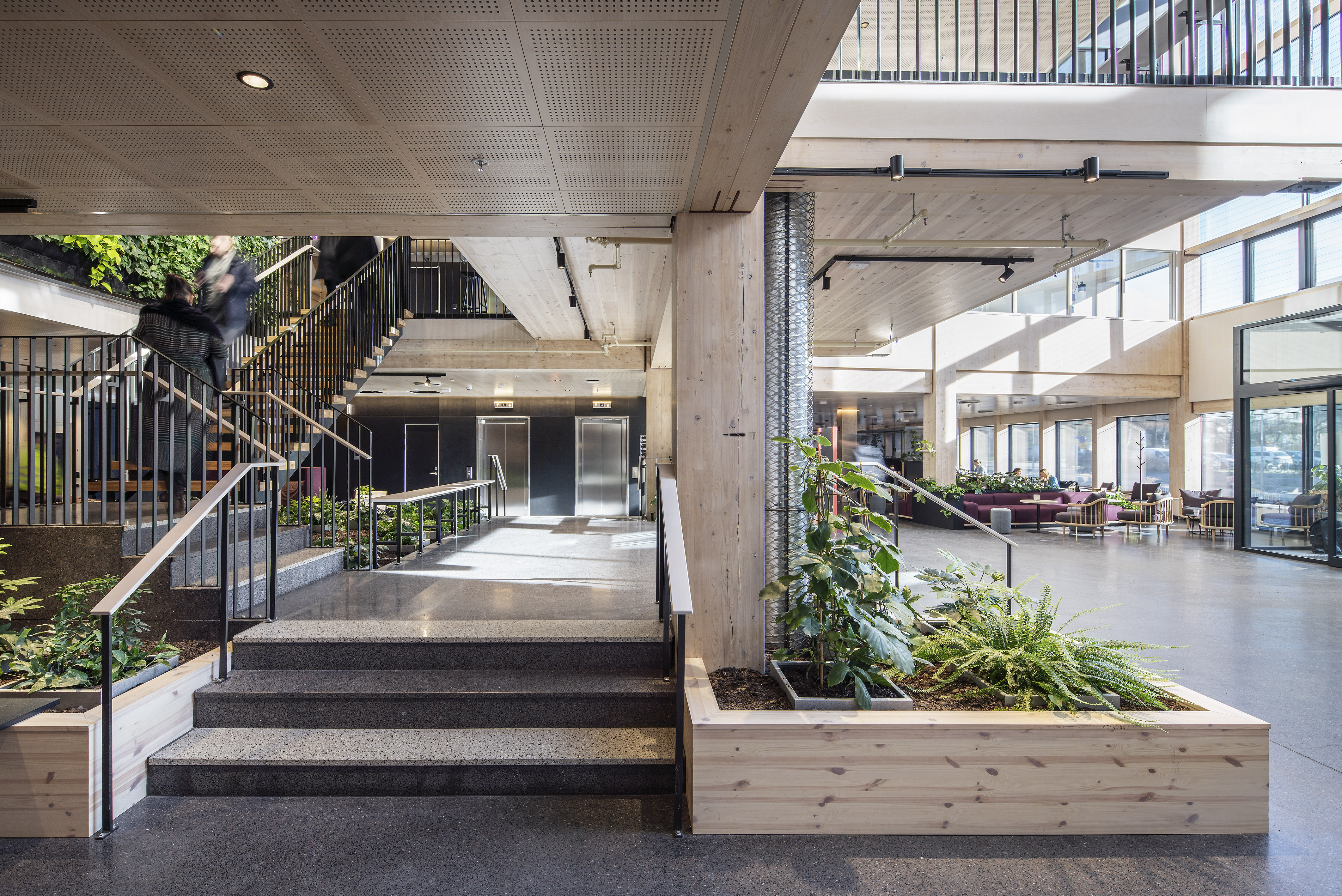
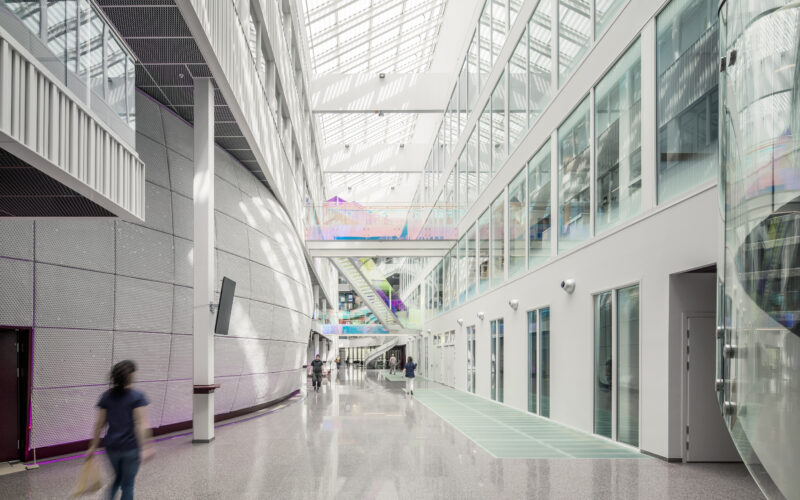
“So, we went with the metaphor that the outside is technology and the inside is health; so the outside is minimalist, made of aluminium and glass, while the interior features accent colours, plus wood and natural light,” says Krister Bjurström, another architect on the project.

Technology and Health_Tengbom
Photographer: Felix Gerlach

Watchword: encounters

No doubt it was a huge project. The TAH building measures in at 22,000 square metres, and its neighbour NEO, which will be inaugurated next year, boasts 26,000 square metres (the latter will house the researchers from the Karolinska Institute). Between the two buildings is a plaza that serves as a meeting place and common main entrance.

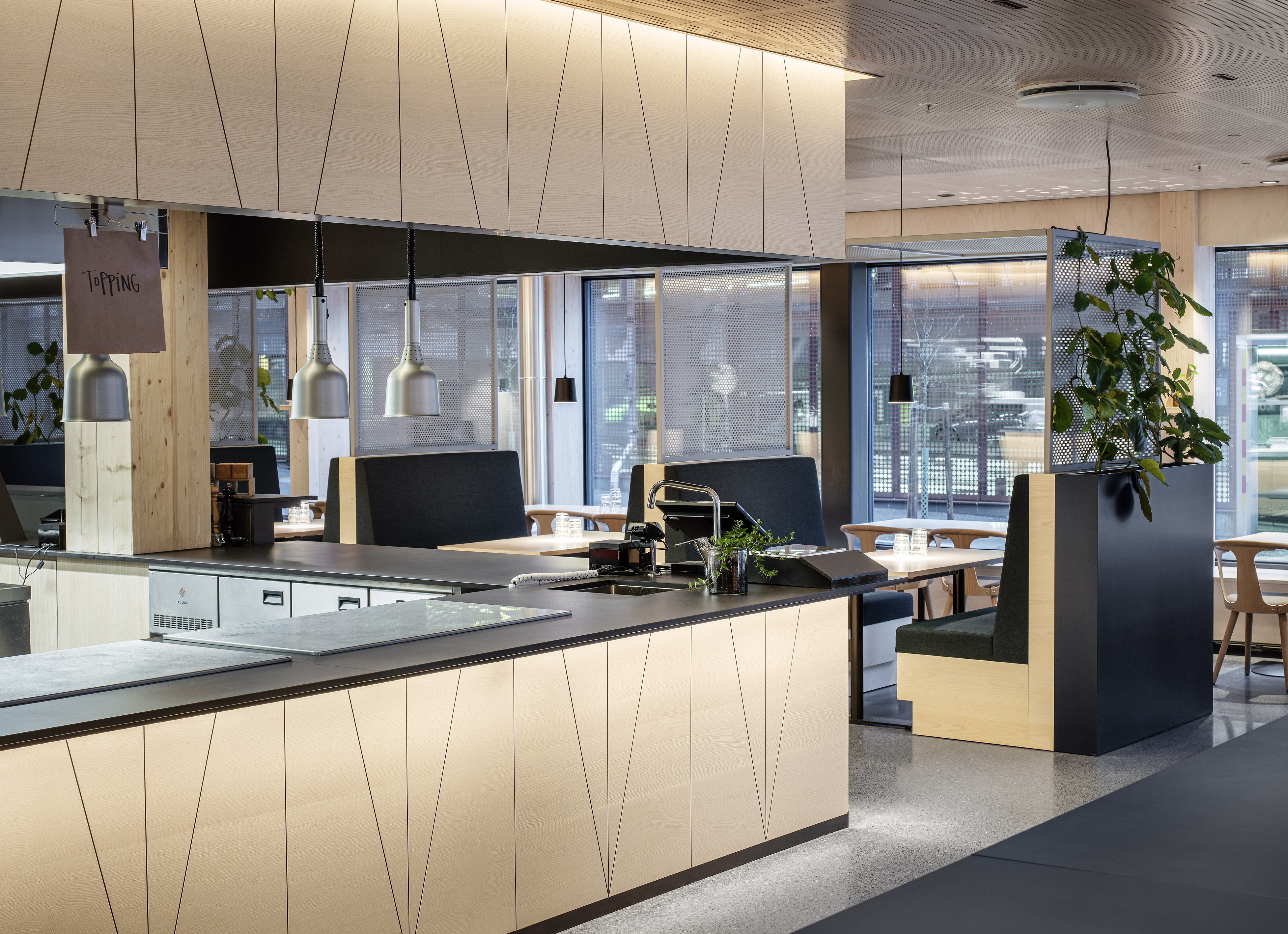
The TAH building has everything that is needed for a functioning university environment. Lecture rooms, reception, custodian, a lunchroom, clubroom, staff room and two large auditoriums, specially adapted for the various needs of KTH and the Red Cross. Plus, there are more exotic elements, like rooms where students can operate on lifelike dolls and a research apartment in which the home environment is under the microscope.

Technology and Health_Tengbom
Photographer: Felix Gerlach

The interior was inspired by the notion of a city or town. You should be able to meet in the avenues and alleys. There will be many small intersections and corners where you can hang out.

Technology and Health_Tengbom
Photographer: Felix Gerlach

“In addition to working with the ‘technology/health’ pair, we worked with ‘meetings’ as a key word. The interior was inspired by the notion of a city or town. You should be able to meet in the avenues and alleys. There will be many small intersections and corners where you can hang out. We tried to create vibrant atrium,” Anna says Morén Sahlin.

Technology and Health
Photographer: Felix Gerlach

Defines Huddinge as a Life Science hub

TAH was inaugurated in October 2016, with students, teachers and researchers already flooding in – and hanging out along the streets and boulevards just as was envisioned. Might this lead to a completely unique approach to both health and technology in the future?

“This project brings together a wide range of activities. It also creates opportunities for crossover encounters between different educational programs and research,” says Krister Bjurström. “Even more impressive is how it has attracted businesses to Huddinge. Many of them were previously based in the city center.”

Awards and Recognitions

TAH received a nomination for the Huddinge Urban Design Prize in 2017.

Contact person

Mark Humphreys

Practice Director Stockholm
+46 8 412 53 43

Skarpåkersskolan

Flexible learning environment inspired by nature
Skarpåkersskolan Tengbom 2014
Architecture, Interior Design
Education
Client: Krambo
Location: Kramfors
Years of commission: 2011–2014
Competences: Education, Interior Design, Accessibility

At the foot of Skuleberget’s steep cliff sides of almost three hundred meters, to the west of the Ångerman river, is Kramfors. In this town, we designed Skarpåkersskolan – a school, inspired by the dramatic landscape of the region. The local enthusiasm for the new school has turned it into a central meeting place for the area.

Forestry and modern architecture in the shadows of Skuleberget

Kramfors breathes the dramatic presence of Skuleberget. Its striking silhouette, the rich colours of the landscape, the surrounding pine forests, and the mysterious caves have inspired myths and stories for centuries. The town carries a deep connection to the sawmill industry. It takes its name from Christopher Kramm, who founded the area’s first sawmill in the 1700s. Wood craftsmanship remains a source of pride for Kramfors’ 6,000 residents. Since 2007, the town has entered a new era of construction, its first major development since the mid-20th century. Today, modern architecture stands side by side with its industrial heritage, shaping a new chapter in Kramfors’ story.

Skarpåkersskolan Tengbom 2014
Photo: Torbjörn Bergkvist

Creative collaboration with enthusiastic Krambo

In 2011, the municipal housing company Krambo Bostads AB gave us the task of designing a new school for years K-3 in the area of Skarpåkern, with twice the capacity of the outdated primary school from 1972. The local council wanted to create an attractive school and were inspired by our vision of flexibility and design inspired by the dramatic forest all around. In September 2014, Skarpåkersskolan was completed. The school stretches over 3,240 sqm, has room for 240 students and is one of the largest construction projects in Kramfors in modern times. The most important success factor was Krambo’s enthusiasm for the architectonic vision. We have loved the creative partnership, and been impressed by their courage, desire and responsiveness.

Skarpåkersskolan Tengbom 2014
Foto: Torbjörn Bergkvist

Skarpåker’s school – forest, mountain and magic

We chose a wooden façade for Skarpåker’s school, using local wood that reflects the changing colours of the mountain. A broken roofline creates movement in the building’s silhouette, mirroring the ups and downs of Ådalen’s mountain landscape.

The entrances take inspiration from the caves in Skuleberget. Inside, wood from Kramfors was used for both the construction and surface layers. The layout of the interior spaces follows a natural flow. Ceiling light in the heart of the school—the square—mimics the way sunlight filters through the tree canopies in the surrounding forest.

We also wanted to capture the magic of the mountain. Colours, materials, and patterns reflect this idea, especially in details such as the glass sections.

We chose to cover Skarpåker’s school in a wooden façade from local wood, with the changing colours of the mountain.

Architecture against bullying in tomorrow’s learning environments

Local builders and craftsmen stayed highly engaged throughout the project. As a result, their dedication played a key role in achieving a high-quality result. Consequently, Skarpåkersskolan has become a central meeting place and a great source of pride in the area. In addition, the rooms provide flexible solutions tailored to the needs of future learning environments. They not only support various activities for students but also serve other purposes outside school hours. This ensures that the space remains active and valuable to the community at all times.

The architecture reflects openness, playfulness, and transparency. It encourages collaboration while reducing vulnerability and bullying among students.


Contact person

Mark Humphreys

Practice Director Stockholm
+46 8 412 53 43

The Police School

New uniform for synergy and safety
Architecture
Education
Client: Akademiska Hus, Skanska
Contractor: Akademiska hus
Years of commission: 2014–2017
Location: Södertörn University
Competences: Education, Landscape, 3D Illustration
Photographer: Sten Jansin

To be integrated with other humanities education programs and thereby participate to a greater degree in the civic development, the Police School will move from Sörentorp to Södertörn’s institute of further education. Here we are focusing on new teaching environments with a focus on synergy and safety.

Just in time for Södertörn’s institute of higher education’s 20th anniversary, we are completing the Police School’s new premises on campus. The project includes both renovation and new construction. It began with a request from Akademiska Hus to adapt ANA 12. We originally designed this building in the 90s when Södertörn’s institute of higher education was founded.

The Police School

An open but safe environment

We quickly realized that housing all 800 police students and meeting the program’s specific requirements would require a new building. The existing building with large windows was hard to adapt due to the security required.

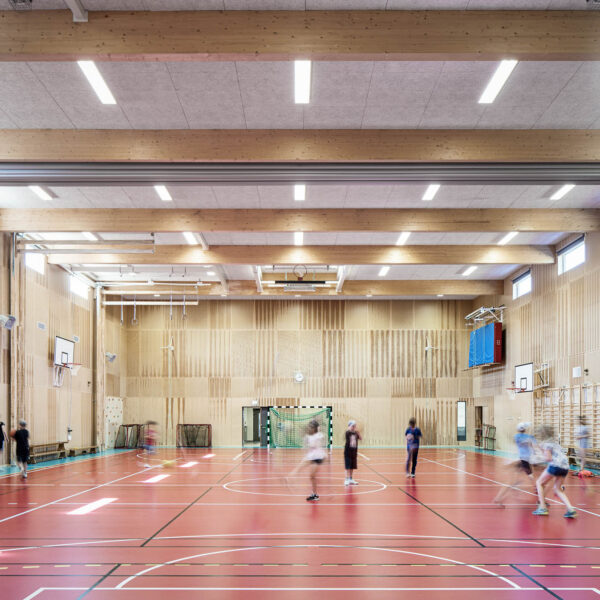
The solution was a new building, ANA 14, right next door, developed specifically for the police school. Here, we have had the opportunity to design a modern teaching environment that feels open and light despite the closed systems according to protection class 2.  Here, there are classrooms inside a lock function. In a large sports hall that can be divided into three parts, self-defence is taught. The building is constructed so that it can be certified according to Eco-building, ‘Miljöbyggnad Silver’.

The architecture is created both with security and the future tenants in mind.

Rooms with a large span

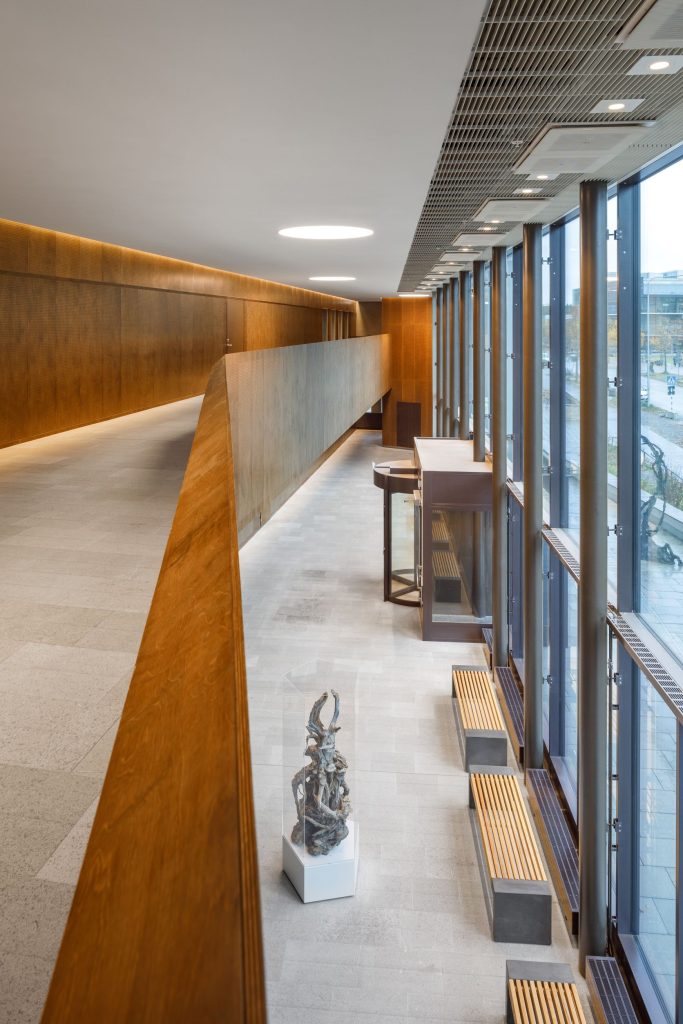
A small number of materials enhances the expression. The façade consists of prefabricated concrete elements  embossed vertically. A foyer of glass opens the building towards the campus and contrasts with the closed exterior. The interior environments give a warmer impression thanks to stained plywood on some walls

”Rooms with a large span and special features have posed been a challenge in the design. In particular, the angled entrance façade with its canopy has required great focus from the project group and the pre-fab contractor “, says Katrin Fagerström.
The Police School The Police School

Another challenge was to adapt the existing premises in ANA 12 to new safety levels where there needs to be room for both openness and closeness in the same building. In this place, auditoria for the entire institute are combined with specific training facilities for the police school.

Open dialogue

After the project application stage, the University House and Skanska carried out the entire project in partnership. Through an open dialogue between the client, the contractor and other consultants, together we were able to develop a very solution based and educational process.

”We are very much looking forward to the result and the official moving-in ceremony in the autumn of 2017. Our common goal is of course that the Police school at Södertörn be the best police school in all of Sweden”, says Anna Moren Sahlin.

Contact person

Mark Humphreys

Practice Director Stockholm
+46 8 412 53 43

Freja school

A new school and a meeting place
Architecture, Interior Design, Landscape
Education, Parks, Play & Public Spaces
Client: Göteborgs stad
Location: Tynnered, Göteborg
Main usable area: Ca 11 300 sq m
Type of project: School with gymnasium
Estimated moving-in-date: 2017/2018
Competences: Education

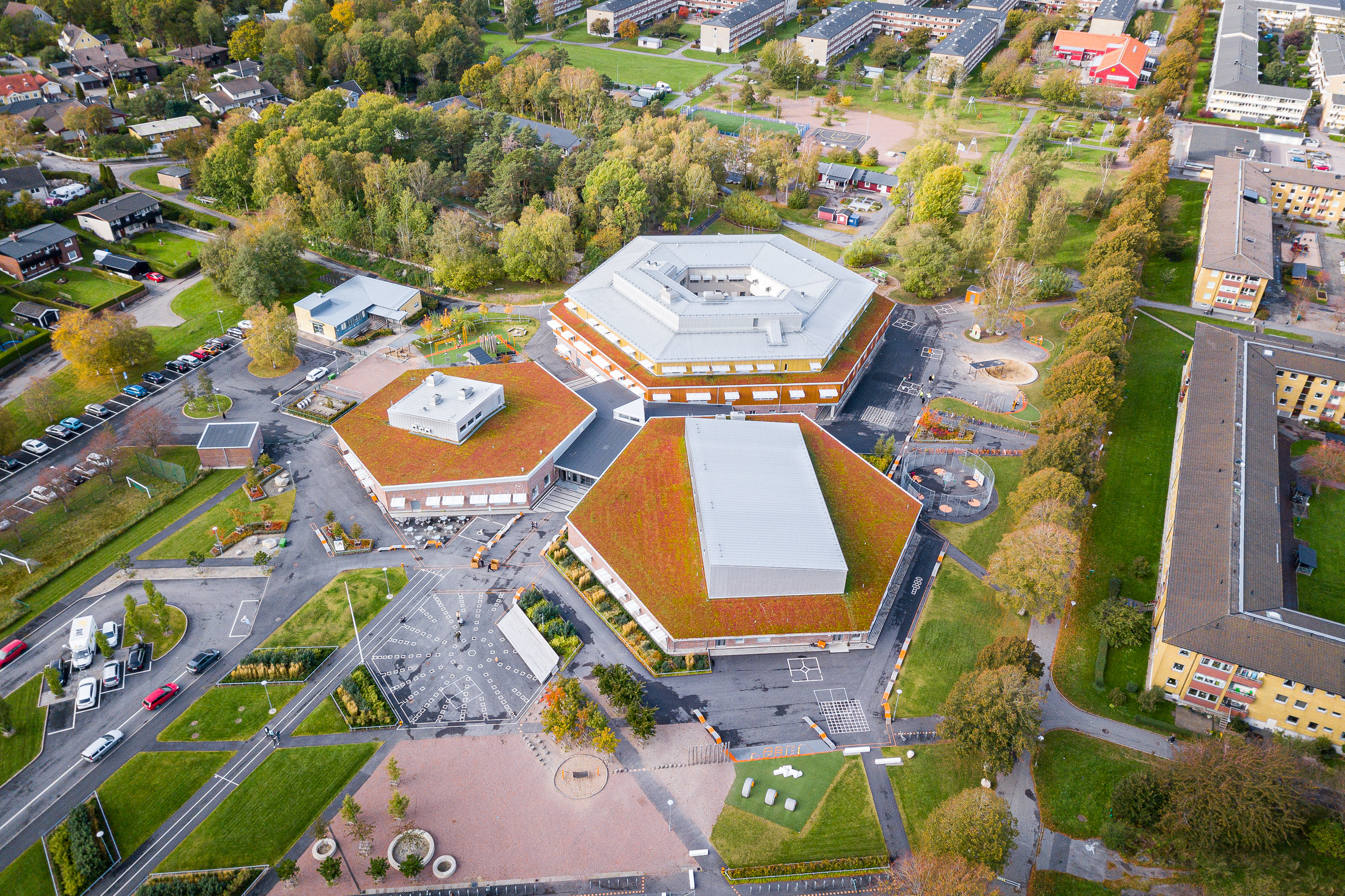
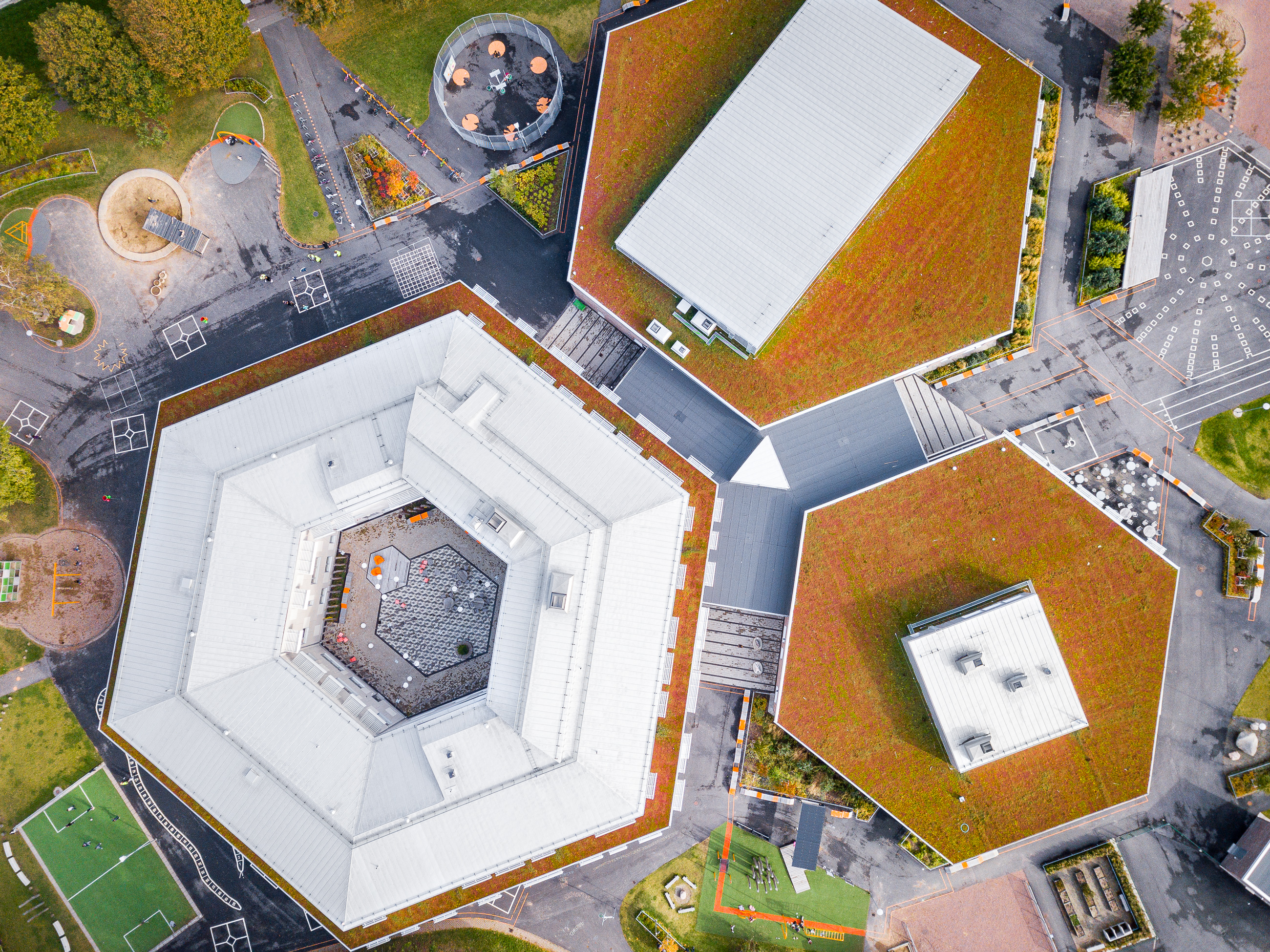
Freja school is unique in both form and function. Three hexagon-shaped buildings create a diverse outdoor environment while enriching the urban space. The school building is oriented to face all directions on the large site.

Frejaskolan – a competition win

In 2014, Tengbom won the commission to design the new Grevegårdsskolan, now called Frejaskolan, through a competition organized by Lokalförvaltningen in Gothenburg. Over two years, we worked closely with the school staff and client to create a new school for approximately 650 students and 100 educators. Freja school (Frejaskolan) is one of the largest new construction projects for our client and a long-awaited upgrade for the educators and students who had eagerly anticipated their new school.

A school without a backside

The competition proposal, named Mångsida, addressed everything from traffic solutions and outdoor environments to logistics, phased construction, and contributing to playfulness in the surrounding urban area. The concept of three hexagon-shaped buildings connected by an entrance hub is designed to create diverse outdoor spaces for children. But as well enrich the existing urban fabric, and face all directions on the large site. Together, the buildings form a school without a backside.

Frejaskolan


We wanted to create something both enduring and adaptable, designed to withstand use

Freja school

Externally, the school is both strict and playful, a design approach that also defines the interior concept. Just as the school appears different from various distances, the interior scale also shifts. A variety of room shapes create spaces that foster safety, community, playfulness, and inspiration. We carefully chose the materials, both inside and out, to ensure they endure and improve over time.

The school stands at the center of the district, serving as a hub for the area. It provides new meeting places for diverse activities and creates arenas for interaction.

Freja school Freja school

Contact person

Kristina Jonasson

Studio Manager Interior Design
+46 708 23 14 33

A Working Lab

An environment designed for innovation
Architecture
Education, Offices
Client: Akademiska Hus region Väst
Location: Gothenburg
Project years: 2013-2019
Type of project: Office building
Contractor: Akademiska Hus region Väst
Photographer: Felix Gerlach

An office built for innovative collisions. A Working Lab, located on Chalmers Campus in Gothenburg, was awarded the title of West Sweden’s smartest property. With sustainable and inclusive solutions down to the finest detail, it challenges the traditional office environment.

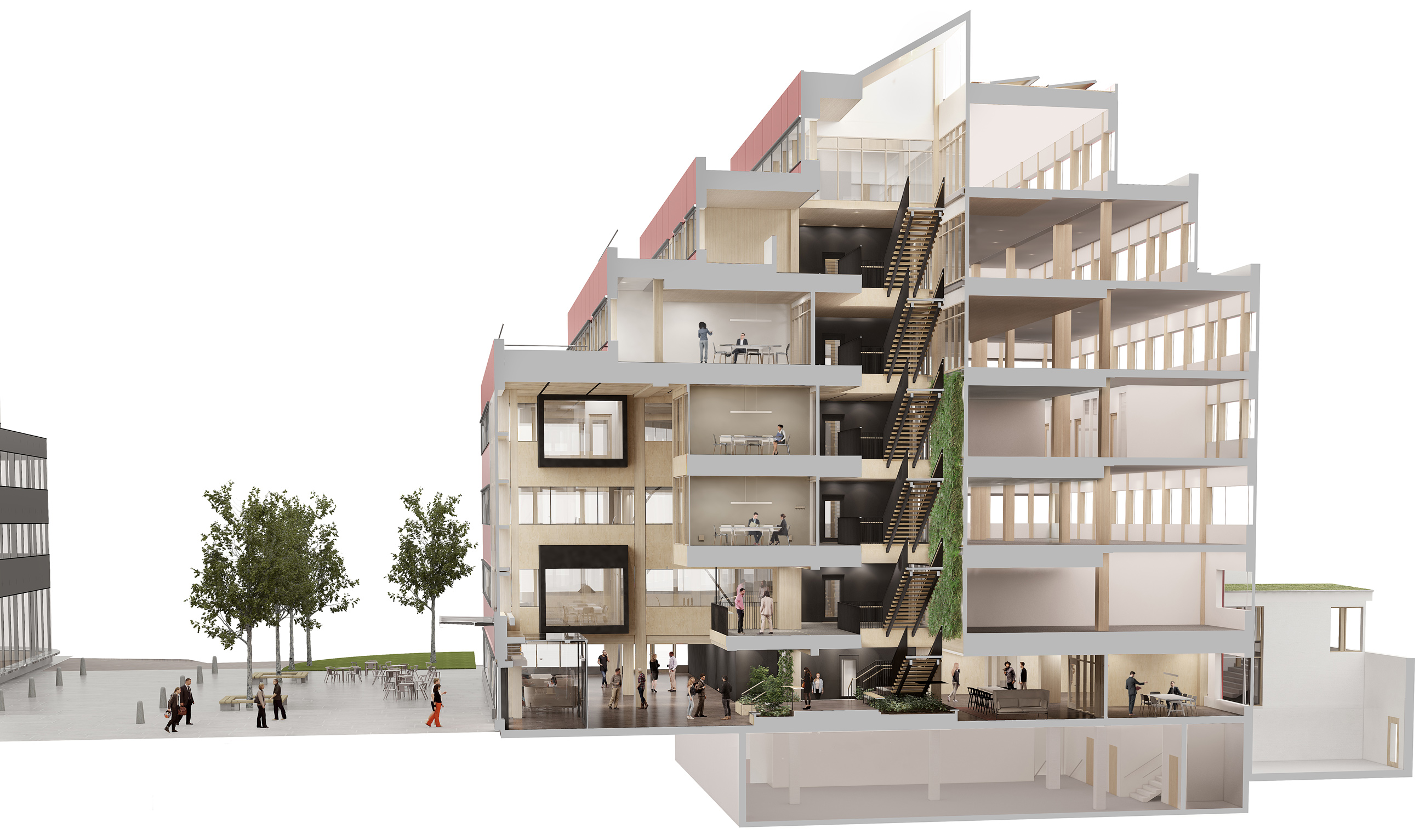
A Working Lab is more than just an office. The building — previously named Johanneberg Science Park Phase 2 — is better described as a multifunctional laboratory environment. Public and private spaces blend into one another from the ground floor all the way up through the building. The aim is to create unexpected meetings and collisions between companies, researchers, and students from around the world. It is a space for the exchange of ideas and knowledge between academia, industry, and public stakeholders.

Johanneberg Science Park

Flows and communication within the building are crucial to realizing this vision.

Architecture that generates new ways of working

The building is characterized by multifunctional and adaptable spaces with advanced digital technology. The open floor plan enables flexible work, research, and interdisciplinary collaboration. One can sit down practically anywhere for spontaneous meetings. The ground floor is designed as a fully public street-level space connecting the campus with the business community. The atrium includes areas for workshops as well as cafés and restaurants.

Focus on sustainability led to environmental certification

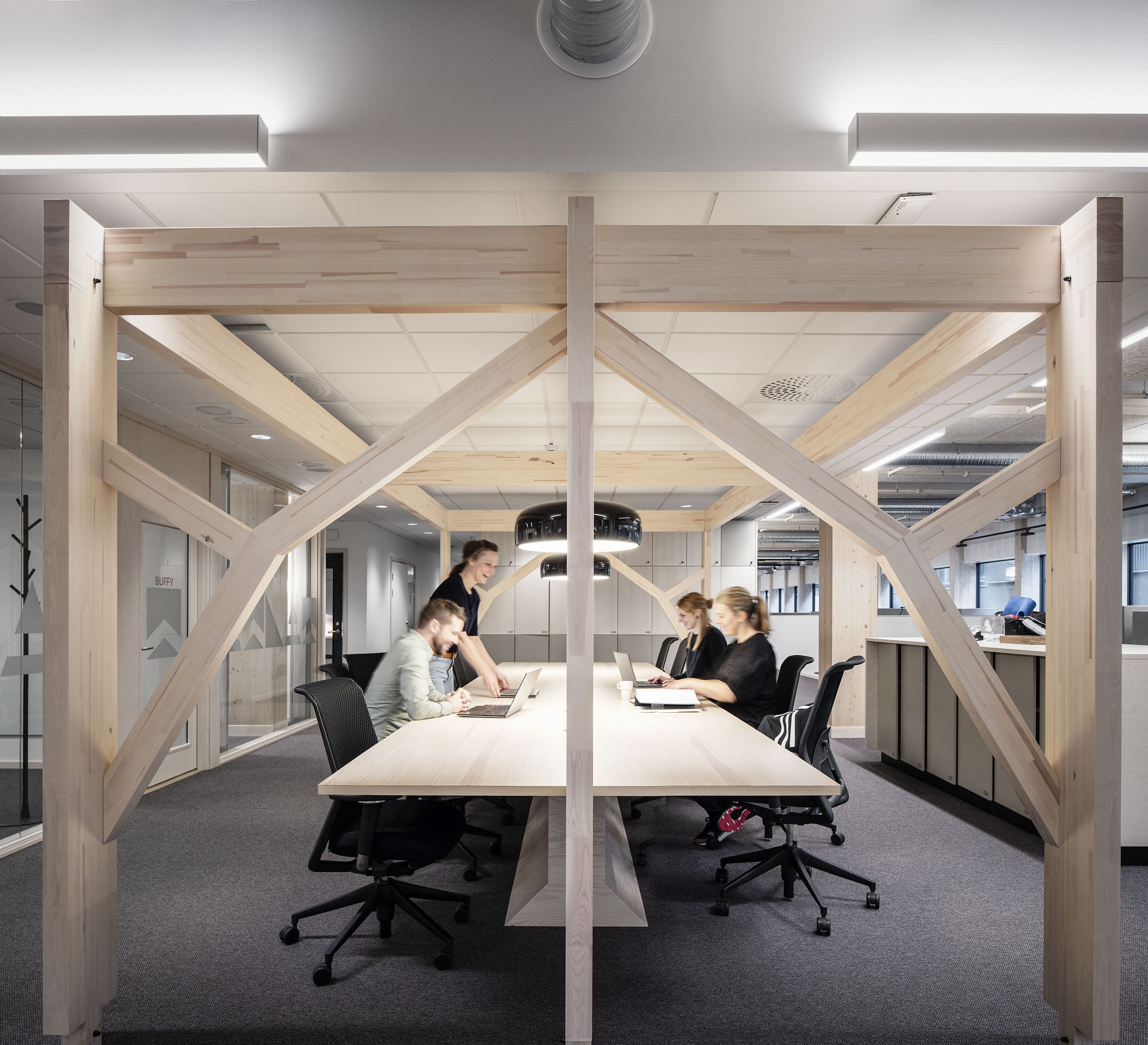
A Working Lab is certified according to Miljöbyggnad Gold. A core principle of the project was to design a sustainable building — down to the smallest detail. From the structural frame to interior surfaces, wood — a renewable material with no carbon footprint — has been used. Wood is also health-promoting, providing a calm, warm indoor atmosphere — ideal for inclusive collaboration spaces.

A Working Lab

Stored energy powers electricity and ventilation

Numerous innovation projects are being conducted within the building in collaboration with tenants, suppliers, and researchers. A Working Lab functions as a so-called test bed — an open platform for development, testing, and innovation. Research topics include timber construction, acoustics, embedded sensors, and digital twins.

Discarded ingredients become restaurant meals

Beyond research initiatives, the sustainability concept runs like a red thread through countless details in the building. For example, the ground floor restaurant “Waste” serves meals made from discarded food ingredients. The coffee cups are made from the inner husk of coffee beans, which is normally thrown away. The coffee itself is Zero Water Coffee, made from sun-dried beans — unlike a regular cup, which typically requires 140 liters of water during production. Solar panels, green multifunctional spaces, and integrated electric public transport are three more environmentally smart solutions that embody the sustainability thinking behind every function.

An algorithm designed the ceiling with no straight lines

Creating an organic pattern of dots without straight lines is a challenge with pen and paper. So is manufacturing a product with such a pattern. However, digital technology simplifies the task. The lighting was to be integrated into the ceiling through a pattern of perforations — without any straight lines between the holes. The organic pattern in the wooden ceiling was intended to reinforce the experience of the building’s core concepts: research and sustainability. The ceiling is divided into sections, and we developed an algorithm that generated non-linear patterns within each section. These sections can be rotated relative to each other to form a large, organic pattern across the entire ceiling. Parametric design makes this kind of challenge more feasible and efficient than traditional methods.

Johanneberg Science Park

A Working Lab – a new growth ring at Chalmers

To contrast the surrounding brick architecture, the building’s façade is red. However, the color was adapted for environmental reasons, as the original idea of a bright Jaguar red shade couldn’t be achieved with eco-friendly components. Together with the two completed buildings from Johanneberg Science Park Phase 1, and our adjacent parking structure, A Working Lab has formed a new growth ring on Chalmers Campus since 2019.

Contact person

Kajsa Crona

Practice Director Gothenburg
+46 727 07 79 73

Smaragdskolan

A green gem on Öland
Architecture, Interior Design
Education
Client: Mörbylånga Bostads AB
Location: Runsbäck, Färjestaden, Öland
Year of commission: 2014
Contractor: Mörbylånga Bostads AB
Competences: Education
Collaborative Partners: Sweco systems AB, LH ingenjörsbyrå AB, Brand och riskanalys AB, Gröna Rummet Landskapsarkitekter AB, Kreativa Storkök Sverige AB

On the outskirts of Färjestaden, a village with approximately 5,000 inhabitants in Mörbylånga municipality on Öland, we find the new Smaragdskolan. In this place, we have managed to create something special, using only some simple tricks; an environment where the children feel welcome and where the quality radiates from the walls. Literally.

Already from the start, there was a vision to design a school that radiated quality. Smaragdskolan, an F-5 activity for approximately 200 students was to be built in a residential area a little outside of Färjestaden’s centre. Together with our client, Mörbylånga Bostads AB, we started thinking of ideas for the students to long for despite the somewhat peripheral location. The end result is exactly as we intended – both children and grown-ups say that they love the place. The quality using a few simple tricks creates a fine balance.

The facade of high quality pine is Sioo impregnated, a new and environmentally friendly surface treatment that quickly gives the wood a beautiful, light grey colour.

Smaragdskolan
Photo: Bertil Hertzberg

An Öland barn with a modern touch

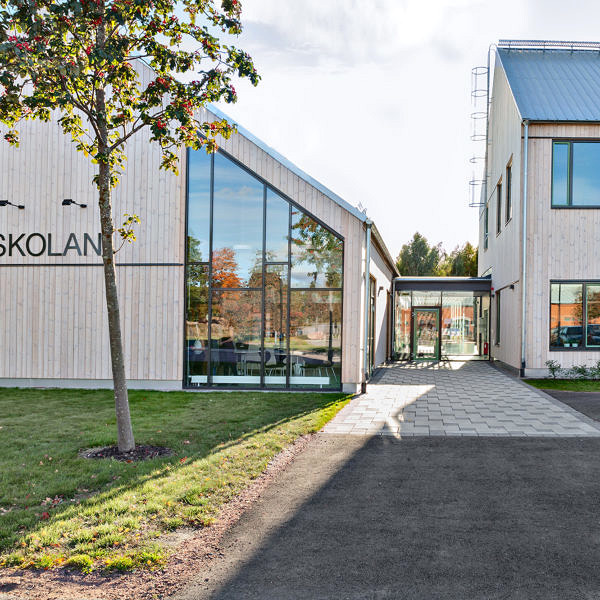
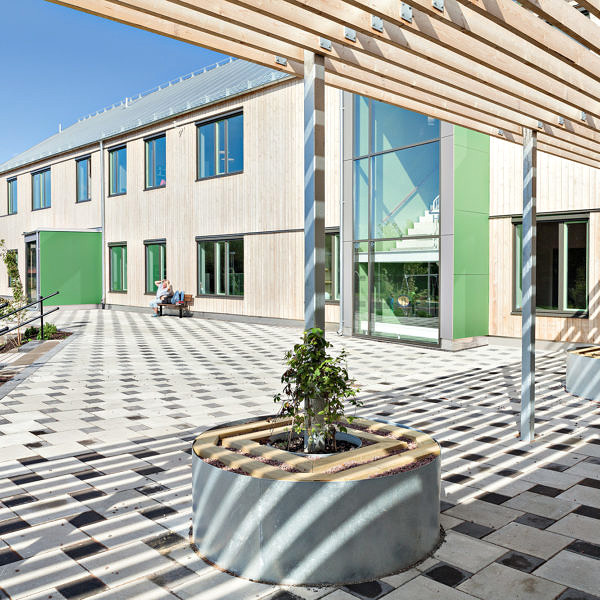
These simple yet robust agricultural buildings are everywhere on Öland—solid wooden walls and pitched steel roofs. We embraced the traditional design but introduced new ideas. The facade, made of high-quality pine, is treated with Sioo, an eco-friendly finish that quickly gives the wood a light grey tone. Large windows let in plenty of daylight and create a sense of transparency. As a nod to its name, Smaragdskolan also features green accent colours at the entrance and in the stairwells.

Flexible environments with the ability to grow

To make the most of the light, we placed the school yard in a south-westerly direction. The building is L shaped in two volumes with the classrooms facing north in one of the volumes. In the other, there is a studio, a library, dining hall and after school activities, spaces that may also be used by other organisations outside of school hours. To allow the school to grow over time, we have made the preparations for a possible extension and the adding of more learning environments.

The colour scheme was chosen due to research that shows that people find those colours peaceful.

Participation offers identity

But let’s go back to the name. To make students feel involved in the new school, the council arranged a naming competition. The winning entry came from class 5C. Their motivation was simple—the school sits near Smaragdvägen, and “it feels good to go to a school named after something as beautiful as an emerald.” The emerald is also a precious gem symbolising growth, harmony, stability, and stamina. Its green colour represents youth and health.

Transparency against exclusion

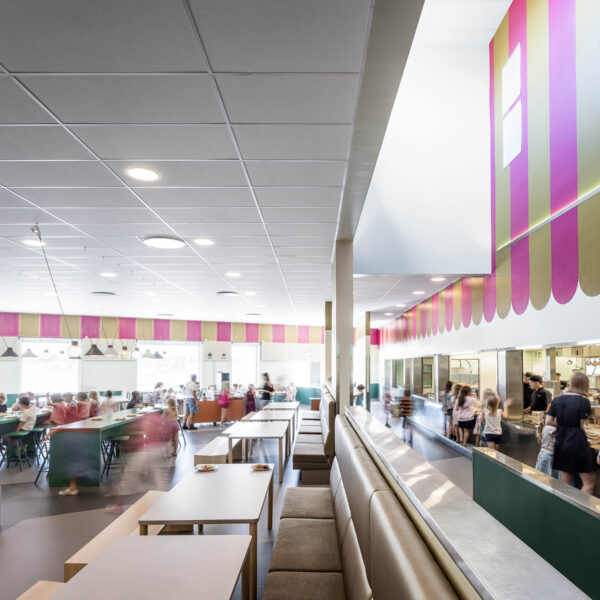
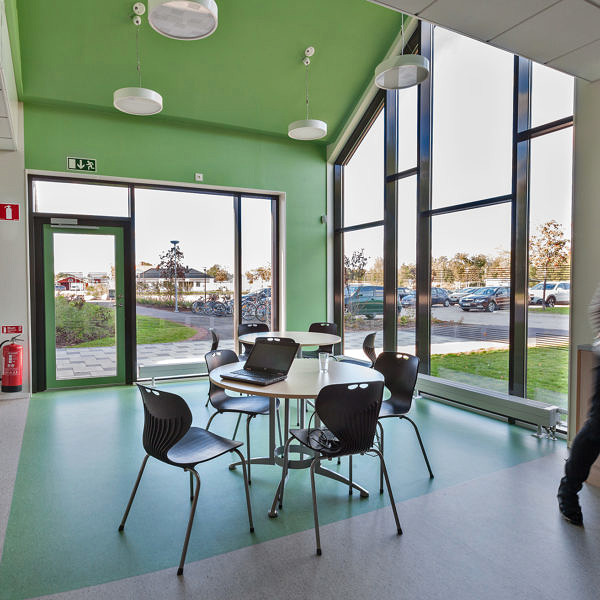
As is the case with white and blue, the green colour is repeated in the interior design. The colour scheme was chosen due to research that shows that people find those colours peaceful. Inside the school too, we have selected several sound and robust materials such as limestone and terrazzo. We also placed a great focus on transparency. Glass areas instead of walls give the teachers an overview of the activities and create security for the kids. Open, light surfaces prevent bullying and exclusion.
Contact person

Joao Pereira

Practice Director Kalmar and Linköping
+46 708 79 99 38