Archives

Accumulator tank in Karlstad

Heat takes form
Architecture
Industry
Client: Karlstad Energi
Location: Karlstad
Project year: 2024–ongoing

As Karlstads Energi advances towards a fossil-free future, the city also gains a new landmark. The new accumulator tank at the Heden plant will serve as much a technical hub as a visual symbol – shaped with great care for function, context and expression.

The accumulator holds 35 million litres of hot water, enabling the storage of surplus heat and balancing energy use throughout the day. It is a central component of Karlstad’s district heating system, but also a clear symbol of the city’s energy transition.

From chimney to contemporary marker

Visualization of the new accumulator tank

Even though the building has an advanced technical purpose, the architecture has been equally important. Beyond designing a building that performs well (of course), our team at Tengbom’s Karlstad studio also wanted to create a building that conveys something about Karlstad’s past and future.

“We wanted to create a building that clearly signals energy, yet respects its setting. Its scale and simple form evoke silos, chimneys and other historic industrial structures in Karlstad. At the same time, it carries an expression that resonates with the present,” says Anki Haasma, lead architect at Tengbom.

When Karlstad Energi built the third stage of the Heden plant in 2011–2015, we participated as architects. Photo: Anders Lipkin.

Industry as a design language

The design draws on the industrial character of the existing plant. The new tank is clad in an external lattice of vertical aluminium profiles that both accentuate its height and create a rhythmic pattern. This rhythm references the site’s architectural language – the vertical lines of nearby silos and sheet-metal façades – and lends the building a sense of movement and energy.

“The repeated form and the sense of height, what we call verticality, create a clear connection to the site’s character. The building has an elegant lightness despite its massive volume,” Anki explains.

Technology for humanity

At the base of the tank, the expression softens through a wave form inspired by the roof of the CHP plant. The form symbolises a new wave of renewable energy in Karlstad – a gentle movement connecting the technical with the human.

The top and the lattice are equipped with RGB lighting that can change with the season or event. From the blue accent colour that characterises the facility today to light themes for Pride, Christmas or the Pink Ribbon – the lighting makes the building a living part of the city’s pulse, especially after dark.

A building for recognition

We chose materials with long lifespans and minimal maintenance, in line with Karlstad’s climate goals and Tengbom’s local climate contract. When the tank is completed in 2028, it will be an everyday yet hopefully valued part of the city’s energy landscape – a building demonstrating that technical facilities too can evoke feelings and spark discussion.

Visualization of the new accumulator tank

Contact person

Elin Larsson

+46 702 75 67 66

Accumulator tank Helan & Halvan

Building with double passes
Architecture
Industry
Client: Göteborg Energi
Location: Gothenburg
What: Accumulator tank
Project year: 2025 and ongoing

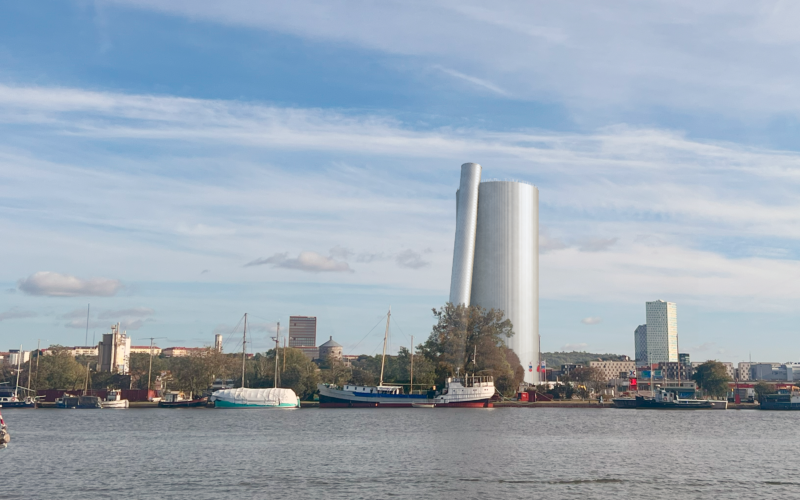
When Göteborg Energi announced an architectural competition for the design of a new accumulator tank in Gullbergsvass, the assignment attracted more than 80 proposals from around the world. The winner was Helan & Halvan, a proposal by the Portuguese architect Marcelo Dantas. We joined forces with Marcelo and are now continuing to develop the project.

Helan & Halvan, visualization by Marcelo Dantas.

With its distinctive silhouette – a slender building volume leaning against the large cylinder – Helan & Halvan balances function, equilibrium and expression in one gesture. The façade in corrugated steel sheeting connects to Gothenburg’s industrial heritage, while the two volumes form an artistic composition. The new accumulator tank will be both an important part of the city’s energy infrastructure and a future landmark as Gullbergsvass transforms into a dense urban environment.

“Working in the boundary between the technical and the aesthetic is something I truly appreciate. Here there is an opportunity to let a necessary building become something that also tells a story about the place and the city’s development,” says Joao Pereira, lead architect at Tengbom.

Gränslöst byggtänk

Behind the design stands Marcelo Dantas, an architect based in Portugal. For the continued development he collaborates with Tengbom, where Joao Pereira leads the work in Sweden. Together they merge two architectural traditions, with the project illustrating how international collaborations can enrich Swedish architecture. When perspectives, climate and culture meet, new ways of thinking about the city’s buildings emerge – even those rarely seen on postcards.

The idea behind Helan & Halvan

“The building’s large scale and inevitably cylindrical form risked becoming yet another massive industrial structure in Gothenburg’s landscape. That is why the idea was born to create a new volume composition that integrates the system’s stairs and pipes into a second cylinder. Smaller in diameter but taller than the main volume, it leans against the large cylinder and leaves a trace of tension and playfulness – an association to the classic duo Helan & Halvan,” explains Marcelo Dantas.

He also explains that the city of Gothenburg inspired him through its character and history:

“One of Gothenburg’s qualities is a spirit that is both critical and demanding, but also humorous and open to difference. When I read about Lilla Bommen and how the building went from controversy to icon, I realised that our accumulator tank will also evoke emotions. The hope is that Helan & Halvan, through its form and materiality, will in time become an equally natural part of Gothenburg’s cityscape.”

“Proposal for the expansion of the City of Gothenburg prepared by the Committee in 1863” Building Committee, Gothenburg.
The industrial area Gullbergsvass in 1935. Photo: Oscar Bladh (Regional Archives for the Västra Götaland Region and the City of Gothenburg).

A meeting between two architectural traditions

Joao Pereira describes the collaboration with Dantas as both natural and instructive. He saw early potential in the winning competition proposal and reached out to Marcelo.

“I became very interested in the proposal and simply invited myself into the collaboration. It was a bold move, but I knew it aligned with his interests – even if he might not have been fully aware of all the challenges ahead,” says Joao.

Joao believes that the Portuguese expression often centres on achieving much with modest means.

“Budgets in Portugal rarely allow for expensive materials or complex forms. One is forced to be pragmatic and work with what is available. Here, Marcelo has used the everyday material of sinus-profiled sheet metal but elevated it by giving the technical stair a clear architectural role. It is an example of how simplicity can become beauty.”

Visualization of Helan & Halvan seen from the Hisingsbron.

Every country has its particularities

The project Helan & Halvan also reflects the differences between the Portuguese and Swedish construction processes. For Joao, international collaborations are about learning, translating and building understanding:

“Every country has its particularities. It requires flexibility and openness. But in the end, it is always the interaction between people that creates the architecture.”

Contact person

Joao Pereira

+46 708 79 99 38

Nederman The Clean Air Company

Where the air is the main character
Architecture, Interior Design
Industry, Offices
Client: Wihlborgs fastighets AB, Veidekke
Location: Helsingborg
GFA: 26 000 m²
Project years: 2022–2024
Photographer: Felix Gerlach

It begins with an idea so self-evident that one almost forgets how unusual it is: clean air. In Helsingborg, Nederman, a world leader in industrial air filtration, has built its new home. Here, the company gathers its entire operation – 26 000 square metres of technology, craftsmanship and human consideration.

When Tengbom was commissioned to design the new facility, the task was not solely about efficient logistics and flows, although that is of course always essential. It was also about ensuring that the building itself reflected the company’s vision of clean air and sustainable development. The building brings production, storage and offices together with an innovation centre featuring a showroom, test environments and training areas.

“This is a facility designed not only to drive innovation and efficient production but also communication and togetherness – from the precise and high-performing to the open and welcoming. We wanted to design a technical and work environment with the human being at its centre, where all employees meet in a meaningful way,” says Patrik Ekenhill, lead architect at Tengbom.

Technology’s social hub

At the heart of the building, a central atrium opens up. It is generous, warm and bright, with timber staircases and seating that encourage movement and pause rather than performance. Here, people from offices, production and storage come together to share coffee, ideas and everyday life. The atrium is bathed in daylight, with stairs and tiered seating that invite people to stop and talk.

“The entrance hall is our social focal point. This is where Nederman’s identity becomes physical – where technology meets the people who work here,” says Maeva Chardon, project lead interior architect at Tengbom.

From darkness to clarity

The architectural expression follows the same process as Nederman’s products: filtration. The dark metal façade represents industry, strength and precision. Inside, you encounter a brighter environment – timber, greenery and open spaces that bring a sense of balance. A movement from gravity to clarity. From machine to human.

Thanks to an intelligent design and procurement strategy, 85 per cent of the furniture was reused

Nederman’s new facility was nominated for Helsingborg’s urban design award. From the jury’s motivation:

“The building takes its starting point in Nederman’s identity and translates the principles of air purification into architecture. The dark external metal shell meets interiors of light natural materials, where timber and greenery create a sensory and warm environment. The entrance hall functions as an inclusive heart where all employees meet – regardless of role – and where community, transparency and movement are key values.

With BREEAM certification, a solar park, 85% reused interior fittings and a focus on long-term robustness, the project is a model for the circular construction of the future. Nederman’s new facility is an example of how industrial architecture can be both efficient and beautiful – where technology and humanity meet in balance. A building that reflects the company’s vision of clean air and sustainable development.”

Surrounded by greenery

The surrounding greenery is the site’s great asset – something we chose to strengthen rather than change. The building is embedded in a green forecourt: meadow areas along the streets and more planted zones by the entrance. The dark façades meet the greenery in a calm and understated way, while the long window bands offer generous views across the production hall – towards the trees in the north and the sunlight in the south.

The three office floors enclose a green courtyard with daylight, outlooks and shelter. Here, a wind-protected microclimate emerges where one can take a break or move work outdoors for a moment. The timber façades in the courtyard, together with the warm interior of the entrance hall, create a soft contrast to the dark exterior. The building is also green in operation: a solar park on the roof helps make the facility partly self-sufficient. The entire project is BREEAM-certified, level Very Good.

Beyond hierarchies

Around 250 people work at Nederman. No one has a better view than anyone else. Offices and production sit side by side with shared dining areas, a gym and terraces.

“We want to be a ‘Nederman Home’ where every employee has their place and where the environment reflects who we are. Light, air and natural materials help us feel well and work better,” says Nederman’s CEO Sven Kristensson.

New pulse in the neighborhood

Where an anonymous and worn-out industrial area once stood, there is now a workplace pulsing with energy. Nederman contributes a new rhythm to the district – a new era from industry to environmental technology company.

“The property is designed so that everyone who works here has the same access and status. It is an inclusive environment that I believe is vital for well-being in a company,” says Benjamin Ulfgard, Wihlborgs.

Contact person

Josefin Klein

+46 40 641 31 18

Water tower

Thought exercise
Architecture
Industry
Client: NSVA
Location: Helsingborg
Developer: NSVA, City of Helsingborg
Commission year: 2016

Designing a water tower is among the more uncommon tasks for architects. It was therefore a distinctive assignment to prepare a proposal for Helsingborg’s expanded water supply. The result is a landmark that is at once monumental and subtle.

We do not design water towers every day. That is to say, not nowadays. When Patrik Ekenhill and his colleagues began working on the contribution to a parallel commission for Helsingborg’s new facility, they dug a little into the past. It turned out that Ivar Tengbom, around a hundred years ago, appears to have been something of a market leader in precisely this building type. Constructions of that era differ from the towers we have become accustomed to seeing in today’s cityscape. Before the functionalist mushroom profile made its entrance, water towers were generally square brick structures. One example is Ivar’s water tower in Sundbyberg, which to our eyes resembles a small fortress.

It turned out that Ivar Tengbom, around a hundred years ago, appears to have been something of a market leader in precisely this building type.

Looking back for balance

The team found inspiration in these older towers with their staircases and internal voids, even though the resulting form is radically different.

“The idea began to appeal to us, as we identified a major challenge in balancing the water reservoirs. According to the programme requirements, the new water tower would in fact contain a greater total water volume in the two low-level reservoirs than in the high-level reservoir. Yet the client still wanted a tower. That is where our idea was born: through a coherent and efficient facility, we could combine them into a single volume, loosely following this older principle,” explains Patrik Ekenhill.

The siting of the tower was also a challenge. The landscape is distinctive — a field bordered by a major road on one side and a nature reserve and apple orchards on the others.

The new water tower (right) in relation to the old ones (left).

“It creates a clear niche, a spatial room along the road. By placing it centrally in the middle of the field, we established a sense of monumentality while maintaining sensitivity towards the adjacent farmland. It also reinforces the impression of a freely placed landmark as an independent object, one of the typical characteristics of water towers,” he continues.

Flowing form

A water tower differs fundamentally from a residential or office building.

“We received very concrete input on the technical aspects. We chose to work with cylindrical tanks, but we wanted to wrap them in a contemporary envelope and create an atmosphere of something delicate and open,” says Patrik.

With perforated, shiny stainless steel sheeting, the tower gains a reflective surface that shifts with the weather. For inspiration for the form, we went to the source itself: the water.

“It is incredibly complex and multifaceted. The water reservoirs at the base form a triangle, while the high-level reservoir is a circle at the top. By following these geometries with the external skin, the outer form generated a transformative twist. The twist conveys a sense of dynamism and a gentle rotational experience — a dialogue between both traffic movements and the water flows within the reservoirs.”

Thanks to its twisted form, the tower changes character as one walks around it or approaches from different directions along the road.

Homely

A classic formal device, also seen for example in vases, notes Patrik Ekenhill. And the water tower sits a little like a vase on the yellow field. Grain is grown there, though the architects would gladly see it become a field of sunflowers. Owing to its twisted form, the tower changes appearance as one moves around it, or approaches from various directions. The tower is also illuminated from within, and in the evening becomes something of a gentle lampshade, possibly making passers-by long for the warmth of home and a glass of clean water.

Contact person

Josefin Klein

+46 40 641 31 18

Järfälla waste collection terminal

A sustainable facility with finesse
Architecture, Landscape
Industry, Parks, Play & Public Spaces
Client: Järfälla kommun
Location: Barkarby
Assignment years: 2012-2014
Project type: New construction of garbage collection terminal
Photographer: Sten Jansin
Collaborators: Sweco, ACAD, ACC, Envac

Modern, sustainable waste management is a given in the rapidly growing Barkarbystaden. With Järfälla waste collection terminal, Tengbom has designed a facility that integrates seamlessly into the urban fabric.

A new district means new waste, and planning for its management must start early. Instead of hiding the problem, Järfälla’s terminal uses an efficient underground vacuum system, transporting waste discreetly beneath the streets. But this is more than just a technical solution — it’s a building that earns its place in the ambitious Barkarbystaden.

Järfälla Municipality wanted a facility that matched the high standards of the surrounding architecture. As lead consultant, Tengbom ensured a thoughtful design, with quality materials and careful attention to detail.

Timeless details built to last

The result is a pared-down brick building, where faceted bricks form subtle patterns along the long façades. Some of the recesses remain open, while others are filled with mortar, creating either a smooth grid effect or striking diagonal patterns when snow settles in the cavities during winter.

The terminal was designed to blend naturally into its residential surroundings while still having its own distinct identity. Through careful detailing, it signals the importance of waste management in a modern city.

With room for future expansion, the terminal is built to serve the district for years to come. But longevity is about more than just capacity — it’s also about material choices and timeless design. Achieving an elegant, simple form requires a deep understanding of the underlying technology, making close collaboration with industry experts essential.

A shared vision for the city of tomorrow

There’s no manual for designing a facility like Järfälla waste collection terminal. Instead, it was a journey taken together with the client, ensuring a clear vision from the start — one that shaped the end result and kept costs in check.

With shared ambitions and a commitment to sustainability, something as unglamorous as a waste collection terminal has become a landmark for the neighbourhood. Winning Järfälla Municipality’s honorary award seems like proof of that.

Contact person

Mark Humphreys

+46 8 412 53 43

Northvolt Ett

Battery-operated future on a massive scale
Architecture
Industry
Client:
Location: Skellefteå
Description: Lithium-ion battery production factory
Assignment years: 2017-

The automotive industry is advancing rapidly. Northvolt chose Skellefteå for its lithium-ion battery production for electric cars and selected Tengbom to design the enormous facility. The team integrates societal benefits and thoughtful design as essential elements in building a more sustainable future.

Northvolt

Enormous in size

Northvolt has begun establishing its primary battery production plant on the outskirts of Skellefteå. The project is a major initiative to manufacture lithium batteries for cars and other industries, driving the next generation of energy. The test lab in Västerås is already operational, and large-scale production at Northvolt Ett is set to launch in 2021.

This massive project presents many architectural challenges. The team is working with groundbreaking technology and processes, but the prototypes are not yet built. The plant’s footprint exceeds that of Stockholm’s old town, and the timeline is tight.

Northvolt Ett

Positive impression

The architecture must unite the different spaces into a complete, well-functioning, and engaging whole without feeling monotonous or heavy. The factory may not be front and center, but its exterior still matters. It will leave a lasting mark on the natural landscape and must be designed with that in mind. The team will use wood for most of the exterior to blend with the surroundings. Metal, glass, and concrete will complement the structure. Recyclability and durability have guided the design process. Inside, the team also tackles challenges related to logistics, process flows, and creating a pleasant work environment.

Northvolt Ett

An assignment that benefits society

Northvolt Ett will employ around 3,000 people, creating many new jobs in the municipality. Tengbom took on the project because of its strong societal benefits—both socially and in the transition from fossil fuels. The client’s focus on visual experience also makes the collaboration rewarding. With the current rush to join the battery industry, flexibility and stress tolerance are key. Quick thinking and fast adjustments drive the project forward. After all, it takes both a positive and negative charge to generate the energy that powers progress.

Contact person

Mark Humphreys

+46 8 412 53 43

Hedenverket

Efficient investment in the environment
Hedenverket
Architecture
Industry
Client: Karlstads Energi
Location: Karlstad
Years of commission: 2011-2015
Type of project: CHP Plant
Collaborative partners: WSP, JD-gruppen, KVE Konsult, Brandskyddslaget
Competences: Industry

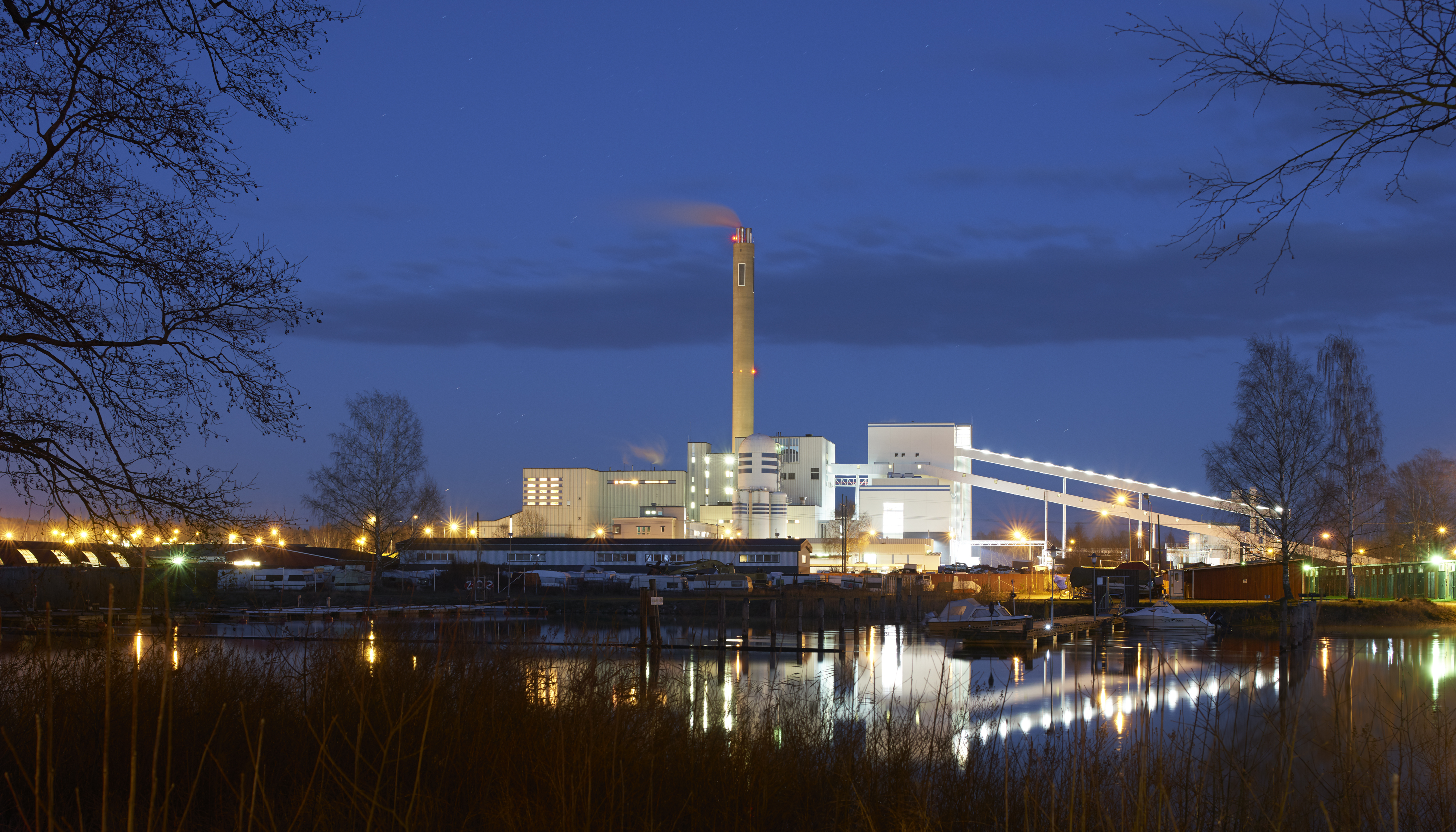
When Karlstad Energi was ready to start construction on the third stage of Hedenverket, we were involved as architects throughout the entire process. This power plant is Karlstad municipality’s greatest investment ever and when it comes to projects this large, it is particularly important that we can contribute to an efficient process.

We did the volume study and developed the architectural idea at the feasibility study stage. We were also responsible for the model visualisation and the system documents; we participated in the procurement of the land, the construction hire and contractor processing, and in the work on the construction documents for the project.

Hedenverket
Illustration: Tengbom

Visualising the process

Part of our work with Hedenverket was to visualise the planned building process. We also developed the tender documents to the suppliers illustrating the supply limits in 3D models. The entire project was completed in a fully developed BIM planning in ArchiCAD, where the architecture model is added to the other player’s models for more coordinated planning.

Thanks to excellent planning and successful procurement, the cost for the investment came in at approximately SEK 150 million less than calculated.

A very successful project

Hedenverket is a project that we are incredibly proud of. Thanks to excellent planning and successful procurement, the cost for the investment came in at approximately SEK 150 million less than calculated. Despite this, Karlstad Energi got an even bigger boiler and a more powerful turbine than they had planned for.

Hedenverket
Photo: Anders Lipkin

More environmental gains

The new power station has played a key role in eliminating fossil oil from district heating production. In just 30 years, Karlstad’s district heating has transitioned from full oil dependence to being completely fossil-free. The station has also doubled renewable electricity production at Hedenverket, increasing output from 100 to 200 GWh. This amount covers the annual electricity consumption of 66,000 apartments.

Contact person

Elin Larsson

Practice Director Karlstad
+46 702 75 67 66

Ursvik Waste Vacuum Terminal

An unexpected architectural gem
Ursvik
Architecture, Landscape
Industry, Parks, Play & Public Spaces
Client: Stora Ursviks KB
Location: Stora Ursvik, Sundbyberg
Years of commission: 2012-2014
Type of project: Industry building
Collaborative partners: SWECO, COWL, Tyréns
Competences: Infrastructure, Industry, Landscape, Sustainability

The new waste vacuum system terminal in Stora Ursvik is run completely by computers and is covered by a large wall of vegetation irrigated by sensors controlled from London. Welcome to a highly technological and environmentally friendly industrial building that – rather unexpectedly – has become a true architectural gem.

Is it possible to create a waste vacuum system to be proud of?

It was an exciting challenge we took on, to create the waste vacuum terminal in Stora Ursvik. We wanted the building to add aesthetic value to the area and become an appreciated part of the surroundings for the residents. It also had to be efficient both from a functional and environmental perspective.

Ursvik
Photo: Åke E:son Lindman

Based on our vision, rational volumes emerged with few but clear effects produced. Industrial architecture with unexpected elements. The sloping façade of the largest volume covered in sheet metal contrasts with the adjacent volumes, that we covered in concrete and decorated in part with a shadowy forest motif. Offsets on the façade, a minimalist window distribution and a beautiful chimney in Corten steel plate gives a strong character to the building. It is exciting for a viewer to see both close up and at a distance.

The first BREEAM-certified industrial building in Sweden

A plant wall for cleaner air

The most effective contrast however, is probably the 250 m2 plant wall which covers the largest volume on one side. The wall consists of more than 2 000 plants and the irrigation is controlled from London using sensors. The green wall, meant to compensate for the land used also extends the life span of the building, filters pollution and cleans the air around it.

BREEAM-certified – and odour free

The waste vacuum terminal is the first BREEAM certified industrial building in Sweden. Fully functional, the system will serve approximately 6 000 flats. Through underground pipe systems several hundred meters long, food waste, packaging and paper is transported to the waste vacuum system from the homes surrounding it. The system is a closed one that keeps out both pests and insects. It does not smell either.

The building in Ursvik is normally unmanned and fully controlled by computers. The containers are emptied once a week. Heavy waste and recycling transporters use the nearby E18, keeping local traffic to a minimum. As a result, the streets become safer for both adults and children.

Contact person

Mark Humphreys

Practice Director Stockholm
+46 8 412 53 43